

Most articles on freelancing collapse into the same shape. Pick a niche. Set up a profile. Hustle. Charge more than you think. Good luck.
That is not a playbook. It is a pep talk.
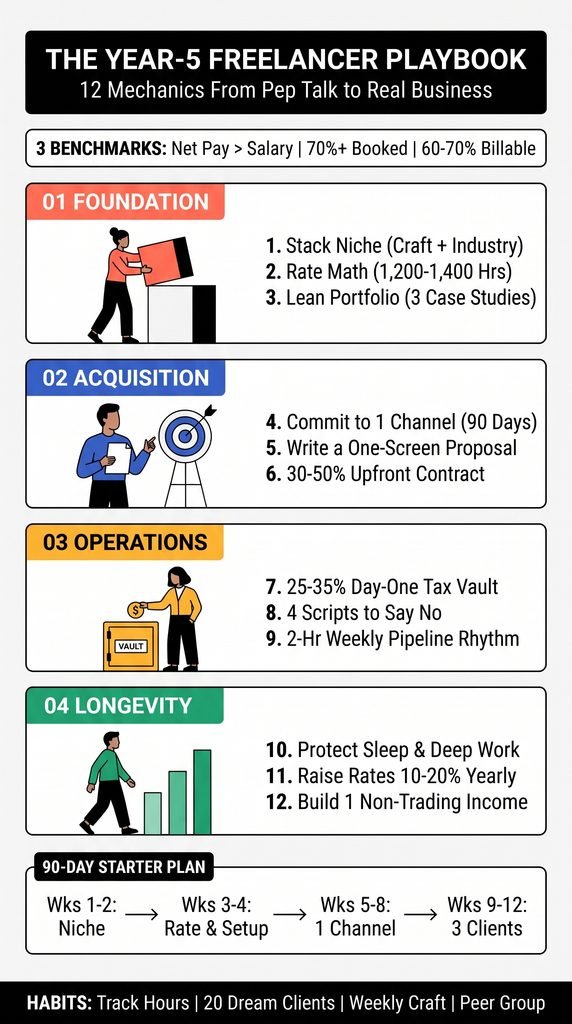
A successful freelancer — the kind who is still freelancing in year five, earning more than their last salary, and sleeping through the night — did roughly twelve specific things that most beginners never got around to. This article is the ordered list. It assumes nothing about the field (design, writing, code, video, translation, consulting, legal, finance, marketing, teaching, wellness). It assumes nothing about the country, because the mechanics are the same in Lagos, Lisbon, Lahore and Lima, and the invoicing tools now reach almost all of them.
What follows is the long version, with the math, the scripts, the external resources that actually help, and the Lifoholic deep-dives for each decision that deserves one. Treat it as a reference you come back to, not a read-once.
What “successful” actually means
Before anything else, three honest benchmarks. A freelancer is doing well when all three are true, and no number alone is enough.
- Income exceeds the last salaried role, after tax and benefits. A $40 hourly rate sounds fine until the self-employment tax, the missing employer health contribution and the three weeks a year with no paid holiday go through the math. See the real-hourly-wage breakdown — the mechanics for freelancers are harsher than for employees, not gentler.
- A pipeline exists. Enough inbound or outbound work that the next three months are 70%+ booked, every month, without panic.
- The calendar is not full of unpaid admin. Successful freelancers spend 60% to 70% of billable hours actually billing; the rest is marketing, admin and recovery. Anyone below 50% is either underpricing or over-pitching, and burning out quietly.
If one of those three is broken, nothing else in this article matters as much as fixing that one.
Step 1: Pick the niche a client would pay you for, not the one you would like
The single most expensive mistake new freelancers make is confusing “what I enjoy” with “what someone will hire me for.” They are often close, rarely identical, and the overlap is where a career starts.
The useful question is not “what am I passionate about.” It is this one, taken from Cal Newport’s framing in So Good They Can’t Ignore You: what is a skill I can be in the top 10% of within twelve months, that enough people are already paying for?
Four tests for a niche worth starting with:
- Stacked, not single. “Writer” is a commodity. “Writer for Series A fintech startups” is not. The stack usually combines a craft with an industry. Designer + SaaS. Translator + legal. Editor + academic. Accountant + Shopify. Each layer cuts the competition roughly in half and raises the price floor.
- Already has a budget. Pick clients who already spend money on the thing you do. If the first conversation involves convincing them the work matters, the margin is not there.
- Repeatable deliverable. The second and third job for the same client should take less time than the first. If every project is bespoke from scratch, the hourly economics never improve.
- Googleable. A would-be client should be able to find you by typing a specific phrase into a search bar. If the search phrase doesn’t exist, the market doesn’t either.
This step usually takes two to four weeks of honest thinking, not two hours. It is worth every day of it.
For a fuller treatment of picking what to double down on, see Mastering Career Longevity.
Step 2: Set the rate by math, not by feel
Almost every freelancer under-prices by 30% to 50% for the first two years. The arithmetic is simple and almost nobody does it.
Start from the target annual income — the salary you want to equal or beat, net. Add the tax load (self-employment, income tax, VAT or GST where relevant). Add business expenses (software, tools, workspace, insurance, equipment amortisation). Add a savings target for retirement and the no-income months. That is the number the business needs to produce in a year.
Now divide not by 2,080 hours (the full-time employee number). Divide by 1,200 to 1,400 billable hours. That is what a healthy freelancing year actually looks like: 46 working weeks after holidays and sick days, 30 to 32 billable hours a week, and the rest consumed by marketing, admin, learning, invoicing and dead gaps between projects.
The result is the minimum sustainable hourly rate. The calculator below runs it live. Do not skip to the project-rate conversation until you know this number.
Two practical notes:
- Charge per project, not per hour, once the niche is clear. Hourly pricing punishes speed. If a redesign takes you four hours because you are good, you get $400 instead of the $1,500 of value you delivered. Flat pricing fixes that.
- Keep a private hourly floor. Even on fixed-price work, divide the fee by the hours spent at the end. If the effective rate drops below the floor twice on the same client, raise the next quote 25% or walk.
For how to run this calculation against a real household, see Real Hourly Wage and One-Person Business: The Hidden Monthly Expenses.
Step 3: Build the smallest possible portfolio that proves the claim
A portfolio does one job: it reduces the client’s risk of hiring you to near zero. Three case studies that show a problem, a method and a result are almost always enough. Ten mediocre samples are worse than three strong ones.
If there is no paid work yet, the portfolio is built in one of three ways:
- Make three spec pieces. Pick three recognisable brands or problems in your niche and produce the work as if you had been hired. Label clearly as spec. This is standard and respected in design, writing, code and video.
- Three heavily discounted first clients. Not free. 60% of the planned rate, for exactly three jobs, with a written agreement that you can use the work publicly and ask for a short testimonial. Then the rate goes to full.
- Volunteer for a nonprofit or local business. One real project with a real brief, delivered to a real deadline, with a real outcome you can point at.
The portfolio page itself is simple. Three case studies, each with: who the client was, what they needed, what you did, what changed. Numbers where they exist. One contact button. Nothing else.
Step 4: Decide where the work comes from — and commit to one channel for 90 days
New freelancers try everything and master nothing. Pick one primary channel, work it seriously for 90 days, and only then add a second.
The four main channels, with honest tradeoffs:
| Channel | How it works | Best for | Downside |
|---|---|---|---|
| Marketplaces (Upwork, Fiverr, Toptal, Contra, PeoplePerHour) | Clients post jobs, you bid or list services | Starting out, building reviews | Price pressure, platform fees up to 20% |
| Referrals | Past clients and colleagues refer you | Year two onward, mid-market clients | Slow to start, dies without delivery |
| Content / Audience (LinkedIn, newsletter, YouTube, a niche blog) | Publish consistently, inbound comes to you | Premium pricing, specialist niches | 6–12 months before it works, then compounds |
| Direct outreach | Cold email or LinkedIn message to a researched list of target clients | Agency work, B2B, high-ticket | Volume game, needs discipline and tracking |
A reasonable year-one mix: marketplace for cashflow + direct outreach for a few larger clients + light LinkedIn presence that becomes the main channel in year two. Avoid trying to be everywhere.
If marketplaces are the starting channel, read both Upwork’s own getting-started guide and Fiverr’s seller help centre before writing a single word of the profile. The platforms tell you what wins — they just don’t shout about it.
Step 5: Learn to write a proposal that gets read
A proposal is a sales document, not a project plan. The entire thing should fit on one screen and answer four questions in this order:
- Do you understand my problem? (One short paragraph that mirrors their brief and names the business outcome they want.)
- What exactly will you do? (A numbered list of deliverables. Concrete nouns, not abstractions.)
- When, and for how much? (A single price, a clear timeline, what is not included.)
- Why you? (One or two sentences. One link to the most relevant case study. No long bio.)
Three mistakes that quietly lose proposals:
- Starting with “Hi, I’m…”. The client is not interested in you yet. Start with their problem.
- Offering three pricing tiers to a cold prospect. The middle one usually wins when clients are familiar with you. In a first email, three options reads as a vendor, not a specialist.
- Attaching a 20-page PDF. One screen, in the body of the message, with a link if they want more.
Save the best three proposals as templates. Do not reinvent each one.
Step 6: Get the paperwork right once, then stop thinking about it
The admin work that protects a freelancing business is almost entirely a one-time setup. The sooner it is in place, the less it steals from the billable week later.
The non-negotiables:
- A written contract on every job, even for repeat clients. One page is fine. Freelancers Union’s contract creator is free and usable almost anywhere.
- A separate business bank account. Personal and business money mixed is a tax-time disaster. Online-only banks (Wise, Revolut Business, Mercury, Payoneer, depending on country) open in minutes.
- One invoicing tool. Stripe, Wise Business, PayPal Invoicing, or a dedicated tool like Bonsai, FreshBooks or Zoho Invoice. Pick one and stop evaluating.
- A deposit policy. 30% to 50% upfront on first-time clients. No deposit, no work starts. This single rule eliminates most non-paying clients before they appear.
- A late-fee clause in the contract. 1.5% per month. Mention it in the first overdue reminder. Most invoices clear immediately.
A set of universal templates — proposal, contract, invoice, late-payment follow-up — belongs in a folder that is open on day one of every new client. The second time you use them, you will never go back.
Step 7: Set up the money the way a business does, not the way a freelancer does
The difference between a freelancer who thrives and one who constantly feels broke is almost always the money system behind the work, not the work itself. Build this before the first big invoice clears.
The structure that works across almost every country:
- Operating account — client payments land here.
- Tax account — on the day each invoice lands, move 25% to 35% (depending on jurisdiction and VAT/GST rules) into a separate account. Treat it as if it never existed.
- Owner pay — pay yourself a fixed “salary” into your personal account twice a month. Not whatever is left over.
- Business expenses — software, subscriptions, tools paid from the operating account.
- Buffer / emergency fund — one month of operating expenses in the buffer, then build to three to six months of personal expenses in the emergency fund.
- Retirement contribution — a monthly standing order once the buffer is complete. The target number is usually bigger than people think; the FIRE number calculator will show the honest version.
This is Mike Michalowicz’s Profit First system, pared to the parts that matter. It feels clerical for a month and then becomes invisible, and it is the single clearest line between freelancers who scale and freelancers who stall.
If credit cards piled up during the transition out of a salary, the snowball-vs-avalanche playoff is the next thing to read.
Step 8: Learn to say no, with a script
Successful freelancers say no more than they say yes. Below are the four most useful scripts, worth rehearsing out loud once.
No to a free “test project”.
Thank you for thinking of me. I don’t do unpaid tests, but the first paid milestone is small and clearly defined, so you can see the quality before committing to the whole engagement. Shall we structure it that way?
No to a scope creep request.
Happy to take that on — it falls outside the original brief, so I’ll send a short change order with the extra time and cost before I start. If it’s a small change, I can usually absorb it; this one is a day of extra work.
No to a client who is late paying.
I’ll pause the next milestone until the current invoice clears. The contract moves the delivery date by the number of days the invoice is overdue, which keeps my other client timelines intact.
No to a project that isn’t a fit.
This isn’t the best match for what I specialise in, and I’d rather point you to someone it is. Would an introduction help?
Each of these costs a client sometimes. Each of them protects the business every time.
Step 9: Build the pipeline before you need it
A freelancer is in danger the week their calendar is 100% booked. That is the week nothing goes into the top of the pipeline, which is the week two months later when the calendar empties.
A simple weekly rhythm that keeps the pipeline healthy:
- Monday, 60 minutes. Marketing. Publish one piece of content, send five cold emails, or follow up with five past clients.
- Wednesday, 30 minutes. Admin. Invoices, expenses, calendar housekeeping.
- Friday, 30 minutes. Review. Note which proposals converted, which clients paid late, which types of project felt good versus draining.
Two hours a week, protected as if they were a client meeting, is enough to prevent most freelance income droughts. Without them, the income curve becomes a sawtooth — big months, empty months, repeat.
Past clients are the single highest-yield pipeline activity. A six-month check-in to every past client, with one specific idea for what they could hire you for next, converts at 20% to 40%. Nothing else comes close.
Step 10: Protect the asset — which is you
The freelancer is the business. If the freelancer breaks, the business stops. Treat the person like infrastructure.
- Sleep. Non-negotiable. If sleep is going, so is the work. Lifoholic’s bedtime guide is a useful start.
- A deep-work block. Two to four hours a day of uninterrupted focused work, phone in another room. See The Deep Work Method for the mechanics.
- A morning that is not reactive. The day a freelancer starts in email is the day the clients own the day. A twenty-minute morning ritual is cheap insurance.
- Movement. 30 minutes a day, outside, non-negotiable.
- A health plan. Freelancers pay for their own healthcare in most countries. Picking the wrong plan costs thousands. The HMO vs PPO vs HDHP breakdown uses US terminology but the logic transfers.
- An annual medical. Because no employer will chase it for you anymore.
One more. Pay attention to the mood. The gap between “this is hard but good” and “this is hollow and I need to change something” is subtle and matters. The burnout vs boredom self-test is the fastest way to know which one is happening.
Step 11: Raise prices every twelve months, visibly
A rate that doesn’t move loses to inflation every year. A rate that moves quietly erodes trust when the client notices later. A rate that moves on a predictable schedule, announced in writing, is a professional standard.
The script, sent to every existing client once a year in the same month:
Quick note on pricing. From [date, 60+ days ahead], my rates are moving to [new rate]. This is my annual adjustment. Work already contracted at the current rate is honoured until completion. Thank you for your continued trust.
Two extra notes on raising rates:
- Raise 10% to 20% a year as a default. Raise 25% to 40% when the pipeline is full or the niche has deepened.
- New clients always start at the new rate. Old clients get the grandfathered rate for one year, then move to current.
A freelancer who has been in the same niche for five years and is still charging year-one rates is the single most common cause of year-five burnout.
Step 12: Build one small source of non-trading income
The final shift from “successful freelancer” to “stable freelancer” is adding one income stream that does not require you to be at the keyboard. It could be:
- A template or product shop (one well-designed Notion template, Figma kit, LUT pack, or Shopify theme can earn $5,000 to $50,000 a year).
- A short paid course on exactly the niche the freelancing is in.
- Royalties from a book, stock photos, or licensed templates.
- A small course community with a monthly fee.
- A productised service — a fixed-scope, fixed-price offer with a long waitlist.
The goal is not to escape freelancing. It is to make sure that one bad month doesn’t threaten the house. For a wider taste of what works for working people, see Lifoholic’s side hustles that pay and one-person business expenses.
The quiet patterns successful freelancers share
Across hundreds of profiles, successful freelancers tend to share five habits that beginners rarely do. None of them are glamorous.
- They track every hour, at least for a month a year. Toggl, Clockify, Harvest. The data changes how they price.
- They have a list of 20 “dream clients” they are patient about. They do not pitch every month. They show up in these clients’ worlds consistently for a year.
- They have one weekly non-client ritual that keeps the craft improving. A tutorial, a book, a side experiment. The craft is the moat.
- They have a single trusted peer or small mastermind. Three or four other freelancers at a similar level. One monthly call, honest about numbers and failures.
- They know when to raise a rate, when to fire a client, and when to take a week off, and they do all three without apology.
A 90-day starter plan
If this article has to collapse into a single next quarter, here it is.
Weeks 1–2. Pick the niche. Write down the four tests and score the top three candidates. Choose one.
Weeks 3–4. Run the rate math. Set up the business bank account, the invoicing tool, the contract template and the proposal template. Build three case studies, spec or discounted.
Weeks 5–8. Pick one channel. Marketplace profiles filled out properly; or a list of 100 cold-outreach targets; or three months of content calendared. Start sending work out.
Weeks 9–12. Land the first three paying clients at the real rate. Install the money system (operating / tax / owner pay / buffer). Book the Friday review. Schedule the first annual rate letter for twelve months out.
Twelve weeks is enough to replace the admin anxiety with a working system. Twelve months is enough to earn a living. Three years is enough to be good at it. Five years is enough to be in the top 10% of your niche if the work has been honest.
Freelancing is not a shortcut, and it is not a lifestyle hack. It is a small business with one employee and no HR department, and the people who succeed at it treat it that way. Everything in this article is a version of that one sentence.
FAQ
Can I really become a successful freelancer without experience?
Yes, but experience will be built on the first three jobs — usually spec work, a volunteer project or a heavily discounted first client. There is no shortcut around needing a portfolio; there are faster ways to assemble one. Expect four to eight weeks of unpaid portfolio-building before the first real-rate job.
How much should a new freelancer charge?
Divide the salary you want to equal by 1,200 to 1,400 billable hours and add 30% to 40% for self-employment taxes and business costs. That is the honest minimum hourly rate. Project rates flow from that number, not from guessing. The calculator in this article runs it live.
Is freelancing better on Upwork, Fiverr or your own website?
Marketplaces (Upwork, Fiverr, Toptal, Contra) give faster first clients and faster reviews, at the cost of 10% to 20% in fees and more price pressure. Your own website gives higher margin and more control, at the cost of 6 to 12 months of slower pipeline. The common pattern: start on a marketplace for cashflow, migrate to direct work and referrals within 12 to 18 months.
How do freelancers handle taxes?
Move 25% to 35% of every invoice into a separate tax account the day it lands. Budget for self-employment / national-insurance / social-security contributions in addition to income tax. In most countries once you cross a VAT or GST threshold you must register and charge it — check your local rules at the start of year two, not after.
How long does it take to make freelancing a full-time income?
Honest numbers from the Payoneer Global Freelancer Income Report and MBO Partners State of Independence studies: roughly 6 months to a part-time replacement income, 12 to 18 months to a full-time one, 2 to 3 years before earnings meaningfully exceed the previous salary. The curve is slow, then steep.
Should I quit my job to freelance full-time?
Almost never on day one. Build a six-month runway in the emergency fund, prove the niche with three real clients while still employed, and then move. If the decision is in play right now, Lifoholic’s should I quit my job walk-through will probably resolve it in one sitting.
What is the single most common reason freelancers fail?
Underpricing combined with no pipeline. They take every job at too low a rate, the calendar fills, there is no time to find the next tier of clients, the rate never moves, and burnout ends the business in year two. Steps 2, 4 and 9 of this playbook exist to prevent exactly that failure mode.



Join the Lifoholic community conversation. We welcome thoughtful insights, questions, and authentic experiences from our readers.
RECOMMENDED DISCUSSIONS
Side Hustles That Pay: Real Earnings per Hour, Ranked
The True Cost of Running a One-Person Business: Software, Fees and Hidden Expenses