

“All you need is a laptop and Wi-Fi.” It’s the most repeated line about working for yourself, and it’s only half true. The laptop is the cheap part. The real one person business expenses are the ones nobody puts on a sales page: the 3% that disappears every time a client pays you, the subscription that quietly went up in July, the tax bill that arrives months after the money is spent, and the holidays nobody pays you for.
None of this means a solo business is expensive to run. It usually isn’t. It means the people who do well know their real number, and price for it.
This guide gives you that number. You’ll get every cost in plain English with current prices, three sample monthly budgets, the 12 hidden expenses that catch most solo owners out, and a free calculator that works out your own monthly costs and what you actually take home.
- Software and tools: most one-person businesses spend about $100 to $200 a month on the essentials (email, website, accounting, video calls, AI and design tools).
- Getting paid: card and PayPal payments cost 2.9% to 3.49% plus a fixed fee per payment, and more for international clients. On $5,000 a month, that’s around $147 to $177.
- Total running costs: for a typical service business, business expenses land at roughly 5% to 12% of revenue.
- The big one is tax. Set aside 25% to 30% of your profit as a starting rule. In the US, self-employment tax alone is 15.3%.
- The hidden costs are the benefits a job used to pay for: health cover, retirement contributions, paid holidays and the hours you work but can’t bill.
- There are about 29.8 million US businesses with no employees, with $1.7 trillion in receipts (US Census Bureau, 2022 data).
- Stripe: 2.9% + 30¢ per domestic card payment, +1.5% for international cards (Stripe pricing).
- PayPal Checkout (US): 3.49% + 49¢, +1.5% for international payments (PayPal fees).
- Microsoft 365 Business Basic rose from $6 to $7 per user a month on 1 July 2026 (Office Watch).
- US self-employment tax: 15.3% on net earnings, with the Social Security part capped at $184,500 for 2026 (SSA).
- US business mileage rate for 2026: 72.5 cents a mile (IRS Notice 2026-10).
The 5 Layers of One-Person Business Expenses
It helps to think of your costs as layers. Most people budget for the first two and get surprised by the rest.
| Layer | What it covers | Typical monthly cost |
|---|---|---|
| 1. Foundation | Domain, website hosting, business email | $10 to $30 |
| 2. Software | Accounting, video calls, AI, design, scheduling, storage | $50 to $200 |
| 3. Getting paid | Card, PayPal and marketplace fees, currency conversion | 1% to 20% of revenue |
| 4. Admin and protection | Accountant, insurance, bank fees, equipment fund | $100 to $250 |
| 5. The job benefits you now pay for | Tax, health cover, retirement, holidays, unbillable time | 30% or more of profit |
Layers 1 and 2 are the ones people argue about online. Layers 3 to 5 are where the money actually goes.
Layer 1 and 2: What the Software Really Costs
Here’s what the common tools cost right now, on each company’s own pricing page. You won’t need all of them.
| What you need | Free option | Paid choice and price |
|---|---|---|
| Business email and documents | Personal Gmail or Outlook (looks less professional) | Google Workspace Business Starter, $7 a month (Google), or Microsoft 365 Business Basic, $7 a month from 1 July 2026 |
| Domain name | No | About $10 to $20 a year for a .com |
| Website hosting | Free builder subdomains | Shared hosting, often $3 a month at first and $10 to $17 at renewal |
| Online store | No | Shopify Basic, $29 a month billed yearly or $39 monthly (Shopify) |
| Accounting and invoicing | A spreadsheet, or your payment tool’s free invoices | QuickBooks Online Simple Start, $38 a month after the intro offer (QuickBooks) |
| Video calls | Google Meet (in Workspace), or free Zoom with time limits | Zoom Workplace Pro, $14.16 a month billed yearly or $16.99 monthly (Zoom) |
| AI assistant | Free tiers | Around $20 a month for the main paid plans |
| Design | Free tools cover most social posts | Around $10 to $15 a month |
| Scheduling, CRM, passwords, storage | Usually yes | $3 to $15 a month each |
Prices checked 18 October 2026, per user, excluding tax.
What this means in practice: a lean service business can run well on about $100 a month of software. Most people who spend $300 or more are paying for overlap: two tools that both do video calls, two places to store files, three AI subscriptions.
The one tool worth paying for early: accounting. Not because the software is clever, but because tracking every expense from day one is what lets you claim them at tax time. If you’re curious how AI tools can take over some of the admin, our guide to artificial intelligence in business covers what’s genuinely useful.
Layer 3: The Cost of Getting Paid
This is the expense most new business owners never budget for, and it scales with your success. Every time a client pays you, a payment company takes a cut.
| Fee | Stripe | PayPal (US) |
|---|---|---|
| Domestic card payment | 2.9% + 30¢ | 2.99% + 49¢ |
| Customer pays with PayPal | n/a | 3.49% + 49¢ |
| International payment | +1.5% | +1.5% |
| Currency conversion | +1% | 3% to 4% spread |
| Bank transfer (ACH) | 0.8%, capped at $5 | n/a |
| Dispute or chargeback | $15 per dispute | $20 chargeback, $15 dispute |
Sources: Stripe pricing and PayPal merchant fees, checked 18 October 2026.
What a $1,000 invoice actually costs you
| How the client pays | Fee | You receive |
|---|---|---|
| Bank transfer through Stripe (ACH) | $5.00 | $995.00 |
| Card through Stripe | $29.30 | $970.70 |
| PayPal Checkout | $35.39 | $964.61 |
| International card through Stripe, with conversion | $54.30 | $945.70 |
| A freelance marketplace taking 10% | $100.00 | $900.00 |
The easy win: if a regular client pays $5,000 a month by card, you lose about $1,744 a year in fees. The same invoices paid by bank transfer through Stripe cost $60 a year. That one change is worth more than cancelling every subscription you have.
Platform and marketplace fees
If you sell through a platform, its fee usually comes before the payment fee:
- Etsy charges $0.20 to list each item and a 6.5% transaction fee on the order total, including shipping, plus payment processing (Etsy fee basics). If a sale comes through its Offsite Ads, add 15% (12% once your shop passes $10,000 in yearly sales) (Etsy fees policy).
- Upwork charges freelancers a service fee of 0% to 15% per contract, set when the contract starts (Upwork Help).
- Shopify has no extra transaction fee if you use Shopify Payments, but charges 2% on the Basic plan if you use a third-party payment provider (Shopify pricing).
Marketplaces are worth it while they bring you clients you couldn’t find yourself. Once a client is a repeat customer, many solo owners move them to direct invoicing, where the platform’s terms allow it.
Three Real Monthly Budgets
Here’s how it adds up for three common one-person businesses. Software prices are from the tables above; insurance, accountant and equipment figures are typical examples, so swap in your own quotes.
| Freelancer | Online shop | Consultant | |
|---|---|---|---|
| Monthly revenue | $5,000 | $3,000 | $8,000 |
| How they get paid | 5 invoices, by card | 100 orders of $30 | 2 clients, by bank transfer |
| Domain, hosting and email | $20 | $9 | $27 |
| Store platform | n/a | $29 | n/a |
| Store apps | n/a | $30 | n/a |
| Accounting | $38 | $38 | $38 |
| Video calls | $0 | n/a | $14 |
| AI and design tools | $35 | $15 | $20 |
| Scheduling, CRM, storage | $5 | n/a | $27 |
| Software subtotal | $98 | $121 | $126 |
| Payment fees | $147 | $117 | $10 |
| Insurance | $40 | $30 | $60 |
| Accountant | $50 | $50 | $75 |
| Equipment fund | $55 | $30 | $55 |
| Training and memberships | n/a | n/a | $50 |
| Total business expenses | $390 | $348 | $376 |
| Share of revenue | 7.8% | 11.6% | 4.7% |
The freelancer is a writer or designer using Google Meet; the shop runs on Shopify Basic, which includes hosting; the consultant uses Workspace Business Standard and Zoom Pro. Accountant fees are a yearly bill spread monthly. The online shop’s figures leave out stock, packaging and postage (your cost of goods), which are usually its biggest costs.
Three patterns stand out:
- Payment fees beat software for anyone paid by card. The freelancer spends more on fees than on every tool combined.
- The consultant’s costs are lowest as a share of revenue because two clients pay by bank transfer. Fewer, larger clients are cheaper to serve.
- None of these budgets is scary. At 5% to 12% of revenue, a solo business is cheap to run. The expensive part comes next.
Layer 5: The Costs Your Old Job Used to Pay
When you’re employed, your employer quietly pays for things you never see on your payslip. When you work for yourself, they become your expenses.
Tax you have to set aside yourself. Nobody withholds it for you. In the US, you pay self-employment tax of 15.3% on 92.35% of your net earnings (both the employee and employer share of Social Security and Medicare), on top of income tax. You generally need to make quarterly estimated tax payments if you expect to owe $1,000 or more. In the UK, self-employed people pay Class 4 National Insurance of 6% on profits between £12,570 and £50,270 and 2% above that, plus income tax, and must register for VAT once taxable turnover passes £90,000 in 12 months. Other countries differ, but the habit is the same everywhere.
Example: the freelancer above makes $4,610 a month in profit. Self-employment tax alone comes to about $651 a month ($7,816 a year), before any income tax.
Rule of thumb: move 25% to 30% of every payment into a separate tax savings account the day it arrives. Ask an accountant to confirm the right figure for your country and income once you have a few months of numbers.
Health cover. In the US, the average employer health plan for one person cost $9,325 in 2025, according to KFF’s Employer Health Benefits Survey, and employers usually pay most of it. Solo, you pay all of it. In countries with public healthcare, budget for income protection or private cover instead.
Retirement with no match. There’s no employer contribution, so a “5% match” you used to get is now 5% you have to find yourself.
Paid holidays and sick days. If you take four weeks of holiday plus public holidays and a few sick days, you might earn in only 46 or 47 weeks of the year. Your prices need to cover the weeks you don’t work, which means charging about 11% more than you would for 52 weeks.
Unbillable hours. Invoicing, chasing payments, marketing, admin and learning are all work, and none of it is paid. If you work 160 hours a month but bill 100, your real hourly pay is your income divided by 160, not 100. Our real hourly wage calculator shows how much this changes the picture.
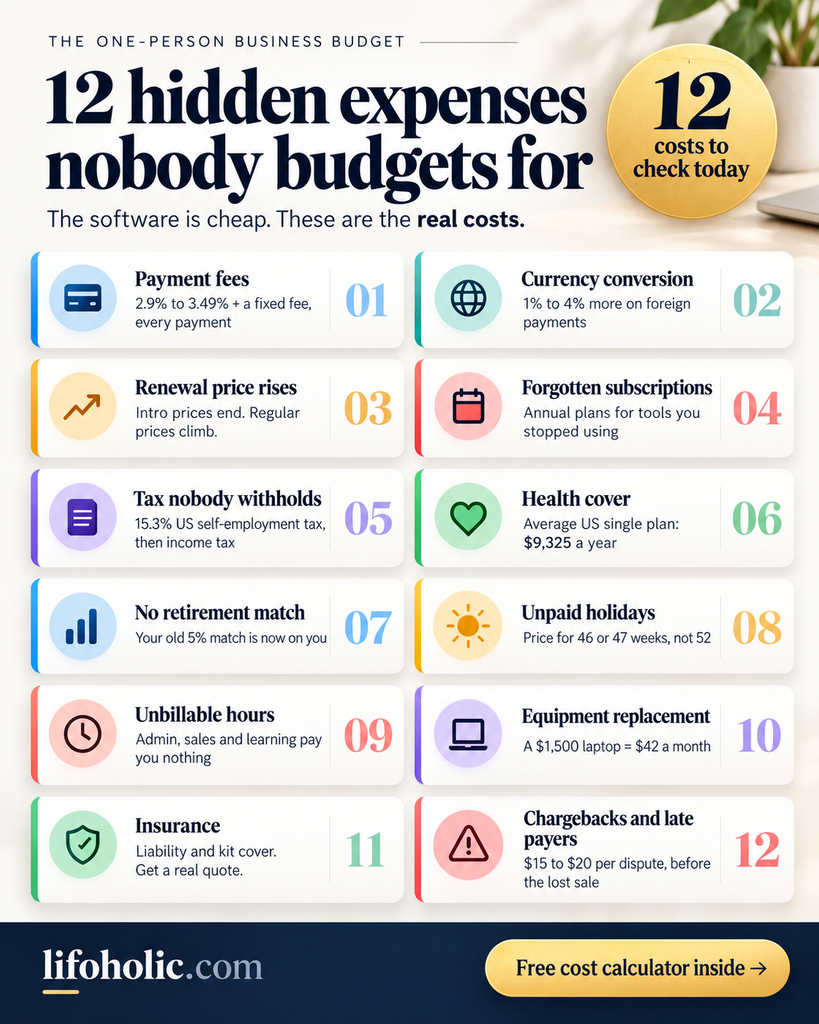
The 12 Hidden Expenses of a One-Person Business
Use this as a checklist. Each one is small on its own; together they’re the gap between what you think you make and what you keep.
- Payment fees. 2.9% to 3.49% plus a fixed fee on every card or PayPal payment. Offer bank transfer for large invoices.
- Currency conversion. 1% on Stripe and a 3% to 4% spread on PayPal when money changes currency. Invoice international clients in their currency only if you know the conversion cost.
- Price rises at renewal. Intro prices end, and regular prices climb. Microsoft raised Business Basic by 16% and Business Standard by 12% in July 2026. Hosting often renews at three to four times the first-year price.
- Forgotten annual subscriptions. The tool you tried once and paid for a year of. Put every renewal date in your calendar.
- Self-employment tax and income tax. The biggest cost of all, and the easiest to spend by accident. Keep it in a separate account.
- Health cover. A real monthly cost in the US, and income protection is worth pricing everywhere.
- Retirement with no employer match. Set up an automatic transfer so it happens without willpower.
- Unpaid holidays and sick days. Price for 46 or 47 working weeks, not 52.
- Unbillable hours. Admin, sales and learning often take a bigger share of your week than you think. Track your hours for a month to find yours.
- Equipment replacement. A $1,500 laptop that lasts three years costs about $42 a month. Save for it monthly so the replacement isn’t a crisis.
- Insurance. Professional liability (also called professional indemnity), public liability, and cover for your equipment. Get a quote for your work and country rather than guessing.
- Chargebacks and late payers. A dispute costs $15 to $20 in fees even before you lose the sale, and a late invoice costs you the use of money you’ve earned. Take deposits and set clear payment terms.
Two more worth budgeting for: an accountant (cheaper than a tax mistake, and their fee is usually a deductible business expense) and a separate business bank account, which may have a monthly fee but makes every other item on this list easier to track.
Calculate Your Real Monthly Costs
Enter your own numbers. The calculator works out your monthly business expenses, what to set aside for tax and retirement, what you actually take home, and your true hourly pay. Nothing you enter leaves your browser.
What does my one-person business really cost?
9 Ways to Cut One-Person Business Expenses (Without Cutting Corners)
- Do a subscription audit every quarter. Export three months of bank and card statements and list every recurring charge. Cancel anything you haven’t opened in 30 days.
- Use what’s already bundled. Google Workspace includes video calls and storage. Your payment provider may already include free invoicing. Your store platform includes hosting.
- Move big, regular clients to bank transfer. On a $5,000 invoice, a card payment costs about $145; a Stripe bank transfer costs $5.
- Pay annually only for tools you’ve used for three months. Annual plans save money on keepers and waste it on experiments.
- Time your software and equipment purchases. Many tools run their deepest discounts around Black Friday. Our guide to the best time to buy everything covers when laptops and tech are cheapest, and why not every Black Friday deal is actually cheaper.
- Claim every legitimate deduction. In the US, the simplified home office deduction is $5 per square foot of a dedicated workspace, up to 300 square feet ($1,500 a year), and business driving can be claimed at 72.5 cents a mile in 2026. Other countries have their own equivalents, so ask your accountant.
- Raise your prices once a year. Your costs rise every year, so your prices should too. A small annual rise is easier for clients to accept than a large one every few years.
- Charge for the hours you don’t bill. Build admin time into project prices instead of absorbing it.
- Protect your energy as well as your budget. The most expensive thing in a one-person business is the person. Overwork leads to mistakes, missed invoices and lost clients. If you’re running on empty, take our burnout or boredom self-test and see our guide to the deep work method for doing more in fewer hours.
Your Monthly Expense Checklist
Copy this into your notes and run through it on the first of every month:
- ☐Move 25% to 30% of last month’s income into the tax account
- ☐Pay or schedule any quarterly tax payment due
- ☐Check last month’s payment fees as a share of revenue
- ☐Check for subscriptions that renewed or changed price
- ☐Send invoices and chase anything more than 14 days overdue
- ☐Move your retirement and equipment fund contributions
- ☐File receipts and log any business mileage
- ☐Note your hours worked and hours billed
- ☐Back up your files and accounts
Thinking of Going Solo?
If you’re still employed and weighing up the jump, these costs are the reason to plan before you quit. Work out the revenue you’d need to replace your salary after tax, benefits and expenses, then add a buffer. Our guide to whether you should quit your job walks through the decision step by step, and the conscious business playbook covers building a business that fits the life you want. And if your goal is to stay in it for the long run, read our guide to sustainable ambition and career longevity.
FAQ
How much does it cost to run a one-person business?
Most one-person service businesses spend about $100 to $200 a month on software and tools, and 5% to 12% of revenue on total business expenses, including payment fees, insurance and an accountant. On top of that, set aside 25% to 30% of profit for tax and budget for health cover and retirement.
What are the typical monthly expenses for a solopreneur?
The usual list is business email, a domain and website, accounting software, video calls, an AI or design tool, payment processing fees, insurance, an accountant, a bank account and an equipment fund. Online sellers add a store platform, apps, stock, packaging and postage.
What is the biggest hidden cost of working for yourself?
Tax, followed by the benefits an employer used to pay for. In the US, self-employment tax is 15.3% of most net earnings before income tax. Health cover, retirement contributions, unpaid holidays and unbillable hours are the other big hidden costs.
How much should I set aside for taxes as a one-person business?
A common starting rule is 25% to 30% of every payment you receive, kept in a separate savings account. The right figure depends on your country, income and deductions, so check it with an accountant once you have a few months of numbers.
How much do payment processing fees cost a small business?
Card payments typically cost 2.9% to 3.49% plus a fixed fee of 30 to 49 cents per payment, with about 1.5% more for international cards and up to 4% more for currency conversion. Bank transfers are much cheaper: Stripe’s US ACH payments cost 0.8%, capped at $5.
How can I reduce my business expenses as a freelancer?
Audit subscriptions every quarter, use tools already bundled into what you pay for, move large regular clients to bank transfer, pay annually only for tools you’ve used for three months, claim every legitimate deduction and raise your prices once a year.
Are business software subscriptions tax deductible?
In most countries, yes. Software, subscriptions and tools used for your business are usually deductible business expenses, which lowers your taxable profit. Keep the receipts, and if a tool is used for both personal and business purposes, you may only be able to claim the business share.
What percentage of revenue should business expenses be for a one-person business?
For a service business, 5% to 15% of revenue is typical, before tax. If yours is much higher, look first at payment fees and overlapping subscriptions. Product businesses spend more because of stock and shipping, so judge them on profit margin instead.
The Bottom Line
A one-person business is one of the cheapest businesses in the world to run. The software rarely costs more than a few hundred dollars a month, and most of it has a free option.
The real cost is everything a job used to handle for you: the tax nobody withholds, the fees on every payment, the holidays nobody pays for and the hours nobody bills. Know those numbers, price for them, and keep a separate account for tax. That’s the difference between a business that looks profitable and one that actually is.
Start with the calculator above, then run the monthly checklist on the first of every month.
Sources
- US Census Bureau, Census Bureau Statistics Shed Light on Self-Employment by Sector and State and Number of U.S. Nonemployers Grew Faster Than Employer Businesses
- IRS, Self-employment tax, Estimated taxes, Simplified option for home office deduction and Notice 2026-10 (standard mileage rates)
- Social Security Administration, If You Are Self-Employed (2026)
- GOV.UK, Self-employed National Insurance rates and VAT registration
- KFF, Employer Health Benefits Survey 2025
- Stripe, Pricing; PayPal, Merchant fees (US); Shopify, Pricing; Etsy, Fee basics and Fees and payments policy; Upwork, Freelancer service fee
- Google, Workspace pricing; Intuit, QuickBooks pricing; Zoom, Pricing; Office Watch, Microsoft 365 business price increase 2026
All prices checked 18 October 2026, in US dollars and excluding tax. This article is general information, not tax or legal advice. Rules differ by country, so check with a qualified accountant before making decisions.


Join the Lifoholic community conversation. We welcome thoughtful insights, questions, and authentic experiences from our readers.
RECOMMENDED DISCUSSIONS
Artificial Intelligence in Business: What the Numbers Show
The Conscious Business Playbook: Profit with Purpose