

You dread Monday. Your energy is gone by Wednesday. You scroll through meetings and can’t remember what you did all day. It’s easy to call that burnout, and plenty of people do.
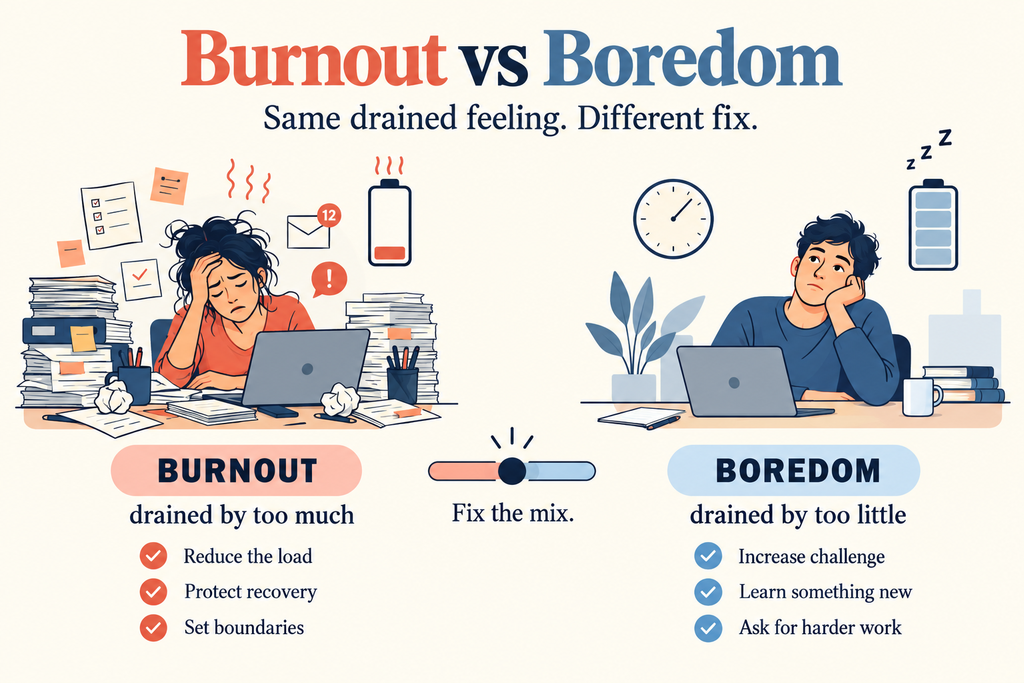
But a lot of the time it isn’t burnout. It’s boredom: work that’s too easy, too repetitive or too pointless to hold your attention. The two feel surprisingly alike from the inside, yet they need almost opposite fixes. Rest helps burnout. Rest makes boredom worse.
This guide gives you a 12-question self-test, the signs side by side, and a plan for whichever result you get.
Quick answer
- Burnout means you’re drained by too much: you feel exhausted, cynical about your job and less effective, and a weekend off doesn’t fix it.
- Boredom (sometimes called “boreout”) means you’re drained by too little: the hours drag, your skills go unused, and a challenging new project would actually perk you up.
- The quickest tell: imagine your boss hands you a big, difficult new project tomorrow. If you feel dread, lean towards burnout. If you feel a flicker of interest, lean towards boredom.
- Can be both. Repetitive work under heavy pressure can leave you exhausted and under-stimulated.
- Or neither. If a few good nights of sleep make you feel like yourself again, you may simply be tired.
Take the 2-Minute Self-Test
Answer each question for how you’ve felt over the last month. There are no right answers, and nothing you choose leaves your browser.
[The interactive self-test goes here in the WordPress version. Twelve questions, four answer options each (Never, Sometimes, Often, Almost always). It scores a burnout scale, a boredom scale and a tiredness check, then shows one of five results with a plan and the next article to read.]
The result types:
| Result | What it means |
|---|---|
| Running on Empty | Strong burnout signs: exhaustion, cynicism and doubting yourself |
| Quietly Bored | Strong boredom signs: work that doesn’t use or stretch you |
| Bored and Burned Out | Both: draining work that also doesn’t engage you |
| Just Tired | Low on both scales, but short on sleep or rest |
| Doing OK | Low on all three. A rough patch, not a pattern |
This is a self-reflection tool, not a medical diagnosis. If you feel hopeless or have thoughts of harming yourself, call or text 988 in the U.S. to reach the 988 Suicide & Crisis Lifeline, any time of day.
Burnout vs Boredom: The Signs Side by Side
| Burnout | Boredom (boreout) | |
|---|---|---|
| The core feeling | “I can’t do any more” | “Is this it?” |
| Energy | Drained before the day starts | Flat and restless, often worse in the afternoon |
| Workload | Too much, too fast, too long | Too little, too easy, too repetitive |
| Attitude to work | Cynical, detached, irritable | Indifferent, checked out, clock-watching |
| Confidence | “I’m not good at this anymore” | “I could do this in my sleep” |
| A new, hard project | Feels like a threat | Feels like a relief |
| After a week off | Better for a few days, then back to empty | Bored again by Monday lunchtime |
| Typical coping | Pushing through, skipping breaks | Scrolling, busywork, looking busy |
| What helps | Less load, real recovery, more control | More challenge, learning, meaningful work |
What Is Burnout?
Burnout is a work-related syndrome caused by chronic workplace stress that hasn’t been successfully managed. That’s the World Health Organization’s definition in the International Classification of Diseases (ICD-11), which describes three dimensions:
- Exhaustion: feelings of energy depletion.
- Mental distance: feeling negative or cynical about your job, or pulling away from it.
- Reduced effectiveness: feeling less capable at work.
Two details in the WHO definition matter. First, burnout is classed as an occupational phenomenon, not a medical condition. Second, it refers specifically to work. Exhaustion from caring for a family member or a long illness is real and serious, but by this definition it isn’t burnout.
You need all three dimensions, not just tiredness. Plenty of people are exhausted but still care about their work and still feel good at it. That’s a workload problem worth fixing, but it’s not yet burnout.
What Is Boreout (Burnout’s Quieter Twin)?
Boreout is chronic boredom at work: being persistently under-challenged, under-used or stuck doing tasks that feel meaningless. The term was popularised by two Swiss business consultants, Philippe Rothlin and Peter Werder, in a 2007 book. It isn’t a clinical term, but the experience behind it is well studied.
The largest study of it, by researchers including Wilmar Schaufeli (one of the leading names in burnout research), surveyed 11,468 employees across 87 Finnish organisations. It found that job boredom:
- shows up across a wide range of industries, not only in “boring” jobs
- was reported most by men, employees under 36, and people in transport, manufacturing, arts, recreation and entertainment
- was linked to poorer self-rated health, stress symptoms and lower work ability
- made people more likely to plan to quit or to retire early
That last finding is the important one. Boredom isn’t a harmless mood you should just push through. Over months, it wears people down in a way that can look a lot like burnout, which is exactly why the two get confused.
Signs you’re bored, not burned out:
- You finish your real work in a few hours and fill the rest.
- You feel more tired on slow days than on busy ones.
- You daydream about learning something new, starting a side project or changing careers.
- You’d say yes to a tough assignment, if anyone offered one.
Can You Be Bored and Burned Out at the Same Time?
Yes, and it’s common. Think of a job that’s all inbox, approvals and status meetings: relentless, high-pressure and dull. It drains you through volume and fails to engage you through repetition. Some writers call this “rust-out”.
If your test result was Bored and Burned Out, the problem usually isn’t you or your stamina. It’s the design of the work: too much of the wrong kind. Resting alone won’t fix it, and neither will simply adding a fun project on top. You need to remove some of the draining work and add some meaningful work, which is a conversation with your manager or, sometimes, a sign it’s time to move on.
Or Are You Just Tired?
Before you label it burnout or boredom, rule out the simplest explanation. The CDC recommends adults get at least seven hours of sleep a night, and in every U.S. state between 30% and 46% of adults fall short (2022 data).
Short sleep makes everything at work feel harder and duller: you’re slower, more irritable and less motivated, which looks a lot like both burnout and boredom.
The test: if two or three nights of proper sleep, or a long weekend, makes you feel like yourself again, sleep is the main problem. Our bedtime calculator works out what time to go to bed for the hours you need, and the science of restorative sleep covers the habits that make those hours count.
And check the season. If the slump started as the days got shorter, read seasonal affective disorder vs the winter blues. Autumn low mood can feel a lot like losing interest in your job.
What to Do About It: A Plan for Each Result
If you’re Running on Empty (burnout)
Burnout is a load problem, so the fix starts with taking things off your plate, not adding self-care on top.
- Name the cause. Is it hours, unclear expectations, lack of control, conflict or work that clashes with your values? Write down the top two. You can’t negotiate a vague feeling, but you can negotiate a cause.
- Cut or delay something this week. Pick one recurring task, meeting or commitment and drop it, delegate it or push it back. Small, visible relief matters.
- Protect real recovery. Recovery comes from switching off: evenings and weekends where you don’t check messages. Our digital detox blueprint is a seven-day plan to break the always-on habit.
- Talk to your manager with specifics. Try: “I’m consistently over capacity. Here are my current priorities. Which two should I pause so I can do the others well?” Our guide to healthy boundaries and clear communication has more on how to say no without burning bridges.
- Get help early. If symptoms have lasted months, talk to a doctor or therapist.
How long does burnout recovery take? It depends on how severe it is. Mild burnout often eases within weeks once the load comes down. Severe, clinical burnout takes much longer: in a Swedish study of 232 patients treated for stress-related exhaustion, 66% still had clinical burnout symptoms after 3 months, 38% after 12 months and 33% after 18 months. People who’d had symptoms for a year or more before getting help recovered more slowly. The lesson: catch it early.
If you’re Quietly Bored (boreout)
Boredom is a challenge problem. The fix is more stretch, not more rest.
- Craft your job. Researchers call it “job crafting”: reshaping your role from the inside. Volunteer for the project nobody’s claimed, automate the dull parts, mentor a new hire, or take on a problem that annoys your team.
- Ask for something harder, specifically. “I’ve got capacity and I’d like more responsibility. Could I take the lead on X?” A specific ask is far easier to say yes to than “I’m bored.” If you’re ready to step up, our guide to negotiating a raise shows how to tie it to pay.
- Learn something on purpose. Pick one skill your next job would need and practise it weekly. Our guides to learning that actually sticks and remembering what you read help it pay off.
- Make the work deeper, not just busier. Block two hours for one difficult task, no notifications. Deep work is the opposite of the scroll-and-switch day that boredom creates.
- Give it a deadline. If three months of crafting and asking change nothing, boredom is telling you something about the role.
If you’re Bored and Burned Out
Fix the mix. Start with the burnout steps to get your load down (you can’t take on anything new while running on empty), then use the freed-up time for one meaningful project from the boredom list. If your manager can’t or won’t change the shape of the job, it’s reasonable to start looking.
If you’re Just Tired
Start with sleep for two weeks: a consistent bedtime from our bedtime calculator, screens off half an hour before bed, and a steady wake-up time with a morning routine you look forward to. If you still feel flat after that, take the test again.
If you’re Doing OK
A bad month isn’t a pattern. Keep an eye on it with a short daily mental health check-in, and retake this test in a month.
Should You Quit If You’re Burned Out or Bored?
Not straight away. Burnout makes everything about a job look worse than it is, and boredom can often be fixed from inside the role. Try the steps above for one to three months first.
It’s time to seriously consider leaving if:
- you’ve asked for specific changes and nothing has changed
- the cause is the culture, your manager or the core of the job itself
- your health, sleep or relationships are clearly suffering
If you’re there, our guide on whether you should quit your job walks through the decision, including how much savings to have before you hand in your notice. And to judge whether a job is worth what it takes from you, work out your real hourly wage after commuting and unpaid overtime. For the long game, see building a career that lasts without burning out.
When to Talk to a Doctor
Burnout and boredom are work problems, but their symptoms overlap with health conditions that need treatment, including depression, anxiety, thyroid problems, anaemia and sleep apnoea. See a doctor if:
- you feel low, hopeless or numb outside work too, including on holidays and weekends
- you’ve lost interest in things you used to enjoy, not just your job
- you’re sleeping far more or far less than usual, or your appetite has changed
- symptoms have lasted more than two weeks and are getting worse
If you ever have thoughts of harming yourself, call or text 988 (U.S.) or your local emergency number straight away.
Latest Data: How Stressed and Engaged Are Workers Right Now?
Updated 17 October 2026. Next update: when Gallup’s next State of the Global Workplace report (usually spring) or APA’s next Work in America survey (usually autumn) is published.
| Measure | Latest | Source |
|---|---|---|
| U.S. and Canada employees who felt a lot of stress the previous day | 50%, the highest of any world region (2025 data) | Gallup, State of the Global Workplace |
| U.S. and Canada employees who are engaged at work | 31% (2025 data) | Gallup |
| Employees engaged worldwide | 20%; 16% actively disengaged | Gallup |
| U.S. workers who typically feel tense or stressed during the workday | 48% (May–June 2026) | APA, Work in America 2026 |
| Say their work environment harms their mental health | 37%, up from 32% in 2025 | APA |
| Worry about losing their job in the next few weeks or months | 32%, up from 26% in 2025 | APA, Work in America 2026 |
| Worry AI could make some or all of their duties obsolete | 48%, the highest since APA started asking in 2023 | APA |
What it means right now: stress is rising while engagement stays low. That’s the recipe for both problems: people are worried and under pressure, but most aren’t engaged by the work itself. If you scored high on either scale, you’re far from alone.
Frequently Asked Questions
How do I know if I’m burned out?
Look for all three signs the World Health Organization uses: exhaustion that rest doesn’t fix, growing cynicism or distance from your job, and feeling less effective at work. If you’re only tired but still care about your work and feel capable, it’s more likely overwork or poor sleep than burnout.
What’s the difference between burnout and boredom?
Burnout comes from too much: too much work, pressure or conflict, leaving you exhausted and cynical. Boredom comes from too little: too little challenge, variety or meaning. A quick test is how you’d react to a hard new project. Dread suggests burnout; interest suggests boredom.
What is boreout?
Boreout is chronic boredom at work from being under-challenged or doing tasks that feel pointless. It isn’t a medical diagnosis, but research on more than 11,000 employees linked job boredom to poorer health, stress symptoms and a higher chance of planning to quit.
Can you be burned out from boredom?
Yes. Long-term boredom is draining, and research links it to stress symptoms and poorer health. Many jobs are also both high-pressure and repetitive, which can cause exhaustion and boredom at the same time. The fix is to reduce draining work and add meaningful work.
How long does it take to recover from burnout?
Mild burnout often improves within weeks once workload and recovery are fixed. Severe burnout can take a year or more: in one Swedish clinical study, about a third of patients still had burnout symptoms after 18 months. Getting help early is linked to faster recovery.
Will a holiday cure burnout?
Usually not on its own. Time off helps you recover, but if the cause, such as workload or lack of control, is still there when you return, symptoms tend to come back within days or weeks. Use the break to plan what will change when you go back.
Is burnout a medical diagnosis?
No. The World Health Organization classes burnout as an occupational phenomenon, not a medical condition, and says it applies only to work. Its symptoms overlap with depression and other conditions, so see a doctor if you feel low outside work too.
What should I do if I’m bored at work?
Ask for a specific, harder responsibility, reshape your role through job crafting, automate dull tasks, and learn one new skill each week. If nothing changes after about three months of trying, the boredom may be a sign the role no longer fits you.
The Bottom Line
Burnout and boredom both leave you dreading work, but they come from opposite ends: one from being overloaded, the other from being under-used. Getting the label right matters, because the wrong fix (resting when you’re bored, or taking on more when you’re burned out) makes things worse.
Take the test, read your result, and pick one step from your plan to do this week. If the answer is “both”, don’t blame yourself: it’s usually the shape of the job, and that’s something you can change, either inside your role or by finding a better one.
Sources
- World Health Organization, Burn-out an “occupational phenomenon”: International Classification of Diseases
- Harju, Hakanen and Schaufeli, Job boredom and its correlates in 87 Finnish organizations, Journal of Occupational and Environmental Medicine, 2014
- Glise, Ahlborg and Jonsdottir, Course of mental symptoms in patients with stress-related exhaustion, BMC Psychiatry, 2012
- Gallup, State of the Global Workplace: global data, 2026 report (2025 data)
- American Psychological Association, Work in America 2026 and press release, 22 September 2026
- Centers for Disease Control and Prevention, FastStats: Sleep in Adults
- CDC/NIOSH, Total Worker Health
- 988 Suicide & Crisis Lifeline
This article and self-test are for general information and self-reflection. They aren’t a diagnosis or a substitute for advice from a doctor or mental health professional.



Join the Lifoholic community conversation. We welcome thoughtful insights, questions, and authentic experiences from our readers.
RECOMMENDED DISCUSSIONS
What Time Should I Go to Bed? A Bedtime Calculator Based on Sleep Science
World Mental Health Day 2026: A 10-Minute Daily Check-In You Can Actually Keep