

Here’s a number most people have never calculated, and it’s usually the most honest number in their working life.
Take a $55,000 salary. Divide it by 2,080 hours, the standard full-time year, and you get $26.44 an hour. That’s the figure on job sites, in salary converters and in the back of your mind when you’re weighing an offer.
Now subtract the taxes. Subtract the car you drive to the office, the $14 salad you’d never buy at home and the clothes you only wear for work. Then count every hour the job really takes: the commute, the “quick” evening emails, the 30 minutes you need to get ready and the half hour on the sofa afterwards before you feel human again.
Run those numbers honestly and that $26.44 an hour can shrink to about $14.
That’s your real hourly wage, and once you know it, you’ll never look at a pay rise, a job offer or a $1,200 phone the same way again.
Quick answer: Your real hourly wage = (take-home pay − the cost of going to work) ÷ (every hour the job takes, including commuting and unpaid overtime). For many office workers it comes out at 50% to 60% of the “salary ÷ 2,080” figure. Use the calculator below to find yours in about two minutes.
Why “Salary ÷ 2,080” Is the Wrong Number
The standard salary-to-hourly conversion assumes three things that aren’t true for most people:
- That you keep all of it. You don’t. Federal income tax, Social Security and Medicare (7.65% combined for employees, according to the Social Security Administration) and state tax usually take somewhere between 15% and 30% of a middle-income salary before you see a cent.
- That the job costs nothing to do. It does. Transportation is the second-biggest expense in the average US household after housing: $13,318 a year, according to the BLS Consumer Expenditure Survey. Not all of that is commuting, but a lot of it is.
- That the job takes exactly 40 hours a week. It rarely does. Full-time workers put in an average of 8.1 hours on the days they work, according to the BLS American Time Use Survey, and that’s before a single minute of travel.
The 2,080 figure measures what your employer pays for your time. Your real hourly wage measures what you get for it. Only one of those should decide whether a job is worth it.
Latest Data Box
Last updated: October 2026. We refresh these figures when new government data is released.
- Average one-way commute: 27.2 minutes, up from 26.8 minutes the year before (US Census Bureau, American Community Survey, 2024 data). For a five-day commuter, that’s about 218 hours a year, or more than five 40-hour work weeks spent in transit.
- How people get there: 69.2% of workers drive alone. Just 13.3% work from home.
- What driving costs: The IRS business mileage rate, its estimate of the full cost of running a car including fuel, maintenance, insurance and depreciation, is 76 cents a mile from July 1 to December 31, 2026 (it was 72.5 cents for the first half of the year) (IRS standard mileage rates).
- How long the workday really is: Full-time employees worked 8.07 hours on an average workday in 2025 (BLS American Time Use Survey, Table 4).
- Tax baseline used in our examples: 2026 standard deduction of $16,100 for single filers and the 2026 federal brackets (IRS), plus 7.65% for Social Security and Medicare.
The Real Hourly Wage Formula
Here it is in one line:
Real hourly wage = (Take-home pay − Annual work costs) ÷ Real annual work hours
Each part takes about 30 seconds to estimate.
Step 1: Find your take-home pay
Look at a recent payslip and multiply your net pay by the number of paychecks a year (26 for every two weeks, 24 for twice a month, 12 for monthly). If you contribute to a 401(k), add those contributions back in, because that money is still yours. It’s just saved.
No payslip handy? Our calculator estimates federal tax, Social Security, Medicare and a flat state rate for a single filer. For a more precise figure, the IRS Tax Withholding Estimator is free.
Step 2: Add up what it costs you to go to work
Only count money you spend because of the job, not things you’d buy anyway:
- Commuting: miles driven × a cost per mile, or your monthly transit pass, tolls and parking
- Food: the extra you spend on workday lunches and coffees compared with eating at home
- Clothes: work-only wardrobe, uniforms, dry cleaning
- Childcare: the care you pay for because you’re at work or commuting (for example, after-school care on office days)
- Everything else: work phone you pay for, professional dues, home-office internet you wouldn’t otherwise need, the takeout you order because you’re too tired to cook
Step 3: Count every hour the job takes
Start with your paid hours, then add:
- Unpaid overtime: the evening email, the early call, the weekend “quick look”
- Commuting: door to door, both ways
- Getting ready: the work-only part of your morning (ironing a shirt counts; brushing your teeth doesn’t)
- Decompression: the time it takes to switch off after work. Be honest but conservative.
Multiply the weekly total by the weeks you actually work. Most people have around four weeks off a year once you add vacation and public holidays, so 48 weeks is a sensible default. (Paid time off is good news: you’re paid for 52 weeks but only work 48, which nudges your real wage up.)
Step 4: Divide
Take-home pay minus work costs, divided by real hours. That’s your number.
Calculate Your Real Hourly Wage
Real Hourly Wage Calculator
Fill in what you know. Defaults match a typical full-time office job. Results update as you type.
| Estimated tax (federal, Social Security, Medicare, state) | |
| Take-home pay | |
| Cost of going to work | |
| Money left for your life | |
| Real hours given to work each year | |
| Hours spent commuting each year | |
| Hours of work to pay for a $1,000 purchase |
Tax estimate assumes a single filer with the 2026 standard deduction ($16,100), 2026 federal brackets, 6.2% Social Security (up to $184,500) and 1.45% Medicare, with your state rate applied to federal taxable income. It ignores retirement contributions and credits. For a precise figure, enter your take-home pay from your payslip. Nothing you enter leaves your browser.
Three Real-Life Examples
To show how much the answer can move, we ran the formula for three typical workers. All three are single filers taking the standard deduction, with an assumed 4% state income tax and 48 working weeks a year. Every assumption is listed in the “How we calculated this” box below.
Maya, office-based marketing coordinator, $55,000. Five days a week in the office, a 45-minute drive each way (18 miles), three hours a week of unpaid overtime, and about 30 minutes a day getting ready and winding down.
Jordan, hybrid operations manager, $90,000. Three days in the office by train (an hour each way, $250 monthly pass), around eight hours a week of evening emails and calls, and $6,000 a year of after-school care on office days.
Sam, fully remote customer success specialist, $40,000. No commute, about one extra hour a week, and $600 a year of extra internet and electricity.
| Maya (office) | Jordan (hybrid) | Sam (remote) | |
|---|---|---|---|
| Salary | $55,000 | $90,000 | $40,000 |
| “On paper” hourly (÷ 2,080) | $26.44 | $43.27 | $19.23 |
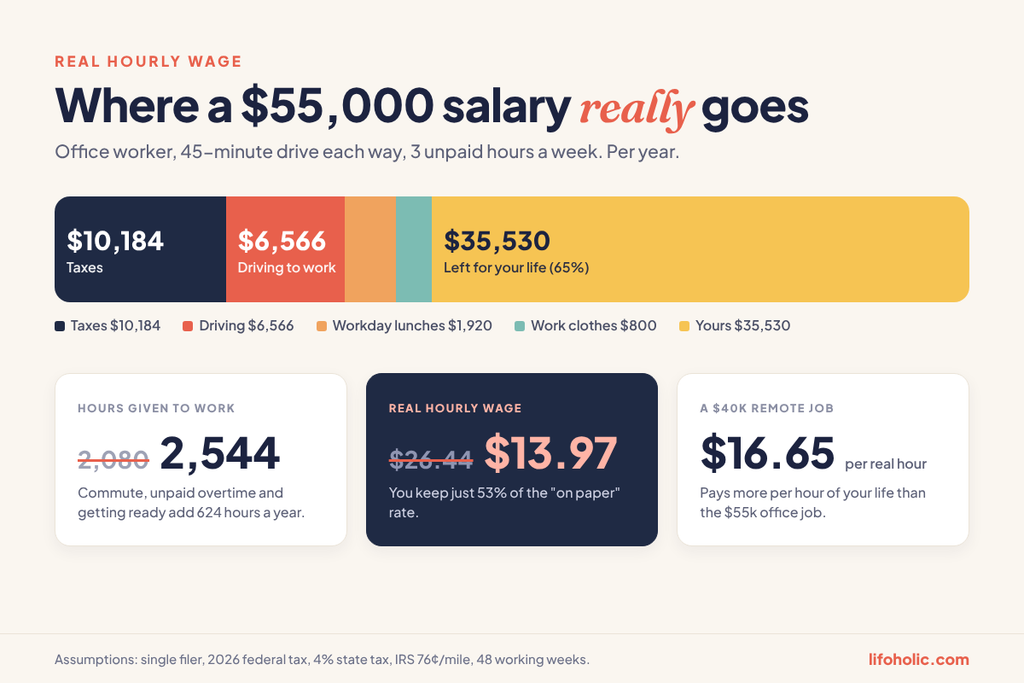
| Estimated total tax | $10,184 (18.5%) | $20,811 (23.1%) | $6,636 (16.6%) |
| Take-home pay | $44,816 | $69,189 | $33,364 |
| Commuting cost | $6,566 (8,640 miles × $0.76) | $3,000 (transit pass) | $0 |
| Lunches and coffee (extra) | $1,920 | $2,160 | $0 |
| Clothes and dry cleaning | $800 | $1,200 | $0 |
| Childcare because of work | $0 | $6,000 | $0 |
| Other work costs | $0 | $0 | $600 |
| Money left for your life | $35,530 | $56,829 | $32,764 |
| Paid hours per week | 40 | 40 | 40 |
| Unpaid overtime | 3 | 8 | 1 |
| Commuting | 7.5 | 6 | 0 |
| Getting ready and decompression | 2.5 | 1.5 | 0 |
| Real hours per year (× 48 weeks) | 2,544 | 2,664 | 1,968 |
| Real hourly wage | $13.97 | $21.33 | $16.65 |
| Share of “paper” wage you actually keep | 53% | 49% | 87% |
What the examples show
The $40,000 remote job pays more per real hour than the $55,000 office job. Sam earns $15,000 less on paper but keeps $16.65 for every hour given to work. Maya keeps $13.97. Maya’s car alone eats almost two months of her take-home pay, and her commute adds 360 hours a year, nine full work weeks, that nobody pays for.
A big salary doesn’t protect you. Jordan’s real wage is less than half the paper rate. Evening email is the silent killer here: eight unpaid hours a week adds up to 384 hours a year. Getting that back to two hours a week would be worth more than a 5% raise.
Small daily costs compound. An extra $8 a day on lunch and coffee looks like nothing. Over 240 workdays it’s $1,920, which is 137 hours, or more than two and a half weeks, of Maya’s real working time.
None of this means remote work is always better or that Maya should quit tomorrow. It means the salary figure on its own is a terrible way to compare jobs.
The Hidden Costs Most People Forget
Run the calculator once and you’ll probably spot the usual suspects. These are the ones people miss.
The true cost of driving. Most people count gas and nothing else. But the car also wears out, needs servicing and costs more to insure the more you drive. That’s why the IRS mileage rate of 76 cents a mile is a sensible upper estimate. If you’d own the car anyway, a lower figure of 25 to 40 cents (fuel plus wear) is a reasonable floor. Either way, a 36-mile round trip is a real expense.
The commute nobody pays for. The average one-way trip is now 27.2 minutes, according to the Census Bureau. Economists Alois Stutzer and Bruno Frey called this “the commuting paradox”: in their study of German workers, people with longer commutes were less satisfied with their lives, and a typical commuter would need roughly 19% more income to be as well off as someone who doesn’t commute. The higher pay that’s supposed to compensate usually doesn’t.
Decompression time. If you need 30 minutes of scrolling on the couch before you can cook dinner, that time belongs to the job. You don’t have to count all of it, but don’t pretend it’s zero.
“Convenience spending.” Takeout because you’re too tired to cook. Paying someone to do the laundry. Last-minute gifts because there was no time to plan. These are hard to measure, so our calculator puts them in “other work costs.” Be honest about the ones that disappear on your days off.
Childcare that only exists because of the commute. Many parents need care for the workday anyway. But late pickup fees, extra hours to cover a long commute, or after-school care only on office days are true work costs.
Turn Your Number Into “Hours of Life”
Here’s where your real hourly wage gets useful in everyday decisions.
Divide any price by your real wage, and you get the number of hours you have to work to pay for it. At Maya’s real wage of $13.97:
- A $1,199 phone, like the base iPhone 18 Pro, costs 86 hours of her life, not the 45 hours the paper rate suggests.
- A $60-a-month streaming bundle costs 52 hours a year.
- A $3 coffee every workday costs 52 hours a year.
This isn’t about guilt. It’s about asking a better question than “Can I afford it?” Ask “Is it worth 86 hours?” Sometimes the answer is an easy yes. Often it isn’t, and you’ll be glad you asked. (It’s also a sharp lens for big-ticket “deals”; see our look at whether Black Friday deals are actually cheaper.)
What’s a Good Real Hourly Wage?
There’s no official benchmark, so here’s a practical way to read your result. Compare your real hourly wage with your “paper” wage (salary ÷ 2,080):
- 80% or more: Your job is unusually efficient. Short or no commute, few work costs, little unpaid time. Protect it.
- 60% to 80%: Typical for many workers with a moderate commute. Worth trimming the biggest cost, but no alarm bells.
- Under 60%: The job is costing you far more than the salary suggests. It’s worth looking hard at the commute, unpaid hours and work costs, or at what else is out there.
The most important comparison, though, is between jobs. When you’re weighing an offer, run the calculator for both. A 15% raise with a much longer commute can easily pay less per real hour than the job you have now.
What to Do With Your Number
Once you know your real hourly wage, you have five practical moves. Most people need only one or two.
1. Negotiate, with your number in hand. Your real wage is a powerful argument for a raise or for flexibility. “I’d like to discuss two remote days a week” is a pay rise in disguise: for Maya, two remote days would cut about $2,600 in driving costs and 144 hours of commuting a year, lifting her real wage by almost $2 an hour. Our guide to negotiating a salary raise has scripts you can adapt for either conversation.
2. Cut the biggest work cost. It’s usually the commute. Carpooling, a pre-tax transit benefit if your employer offers one, a cheaper parking option or moving your hours to avoid traffic can each make a real difference.
3. Win back unpaid hours. Set a cut-off time for email and protect it. Unpaid overtime is the easiest way to lose money without noticing. Techniques from our guide to deep work help you get more done inside paid hours, so less spills into your evenings.
4. Compare jobs on real wage, not salary. If you’re already thinking about leaving, add your real hourly wage to the decision. Our guide on whether you should quit your job walks through the money runway and the other questions to ask first.
5. Or stay, happily, on purpose. A lower real wage isn’t automatically a bad deal. Maybe the job gives you skills, people you love working with, or a path to something bigger. That’s a legitimate trade, and knowing the number lets you make it deliberately rather than by default. If you’d like to build a career that lasts without burning out, read our piece on sustainable ambition. And if the calculation leaves you wanting fewer, better-spent hours, the ideas in slow living are a good place to start.
How We Calculated This
- Taxes: single filer, 2026 federal brackets and $16,100 standard deduction from the IRS; Social Security at 6.2% up to $184,500 and Medicare at 1.45% from the Social Security Administration; a flat 4% state income tax on federal taxable income as an illustration. No retirement contributions, credits or other deductions. Your real tax bill will differ.
- Driving cost: the IRS business mileage rate of 76 cents a mile (July to December 2026), applied to round-trip commute miles on office days.
- Working year: 48 weeks worked (four weeks of vacation and holidays), 240 workdays for a full-time office worker.
- Food: only the extra cost compared with eating at home ($8 a day for Maya, $15 a day on office days for Jordan).
- On-paper hourly rate: salary ÷ 2,080 (40 hours × 52 weeks), the standard conversion.
- Examples: illustrative composites, not real people. Figures are rounded to the nearest dollar.
Frequently Asked Questions
How do I calculate my real hourly wage?
Take your annual take-home pay, subtract everything you spend because of the job (commuting, work lunches, work clothes, work-related childcare), then divide by every hour the job takes in a year, including commuting, unpaid overtime and getting ready. Our calculator does the maths for you.
How do I convert my salary to an hourly rate?
The standard conversion is your annual salary divided by 2,080 (40 hours a week for 52 weeks). A $55,000 salary works out at $26.44 an hour. That’s your gross “on paper” rate. Your real hourly wage, after tax, work costs and unpaid time, is usually much lower.
Does commuting count as work time?
Under US federal law, ordinary home-to-work commuting generally isn’t paid working time. But for your own calculation, it absolutely should count: you can’t spend those hours on anything else, and you’d stop doing them the day you left the job.
How much does commuting really cost?
If you drive, multiply your round-trip miles by a cost per mile. The IRS’s business rate of 76 cents a mile is a good estimate of the full cost of running a car; 25 to 40 cents is a reasonable floor if you’d own the car anyway. An 18-mile commute each way, five days a week, can cost around $6,500 a year at the IRS rate.
What’s a good real hourly wage?
There’s no official benchmark. A useful rule of thumb is to compare it with your on-paper hourly rate: keeping 80% or more is excellent, 60% to 80% is typical, and under 60% means the job is costing you far more than your salary suggests.
Is a higher-paying job always worth it?
No. A higher salary with a long commute, more unpaid hours or higher work costs can pay less per real hour than a lower-paid job closer to home or remote. Always compare real hourly wages, not salaries, before you accept an offer.
The Bottom Line
Your salary is what your job is worth to your employer. Your real hourly wage is what your job is worth to you.
Work it out once. It takes two minutes, and it might be the most useful number you calculate all year. You may find that your job is a better deal than you thought. Or you may find that two remote days, a firm cut-off for email or a job closer to home is worth more than your next raise.
Either way, you’ll be deciding with the right number.
Sources
- US Census Bureau, Commuting at a glance: American Community Survey 1-year estimates and Commuting (Journey to Work)
- US Bureau of Labor Statistics, American Time Use Survey and Table 4: hours worked on days worked
- US Bureau of Labor Statistics, Consumer Expenditures and the Consumer Expenditure Surveys
- Internal Revenue Service, Standard mileage rates, Federal income tax rates and brackets and Tax Withholding Estimator
- Social Security Administration, Contribution and benefit base
- Alois Stutzer and Bruno S. Frey, Stress That Doesn’t Pay: The Commuting Paradox, IZA Discussion Paper No. 1278
This article is for general information and isn’t financial or tax advice. Tax rules, benefits and costs vary by state, country and personal situation, so check the details that apply to you.
Your Real Hourly Wage at a Glance: Where a $55,000 Salary Goes



Join the Lifoholic community conversation. We welcome thoughtful insights, questions, and authentic experiences from our readers.
RECOMMENDED DISCUSSIONS
Should You Quit Your Job? How to Decide, What to Check First and How to Leave Well
How to Remember Everything You Read: What Actually Works