

Almost everyone asks it at some point, usually on a Sunday night or right after a bad meeting: should I quit my job?
It’s a big decision, and the internet is full of advice that’s either “follow your passion” or “never leave without a plan.” Neither helps much when you’re the one staring at your inbox.
This guide gives you a clearer way to decide. You’ll get a 5-question test, the warning signs that mean it really is time to go, a simple way to work out how long your savings would last, and a step-by-step plan for leaving well, whether you have another job lined up or not.
Quick answer: If your job is harming your health or safety, it’s reasonable to put leaving first and plan around it. Otherwise, the safest move is usually to try to fix the problem first, line up your next job or build a savings cushion, and only then hand in your notice. The test below helps you work out which camp you’re in.
Why So Many People Want to Quit
If you’re thinking about leaving, you’re far from alone, and your reasons are probably the same as most people’s.
When the Pew Research Center asked US workers who quit a job why they left, the top answers were:
- Low pay (63%)
- No opportunities for advancement (63%)
- Feeling disrespected at work (57%)
- Child care problems (48% of parents with children under 18)
- Not enough flexibility over working hours (45%)
Notice something about that list: several of those problems can sometimes be fixed without leaving. Pay can be negotiated. Hours can sometimes be changed. A new manager or a move to another team can solve a respect problem. That’s why the first question in the test below is about whether you’ve tried.
The same survey found that most people who quit and found new work said their new job paid more (56%) and offered more chances to advance (53%). So leaving can pay off. The key is leaving for the right reasons, at the right moment, with a plan.
Latest Job Market Snapshot
Last updated: October 2026. We refresh these figures as new government data is released.
Your decision doesn’t happen in a vacuum. Here’s what the latest official US data shows:
- Hiring is slow. Employers added just 29,000 jobs in September, according to the Bureau of Labor Statistics jobs report. Unemployment was 4.2%.
- Fewer people are quitting. In August, about 3.1 million people quit their jobs, a quits rate of 1.9%, according to the BLS Job Openings and Labor Turnover Survey. That’s well below the peak of the 2021–22 “Great Resignation.”
- Layoffs are still low. Layoffs and discharges were around 1.0% of workers in August.
- Job searches can take a while. About 1.9 million people, or 27% of everyone unemployed, had been looking for work for 27 weeks or more.
- Switching still pays more than staying, for now. The Atlanta Fed Wage Growth Tracker shows typical pay growth of 4.7% for people who changed jobs, compared with 3.4% for people who stayed.
What this means for you: Economists describe this as a “low-hire, low-fire” market. If you have a job, it’s relatively secure, but if you leave without another one, finding the next role may take longer than you expect. That doesn’t mean you shouldn’t quit. It means planning matters more than usual.
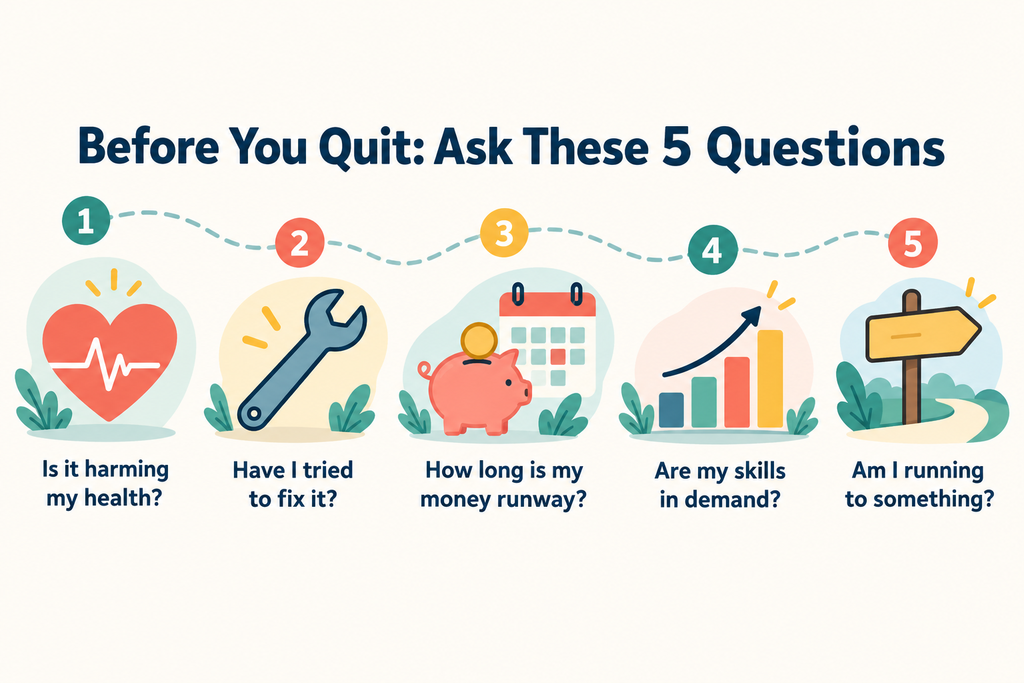
The 5-Question “Quit or Stay” Test
Grab a notebook and answer each question honestly. There’s no score to add up. Instead, the pattern of your answers will point you towards one of three paths at the end.
1. Is this job harming my health, safety or wellbeing?
Start here, because it overrides everything else.
The World Health Organization defines burnout as an occupational phenomenon with three signs:
- Feeling drained or exhausted
- Feeling mentally distant, negative or cynical about your job
- Feeling less effective at work
If all three describe you most days, take it seriously. The same goes for harassment, discrimination, unsafe working conditions, or being asked to do something illegal or unethical.
If your answer is a clear yes, your health comes first. Talk to a doctor if you’re struggling, and look at the “leave sooner” path below. If you’re not sure how you’re really doing, our 10-minute daily mental health check-in is a good way to track it for a couple of weeks.
2. Have I actually tried to fix the problem?
Be honest. Have you:
- Asked for a raise, with evidence of what you deliver?
- Told your manager specifically what isn’t working?
- Asked about a different team, role, schedule or remote days?
- Asked what it would take to be promoted, and by when?
If you haven’t, you may be leaving a solvable problem on the table. Our guide on how to negotiate a salary raise has word-for-word scripts and the data to bring.
If you have tried and nothing changed, that’s useful information too. It tells you the problem is the job, not the conversation.
3. How many months could I cover my bills without a paycheck?
This is your money runway, and it’s the most practical question on the list.
To work it out:
- Add up your essential monthly costs: rent or mortgage, utilities, groceries, insurance, minimum debt payments, transport, and health insurance if you’d lose your employer’s plan.
- Add up the savings you could realistically use (not retirement accounts).
- Divide your savings by your monthly costs.
Example: If your essentials cost $3,200 a month and you have $16,000 in savings, your runway is 5 months.
How long is long enough? The Consumer Financial Protection Bureau says the right emergency fund depends on your situation. For quitting without another job lined up, a useful rule of thumb is at least six months, given how many job searches now take half a year or more. If your runway is shorter, the safest move is usually to job hunt while you’re still employed.
4. Are my skills in demand right now?
Some fields are hiring even when the overall market is slow, and some are shrinking. Before you leave, check:
- The BLS Occupational Outlook Handbook, which shows pay and projected growth for hundreds of jobs
- How many current openings there are for your role in your area or in remote roles
- Whether recruiters still contact you, and how often
If your role is being reshaped by automation, it’s worth reading how AI is changing business and which skills employers are leaning on.
5. Am I running towards something or just away from something?
“I hate my boss” is a reason to leave. It isn’t a plan.
Try finishing this sentence: “In my next job, I want…” If you can name what you want (more pay, a specific role, flexibility, a different industry), you’ll make better choices and interview more convincingly. If all you can name is what you’re escaping, spend a little time on the next step first.
What Your Answers Mean
Path A: Stay and fix it. You haven’t tried to solve the problem yet, the job isn’t harming you, and you’d like to stay if things improved. Have the raise or role conversation in the next two weeks, set yourself a deadline (for example, 90 days), and revisit this test then.
Path B: Stay while you search. You’ve tried to fix things, it’s not working, but your runway is short or the market for your skills is slow. Keep your job, start looking quietly, and leave once you’ve signed a new offer. This is the right path for most people most of the time.
Path C: Leave sooner. Your health or safety is at risk, or you have a solid runway (six months or more) and a clear idea of what’s next. Plan your exit using the steps below.
Signs It’s Time to Quit Your Job
Still on the fence? These are strong signs it’s time to move on:
- You dread work every day, not just on bad days, and it’s affecting your sleep, health or relationships.
- You’ve asked for change, more than once, and nothing has happened.
- You’ve stopped learning, and there’s no realistic path to the next level.
- You’re paid noticeably less than the market rate and your employer won’t move.
- The company is in visible trouble: repeated layoffs, missed payroll, leaders leaving.
- You’re being asked to do things that conflict with your values or the law.
- You keep imagining your next job, and you could describe it in detail.
One or two of these might be a rough patch. Several together usually aren’t.
How to Quit a Job Without Another One Lined Up
Sometimes leaving first is the right call. If you’re going to do it, do it deliberately:
- Build your runway first. Aim for six months of essential costs if you possibly can. Cut nonessential spending for a few months before you leave.
- Sort out health insurance. In the US, if your employer has 20 or more employees, you can usually keep your health plan through COBRA, but you may pay up to 102% of the full cost. You generally have at least 60 days to elect coverage. Compare the cost with marketplace plans at HealthCare.gov, since leaving a job lets you enroll outside the usual window.
- Don’t count on unemployment benefits. Each state sets its own rules, but benefits are generally for people who are unemployed through no fault of their own. If you quit voluntarily, you usually won’t qualify unless your state accepts your reason as “good cause.” Check with your state’s program before you decide.
- Check what you’d leave behind. Look at unvested retirement contributions, bonuses due soon, stock options and payout rules for unused vacation, which vary by state and employer.
- Plan your days. Treat the search like a part-time job, with set hours for applications, networking and skill-building. It also protects your mood. A gentle structure, like a consistent morning routine, helps more than you’d think.
How to Look for a Job While You’re Still Employed
For most people, this is the smartest route. A few practical tips:
- Lead with your network. Tell a handful of trusted former colleagues and contacts what you’re looking for. Introductions and referrals often get you a conversation that a cold application doesn’t.
- Keep it quiet at work. Don’t search on a work laptop, use your work email or post “open to work” publicly if you’d rather your employer didn’t know.
- Protect your focus. Block two or three short sessions a week for applications and interviews, rather than squeezing it into every spare moment. Our guide to deep work helps you get more done in less time.
- Use interviews to compare. Ask about the things that made you want to leave: how promotions work, how pay is reviewed, how flexible the hours really are.
- Get the offer in writing before you resign, including salary, start date and benefits.
How to Quit Your Job Without Burning Bridges
When you’re ready to leave, how you go matters. Your old manager and colleagues may be future references, clients or co-workers.
- Tell your manager first, in person or on a video call. Don’t let them hear it from someone else.
- Give proper notice. Two weeks is customary in the US, though your contract or role may expect more. In most US jobs it isn’t legally required, but it’s the professional standard.
- Keep the reason short and positive. “I’ve accepted a role that’s a great next step for me” is enough. You don’t owe a full explanation.
- Put it in writing. Send a short resignation letter (see the template below).
- Hand over well. Document your work, finish what you can and offer to train your replacement.
- Be careful with counteroffers. If you’re leaving purely for pay, a counteroffer might solve it. If you’re leaving for growth, respect or flexibility, more money rarely fixes the underlying problem.
- Leave gracefully. Say thank you, connect with colleagues on LinkedIn, and keep any exit interview feedback constructive.
Simple resignation letter template
Dear [Manager’s name],
Please accept this letter as formal notice of my resignation from my role as [job title]. My last day will be [date].
Thank you for the opportunities I’ve had here, especially [one specific thing]. I’ll do everything I can to make the handover smooth over the coming weeks.
Best regards, [Your name]
Thinking Long Term
Quitting one job is a single decision. Building a career you don’t want to escape is a longer project. Once you’ve decided, it’s worth reading about sustainable ambition and career longevity, so your next role is one you grow in, not just one you escape to.
You’ll find more practical guides in our Career section.
Frequently Asked Questions
How do I know if I should quit my job?
Ask yourself five questions: Is the job harming my health or safety? Have I tried to fix the problem? How many months could I cover my bills? Are my skills in demand? Am I running towards something, not just away? If your health is at risk, or you’ve tried to fix things and have a solid plan, it’s probably time to go.
Is it a good time to change jobs?
It depends on your field. Right now, US hiring is slow, but people who switch jobs still tend to get bigger pay rises than people who stay. For most people, the best approach is to search while still employed and resign only after accepting an offer.
How many months of savings should I have before quitting?
There’s no official number, but a useful rule of thumb is at least six months of essential expenses if you’re quitting without another job. Job searches often take several months, and quitting voluntarily usually means you won’t qualify for unemployment benefits.
Can I get unemployment if I quit my job?
Usually not. Unemployment benefits are generally for people who lose work through no fault of their own. Some states pay benefits if you quit for “good cause,” such as unsafe conditions, but rules vary, so check with your state’s unemployment program.
Should I tell my boss I’m looking for another job?
In most cases, no. Keep your search private until you have a written offer. The exception is if you have a strong, trusting relationship with your manager and you’d genuinely stay if things changed. Then an honest conversation about what you need can sometimes solve the problem.
How much notice should I give when I quit?
Two weeks is the usual standard in the US. Check your contract, since some roles require more. Giving proper notice and a clean handover protects your references and your reputation.
The Bottom Line
Wanting to quit isn’t a failure. It’s information. The goal is to use it well.
Take the 5-question test this week. If you can fix the problem, try. If you can’t, start searching while you still have a paycheck. And if your health is on the line, put yourself first and plan your exit carefully. The right move is the one you make on purpose, not the one you make on a bad Monday.
Sources
- US Bureau of Labor Statistics, The Employment Situation and Job Openings and Labor Turnover Survey
- Federal Reserve Bank of Atlanta, Wage Growth Tracker
- Pew Research Center, Majority of workers who quit a job in 2021 cite low pay, no opportunities for advancement, feeling disrespected
- World Health Organization, Burn-out an “occupational phenomenon”
- US Department of Labor, COBRA continuation coverage and Unemployment insurance
- Consumer Financial Protection Bureau, An essential guide to building an emergency fund
This article is for general information and isn’t financial, legal or medical advice. Employment, benefits and tax rules vary by state and country, so check the details that apply to you.



Join the Lifoholic community conversation. We welcome thoughtful insights, questions, and authentic experiences from our readers.
RECOMMENDED DISCUSSIONS
How to Remember Everything You Read: What Actually Works
How to Negotiate a Salary Raise in 2026: Scripts, Timing, and the Data to Bring