

Most of us check the weather, our bank balance and our phone battery every day. Very few of us check how we’re actually doing.
That gap matters. According to the World Health Organization, more than a billion people worldwide live with a mental health condition. Many more go through stretches of stress, low mood or burnout that never get a name, and often never get noticed until they’ve grown into something bigger.
A daily mental health check-in is a simple way to close that gap. It takes about 10 minutes, needs nothing more than a notebook or your notes app, and gives you an early warning system for your own mind.
This guide gives you the exact questions to ask, a copy-and-paste template, the signs that mean it’s time to get more support, and how to check in on someone else.
What Is World Mental Health Day 2026 About?
World Mental Health Day is held every year on 10 October. It’s led by the World Federation for Mental Health and supported by the WHO.
The 2026 theme is “Lived Experiences Heard: Real Voices, Real Change”. The idea is that the people who live with mental health challenges should be listened to and should help shape the support that’s available.
That starts closer to home than it sounds. Hearing lived experience includes hearing your own: noticing how you feel, naming it honestly and acting on it. That’s exactly what a daily check-in does.
Why a Daily Check-In Works
Naming a feeling helps calm it
In a well-known UCLA brain-imaging study, researchers found that putting feelings into words reduced activity in the amygdala, the part of the brain that reacts to threat and strong emotion. Psychologists call this “affect labelling.”
In plain terms: writing “I feel anxious about tomorrow’s meeting” is more helpful than carrying around a vague sense that something is wrong.
Patterns are easier to see on paper
One bad day tells you very little. Two weeks of notes can tell you a lot. You might spot that your mood drops after nights under six hours of sleep, on days you don’t leave the house, or every Sunday evening before the work week.
That pattern is useful information. It is also exactly what a doctor or therapist will ask about if you ever need extra support.
It catches problems early
The US National Institute of Mental Health says to seek professional help when distressing symptoms last two weeks or more. Without a record, two weeks can easily slip by. A daily check-in makes that timeline visible.
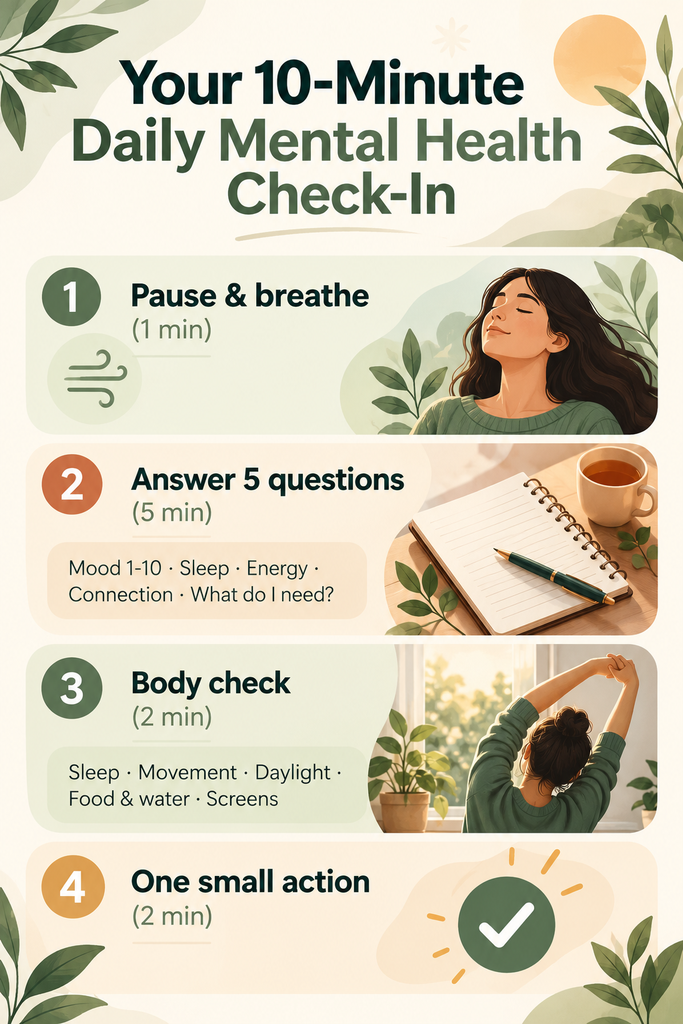
The 10-Minute Daily Mental Health Check-In
Pick a consistent time. Many people like the evening, when the day is done, or pair it with an existing habit such as their first coffee. If you already have a morning ritual, add it there.
Step 1: Pause and breathe (1 minute)
Sit down, put your phone face down and take five slow breaths, breathing out for longer than you breathe in. This isn’t about relaxing perfectly. It just separates the check-in from the rush of the day.
Step 2: Answer the five check-in questions (5 minutes)
These are the core mental health check-in questions. Write short, honest answers. There are no wrong ones.
- How is my mood today, from 1 to 10? Then add one word for the main feeling: calm, flat, irritable, anxious, hopeful, tired.
- How did I sleep last night? Roughly how many hours, and did you wake up rested?
- How is my energy? Low, medium or high. Note anything that drained or boosted it.
- Did I connect with anyone today? A real conversation, not just a scroll through other people’s lives.
- What do I need right now? Rest, movement, company, quiet, food, help with a task, or simply to say no to something.
Question five is the most important. It turns noticing into doing.
Step 3: Run a quick body check (2 minutes)
Your mental and physical health are closely linked. Give each of these a quick tick or cross:
- Sleep: The CDC recommends 7 or more hours a night for most adults.
- Movement: Even a 10-minute walk counts. The WHO recommends at least 150 minutes of moderate activity a week, which is about 20 minutes a day.
- Daylight: Did you get outside in natural light? This matters more as the days shorten. If your mood dips every autumn, read our guide to seasonal affective disorder vs. winter blues.
- Food and water: Did you eat regular meals and drink enough? Notice how caffeine and alcohol affected you.
- Screens: Did your phone leave you feeling better or worse today?
Step 4: Choose one small action (2 minutes)
Look at your answers and pick one thing to do in the next 24 hours. Keep it small enough that you’ll actually do it:
- Go to bed 30 minutes earlier.
- Text a friend you haven’t spoken to in a while.
- Take a walk at lunch.
- Leave your phone in another room for the first hour of the morning.
- Say no to one non-essential commitment.
Then close the notebook. That’s it.
Your Copy-and-Paste Check-In Template
Save this in your notes app or print it and keep it by your bed.
Date:
Mood (1–10) and main feeling:
Sleep (hours / rested?):
Energy (low / medium / high):
Connected with:
What I need right now:
Body check: Sleep ☐ Movement ☐ Daylight ☐ Food & water ☐ Screens OK ☐
One small action for tomorrow:
After a week, read back through your entries. After a month, look for patterns: which days are best, which are hardest, and what tends to come before each.
Building It Into a Mental Health Self-Care Routine
A check-in tells you what you need. A mental health self-care routine is how you meet those needs consistently. A few Lifoholic guides can help with the areas that come up most often:
- If sleep keeps scoring low: Try the steps in our guide to restorative sleep and better nighttime routines.
- If screens keep leaving you drained: Our 7-day digital detox blueprint walks you through cutting back without going offline completely.
- If other people’s demands keep showing up in “what I need”: Read about communication and healthy boundaries.
- If life just feels too fast: Ideas from slow living can help you build calmer days.
You can find more practical guides in our Wellness section.
Signs It’s More Than a Bad Week
A daily check-in is a self-care tool, not a diagnosis or a replacement for professional care. Talk to a doctor or mental health professional if you notice any of the following for two weeks or more, especially if they’re making daily life hard:
- Trouble sleeping, or sleeping far more than usual
- Changes in appetite or weight you didn’t plan
- Struggling to get out of bed because of your mood
- Difficulty concentrating
- Losing interest in things you normally enjoy
- Not being able to manage your usual tasks at work or home
- Feeling irritable, restless or frustrated much of the time
This is where your check-in notes become really valuable. Instead of saying “I’ve been feeling off,” you can show exactly what has changed and for how long.
If you’re having thoughts of harming yourself, don’t wait two weeks. Reach out today using one of the free helplines below.
How to Check In on Someone Else
This year’s theme is about voices being heard, and sometimes the most helpful thing you can do is listen to someone else.
- Ask twice. “How are you?” usually gets “fine.” Follow up with “No, really, how are you doing?”
- Ask open questions. “What’s been on your mind lately?” invites more than a yes or no.
- Listen more than you advise. Most people want to feel understood before they want solutions.
- Don’t panic about saying the wrong thing. Showing up imperfectly is better than not showing up.
- Offer something concrete. “Want to go for a walk on Saturday?” is easier to accept than “Let me know if you need anything.”
- Know where to point them. If they’re struggling, share the helplines below and offer to help them make the first call.
Where to Get Free Help Today
If you or someone you know needs support right now, these services are free and confidential:
- United States: Call or text 988, or chat online through the 988 Suicide & Crisis Lifeline. It’s available 24 hours a day, every day.
- United Kingdom and Ireland: Call Samaritans free on 116 123, 24 hours a day.
- Anywhere else: Find A Helpline lists free, confidential helplines in more than 130 countries.
If you’re in immediate danger, call your local emergency number.
Frequently Asked Questions
What is a daily mental health check-in?
A daily mental health check-in is a short routine, usually 5 to 10 minutes, where you ask yourself a set of questions about your mood, sleep, energy, connection and needs, then choose one small action. It helps you notice changes early and spot patterns over time.
What questions should I ask in a mental health check-in?
Five simple questions cover most of what matters: How is my mood from 1 to 10? How did I sleep? How is my energy? Did I connect with anyone? What do I need right now?
How do I check on my mental health if I don’t know what I’m feeling?
Start with your body rather than your emotions. Rate your sleep, energy and appetite. Then pick the closest word from a short list such as calm, flat, anxious, irritable, sad or hopeful. Naming a feeling gets easier with practice.
When is World Mental Health Day 2026?
World Mental Health Day 2026 is on Saturday, 10 October. The theme is “Lived Experiences Heard: Real Voices, Real Change.”
Can a daily check-in replace therapy?
No. A check-in is a helpful self-care habit, but it isn’t a substitute for professional support. If symptoms last two weeks or more or are affecting your daily life, speak to a doctor or mental health professional.
The Bottom Line
You don’t need a perfect routine to look after your mental health. You need a small, honest habit you’ll actually keep.
Start tonight: five breaths, five questions, one small action. Ten minutes a day is enough to hear your own voice, and on this World Mental Health Day, that’s a good place to start.
This article is for general information and is not medical advice. If you’re worried about your mental health, please speak to a qualified professional.



Join the Lifoholic community conversation. We welcome thoughtful insights, questions, and authentic experiences from our readers.
RECOMMENDED DISCUSSIONS
Seasonal Affective Disorder vs. Winter Blues: Signs, Causes, and 12 Science-Backed Ways to Feel Better
The Science of Restorative Sleep: Optimizing Nighttime Routines
Reader Discussion