

Year-End Money Checklist: 12 Moves to Make Before December 31
Every year, on the first week of January, somewhere between $3,000 and $12,000 quietly leaves the average US household’s balance sheet. Not because anyone spent it. Because nobody did the handful of boring things that had to be finished by midnight on December 31.
A healthcare FSA that resets with $900 still in it. A 401(k) that captured the match in July and then quietly stopped. A Roth conversion that could have been done at 12% and will now be done at 22% in retirement. A capital-gain harvest that would have been taxed at zero if it had been sold two weeks earlier.
None of these are mistakes of greed or ambition. They’re mistakes of calendar. The tax code closes a long list of doors on the same single date, and anyone who doesn’t walk through them that week forfeits the money forever.
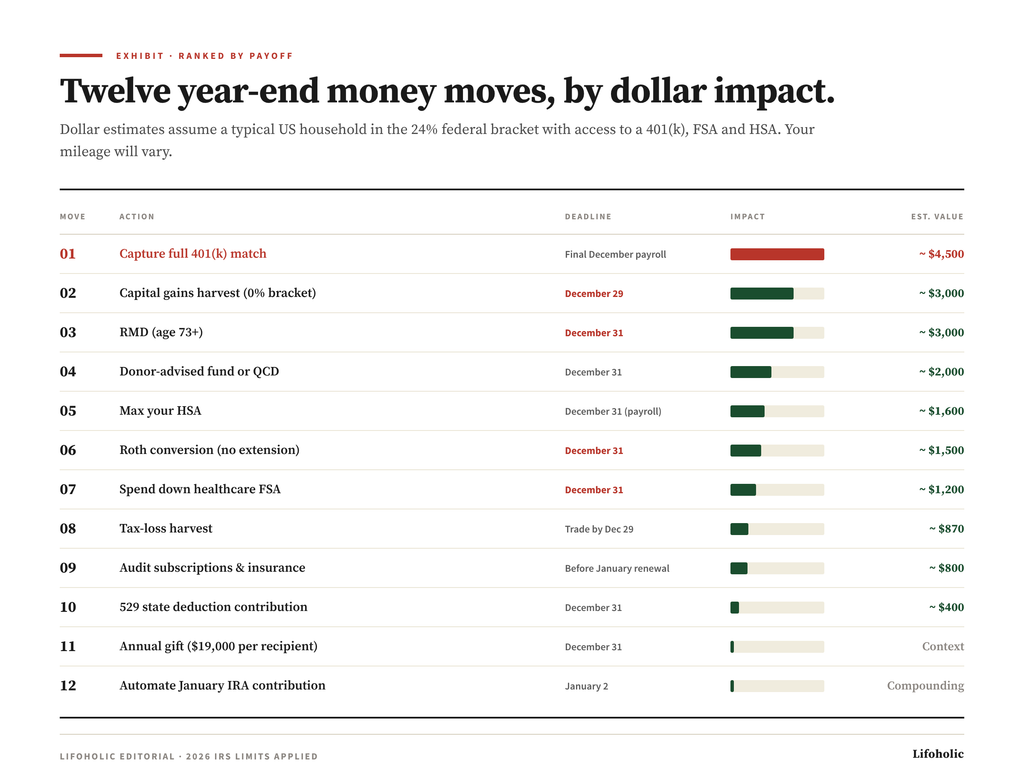
This is the short list of things actually worth doing before that date. Not resolutions, not goal-journals, not “spend less on lattes.” Twelve specific moves, each with a dollar outcome, each with a hard December 31 deadline, each one ranked by how much money it saves per hour of your time.
If you only have one hour this month, do move number one. If you have an afternoon, do the first five. The rest reward the people who make year-end a half-day calendar block.
The twelve moves, at a glance
- Capture your full 401(k) employer match (biggest free money on the list)
- Spend down your Healthcare FSA — anything over the $680 carryover disappears
- Max your HSA — the only triple-tax-free account you have access to
- Take your Required Minimum Distribution if you’re 73 or older (penalty is 25% otherwise)
- Tax-loss harvest losers, offset gains plus $3,000 of ordinary income
- Capital gains harvesting in the 0% bracket (singles under $49,450, couples under $98,900)
- Roth conversion to fill the remaining space in your current bracket
- 529 contribution for the state tax deduction
- Charitable giving — donor-advised fund bunching or QCD if you’re 70½+
- Annual gifts up to $19,000 per recipient, estate-tax free
- Audit subscriptions and insurance before the January renewal wall
- Open an IRA for next year and set the auto-contribution now
The rest of this piece walks through each one with the exact 2026 IRS numbers, the real dollar impact, and the one decision that makes or breaks it.
1. Capture your full 401(k) match
Payoff: $3,000–$10,000 for most households. It’s a 50–100% instant return on the money you put in.
Deadline: final paycheck of the year (so last payroll in December, not December 31).
If your employer matches 50% of the first 6% of salary, and you’re earning $80,000, you leave $2,400 on the table if you don’t hit 6%. Match percentages above 6% are rare but more common at tech companies.
Check two things on your pay stub this week:
- The 401(k) contribution year-to-date.
- The employer match year-to-date. If employer match ÷ your contribution is less than the stated match ratio, something’s off. Raise it with HR before the final payroll.
Most 401(k) portals let you push the remaining paychecks to a higher percentage to catch up. A 15% bump for the last two paychecks of the year often clears the full match.
The under-50 contribution limits in 2026
- 401(k) elective deferral: $24,500 ($23,500 in 2025).
- Catch-up for ages 50+: $8,000.
- Super catch-up for ages 60–63 (SECURE 2.0): $11,250.
For most households the full max isn’t the goal — the full match is.
Related: how to negotiate a salary raise for the money your 401(k) contributes a percentage of.
2. Spend down your Healthcare FSA
Payoff: $500–$2,720 of forfeited tax savings.
Deadline: December 31 for most plans (plus a $680 carryover if your employer allows it).
The healthcare FSA is use-it-or-lose-it. In 2026 the contribution cap is $3,400; any balance above the carryover ($680 if your plan permits it, otherwise $0) disappears on January 1.
If you’re sitting on $1,500 in an unused FSA and you’re in the 24% bracket, you forfeit $360 of saved tax plus the $1,500 itself. Both can be fixed in an hour.
Things an FSA covers that most people miss:
- Sunscreen with SPF 30+ (reimbursable without a prescription since 2020).
- First-aid kit, thermometer, blood-pressure monitor.
- Reading glasses at any pharmacy.
- Prescription-strength allergy medicine (Pepcid, Zyrtec, Allegra over-the-counter versions).
- Massage therapy with a letter of medical necessity from a doctor — easy to get for back pain.
- Mental health therapy copays (even remote).
- Lasik evaluation, if you want to roll it into next year.
If you’re close to the full cap and don’t need it, schedule the dental cleaning you’ve been putting off before year end — any copay or out-of-pocket portion is FSA-eligible.
Dependent-care FSA
If you have a childcare dependent-care FSA, the 2026 cap is $7,500 ($3,750 if married filing separately). Same deadline, same forfeit rule unless your plan has a grace period (check the plan document).
Related: how to choose a health plan for whether your FSA/HSA split is right next year.
3. Max your HSA
Payoff: $1,000–$2,000 in tax saved today, plus 30+ years of tax-free growth.
Deadline: officially tax day (April 15), but easier to do by December 31 while you’re still on payroll.
The HSA is the only account in the US tax code that is triple tax-free: deductible going in, growing tax-free, and tax-free coming out for qualified medical expenses. There is no other account with all three.
2026 HSA limits:
- Single HDHP: $4,400
- Family HDHP: $8,750
- Catch-up (age 55+): additional $1,000
If you’re in the 24% federal bracket plus 5% state plus 7.65% FICA (payroll HSA contributions skip FICA; direct IRA-style contributions don’t), funding $4,400 through payroll saves roughly $1,615 in tax.
The big insight nobody states: don’t spend the HSA this year. Pay medical bills out of pocket if you can, keep the receipts, let the HSA invest for decades, then reimburse yourself years later. The IRS has never put a time limit on reimbursement.
Requires: a High-Deductible Health Plan (HDHP). If you don’t have one, skip this move and go to #4.
Related: the FIRE number calculator uses HSA assumptions in the account-mix adjustment.
4. Take your Required Minimum Distribution (if you’re 73 or older)
Payoff: avoiding a 25% excise tax (10% if you catch it within two years).
Deadline: December 31 for everyone except the year you turn 73 (that first RMD can be taken by April 1 of the following year).
If you’re 73 or older with a traditional IRA or 401(k), the IRS requires you to take a Required Minimum Distribution each calendar year. Missing it is one of the few tax mistakes that carries a specific statutory penalty: 25% of the shortfall.
Many brokerages will compute and send you the RMD automatically if you ask. If you have multiple traditional IRAs you can take the total RMD from any one of them. Multiple 401(k)s each require their own RMD.
If you don’t need the money, consider move #9 below (QCD) to send the RMD straight to charity and skip the income tax entirely.
5. Tax-loss harvesting
Payoff: $450–$2,400 of federal tax saved for most households.
Deadline: trade must settle by December 31, which in practice means execute by December 29 for safety.
Tax-loss harvesting is selling an investment that’s down to realise the loss, using it to offset capital gains elsewhere, and if losses exceed gains, deducting up to $3,000 against ordinary income (losses above that carry forward indefinitely).
For someone in the 24% bracket + 5% state, that $3,000 deduction is worth $870 of tax. Every year.
Three rules to remember:
- The wash-sale rule: you can’t buy the “substantially identical” security within 30 days before or after the sale. Workaround: sell VTI, buy ITOT or VOO — different funds, nearly identical exposure.
- Short-term losses offset short-term gains first, then long-term, then ordinary income.
- Carryover losses have no expiry. If you’re sitting on 2022 or 2024 harvested losses, they still cushion this year’s gains.
Where not to do it: a Roth IRA or 401(k) is already tax-sheltered, so losses in them can’t be harvested. This is strictly a taxable brokerage move.
6. Capital gains harvesting (the opposite move)
Payoff: potentially $0 tax on $20,000–$80,000 of gains.
Deadline: trade by December 29.
The 0% long-term capital gains bracket is the most under-used provision in the US tax code. In 2026 it applies to taxable income up to $49,450 (single) or $98,900 (married filing jointly). If your taxable income is below the threshold, long-term gains are taxed at 0% federal — up to the threshold.
Who it’s for:
- Early retirees living on taxable brokerage.
- Graduate students, sabbatical takers, parents on leave, anyone with a low-income year.
- Self-employed people who had a slow year.
How it works: sell appreciated shares up to the 0% threshold, pay zero federal tax on the gain, immediately rebuy the same shares (the wash-sale rule applies only to losses). Your cost basis is reset upward, meaning you’ll owe less tax when you sell for real later.
For a married couple with $70,000 of income and $20,000 of unrealised gains, harvesting the full $20,000 at 0% saves roughly $3,000 of future federal tax compared to realising it in a normal income year.
7. Roth conversion to fill your current bracket
Payoff: can be worth $20,000–$60,000 over a 30-year retirement.
Deadline: December 31 — unlike IRA contributions, Roth conversions do NOT get the April 15 extension.
A Roth conversion moves money from a traditional IRA or 401(k) into a Roth IRA, paying ordinary income tax on the converted amount now, in exchange for tax-free growth and withdrawals later.
Why do it at year end: you now know your 2026 taxable income almost exactly. Convert an amount that “fills up” your current tax bracket without pushing you into the next one.
Example: a couple with $95,000 of taxable income sitting at the top of the 12% bracket (bracket ceiling is $96,950 in 2026) can convert about $1,950 at the 12% rate. If they’ll be in the 22% bracket in retirement, that’s a 10-percentage-point saving on every converted dollar.
The hidden traps:
- Conversions count as ordinary income. They can tip you over ACA subsidy cliffs, IRMAA brackets for Medicare, and the 0% capital gains threshold. Model the full-year income impact before you convert.
- Once done, conversions can’t be undone. The old “recharacterisation” rule was repealed in 2017.
Related: FIRE number calculator — the article’s “Roth ladder” move is the multi-year version of this.
8. 529 contribution for the state tax deduction
Payoff: $100–$1,000 in state tax, depending on your state.
Deadline: usually December 31 (a handful of states — IA, MS, OK, SC — allow contributions until the tax-filing deadline).
If your state has an income tax and offers a 529 deduction (33 states and DC do), funding a 529 before December 31 is a direct tax discount on money you were going to save anyway.
Examples of generous deductions:
- New York: up to $5,000 single / $10,000 married.
- Illinois: up to $10,000 single / $20,000 married.
- Virginia: $4,000 per account per year (unlimited rollover).
- Indiana: 20% tax credit, up to $1,500.
Check your state’s rules — some only deduct contributions to the state’s own plan; others are “tax parity” states that let you deduct any state’s plan.
If you don’t have kids, a 529 can still be set up with you as the beneficiary and converted later, or rolled into a Roth IRA (up to $35,000 lifetime, five-year-old plan required), per SECURE 2.0.
9. Charitable giving (the two advanced moves)
Payoff: varies, but a QCD can save $1,000–$10,000 of tax for retirees.
Deadline: December 31. QCDs must hit the charity’s account by year end.
Two moves outperform writing a personal cheque:
Donor-advised fund bunching.
The standard deduction is $31,500 (married filing jointly, 2026). Most people take it rather than itemise, which means their charitable giving is tax-neutral. A donor-advised fund lets you contribute several years of giving in one year, itemise that year, then use the fund to grant to charities over the following years. Fidelity Charitable, Schwab Charitable and Vanguard Charitable all have minimums under $5,000.
Qualified Charitable Distribution (QCD).
If you’re 70½ or older with a traditional IRA, you can direct up to $108,000 (2026) from the IRA straight to a qualified charity. The amount counts toward your RMD (move #4) and never enters your taxable income. This is dramatically better than withdrawing, paying tax, then donating — because the donation itself would only reduce taxable income if you itemise, and most retirees don’t.
Donating appreciated stock (held >1 year) is also strictly better than cash for itemisers: you deduct the full market value and the charity receives it capital-gains-free.
10. Annual gifts up to $19,000 per recipient
Payoff: $0 of immediate tax savings for you, but keeps assets out of your taxable estate.
Deadline: cheque cashed by December 31, or transfer completed.
The 2026 annual gift tax exclusion is $19,000 per recipient, per giver. A married couple can give $38,000 to one child and another $38,000 to the child’s spouse — $76,000 a year to one couple, forever, no gift tax return required.
For high-net-worth families, consistent annual gifting is one of the simplest ways to move wealth out of the taxable estate without ever using the $15 million lifetime exemption.
Even if you’re not near the exemption, 529 contributions and Roth IRA contributions (for kids with earned income) make use of the annual exclusion while building compounding assets.
11. Audit subscriptions and insurance before January’s renewal wall
Payoff: $300–$2,000 recovered per household.
Deadline: before each annual renewal hits — most trigger in January.
Insurance renewals and streaming plans both quietly reprice in January. In 2026, average auto insurance premiums are up another 7% and the full six-streamer “ad-free” bundle has crossed $1,300 a year (see our subscriptions post).
A 45-minute year-end audit routinely recovers more than any of the tax moves above, with none of the complexity:
- Pull the last 12 months of credit-card statements. Sort by merchant.
- For every subscription, ask “have I used this in the last 60 days?” If no, cancel today.
- Re-shop auto insurance using at least two quote aggregators. 40% of policies have cheaper equivalents at the same coverage.
- Check your health plan’s in-network list — if your doctor dropped out mid-year (common in 2026), switch during the ACA Dec 15 deadline.
12. Open and fund an IRA for next year (set it on auto)
Payoff: compounding. $7,500 contributed every January for 30 years at 7% real = roughly $735,000.
Deadline: technically April 15, but the move that actually works is automating it by January 2.
The IRA contribution limit for 2026 is $7,500 ($8,600 if 50+). The people who actually hit it every year are the ones who automate monthly contributions of $625 on January 2 and forget about it. Doing it on April 14 for the previous year is a worse habit because you have to remember it.
Which type:
- Roth if your current bracket is 22% or below, or you want tax-free flexibility.
- Traditional if your current bracket is 24%+ and you expect to be in a lower one in retirement.
- Backdoor Roth if your income is over the Roth phase-out ($165,000 single / $246,000 MFJ in 2026).
Latest data box (last updated 15 November 2026)
- 401(k) elective deferral (2026): $24,500.
- 401(k) catch-up (50+): $8,000; super catch-up (60–63): $11,250.
- IRA contribution limit (2026): $7,500; catch-up $1,100.
- HSA (2026): $4,400 single / $8,750 family; $1,000 catch-up at 55+.
- Healthcare FSA (2026): $3,400 max; $680 carryover (if plan allows).
- Dependent care FSA (2026): $7,500 ($3,750 married filing separately).
- Gift tax annual exclusion (2026): $19,000 per recipient per giver.
- Lifetime gift/estate exemption (2026): $15,000,000 per person.
- Long-term capital gains 0% bracket (2026): up to $49,450 single / $98,900 MFJ.
- RMD age: 73; QCD limit: $108,000.
Refresh in January when the IRS publishes the next year’s inflation adjustments, and again after any ACA or OBBBA policy change.
Interactive checklist
(Tool embedded in the article.)
Tick each move you’ve completed. The tool shows your progress and the exact dollar impact you’ve captured so far.
For non-US readers (short version)
- UK: use your ISA allowance (£20,000) by 5 April — the UK tax year ends then, not December. Pension contributions also cap at £60,000. Check your emergency fund in a cash ISA before rate drops.
- India: complete 80C investments (₹1.5 lakh) and 80D health insurance (₹25,000) by 31 March. If on the new tax regime, check whether the standard deduction (₹75,000) and NPS employer contribution (10% of salary) still beat the old regime for your situation.
- Canada: TFSA room ($7,000 in 2026) and RRSP room (18% of prior-year earned income, capped at $31,560) carry forward, but the RRSP deadline for a current-year deduction is the first 60 days of the next calendar year.
The muscle here is the same everywhere: know the deadlines, don’t leave free money behind.
FAQ
What are the most important year-end money moves?
Capturing your full 401(k) match, spending down your Healthcare FSA, and maxing your HSA. Those three alone recover $3,000–$10,000 of value for a typical household and take about three hours of work combined.
What happens to my FSA if I don’t use it?
Anything above your plan’s carryover amount (up to $680 in 2026 if your employer allows carryover) is forfeited on December 31. Some plans offer a 2.5-month grace period instead of the carryover. Check your plan document, but never both — the IRS doesn’t allow it.
What is the deadline for Roth conversions?
December 31 of the conversion year, with no extensions. This is different from IRA contributions, which get the April 15 tax-filing deadline. Make sure the money is in the Roth account, not just initiated, by year end.
How much can I give as a tax-free gift in 2026?
$19,000 per recipient per giver, with no limit on the number of recipients and no gift tax return required. A married couple can double this to $38,000 per recipient per year.
How does tax-loss harvesting work?
Sell investments that are currently worth less than you paid, use the losses to offset any realised gains, and if losses exceed gains, deduct up to $3,000 against ordinary income. Any extra loss carries forward indefinitely. Watch the 30-day wash-sale rule if you plan to repurchase.
What is capital gains harvesting?
The opposite move. In a low-income year, sell long-term holdings at a gain while your taxable income is below the 0% capital gains threshold ($49,450 single, $98,900 MFJ in 2026), then immediately rebuy to reset cost basis. No tax paid, no future tax saved — on that portion.
When is the RMD deadline?
December 31 for people 73 and older with traditional IRAs or 401(k)s. The only exception is the year you turn 73, when the first RMD can be deferred to April 1 of the following year (but doing so means two RMDs in one tax year).
What’s a Qualified Charitable Distribution and how much can I donate?
A QCD is a direct transfer from a traditional IRA to a qualified charity, available at age 70½+. In 2026 the limit is $108,000 per person. It counts toward your RMD, isn’t included in taxable income, and doesn’t require itemising. For charitably inclined retirees, it’s typically the single most tax-efficient way to give.
Related reading on Lifoholic
- How Much Emergency Fund Do You Actually Need?
- How Much Money Do You Need to Retire Early? (FIRE Number)
- Your Real Hourly Wage Calculator
- How Much Do You Spend on Subscriptions?
- How to Choose a Health Plan
- How to Negotiate a Salary Raise
- Side Hustles That Pay
- One-Person Business Expenses
- How Much to Spend on Christmas
- Best Places to Retire
- How Much Does Having a Baby Cost?
External sources
- IRS — Revenue Procedure announcing 2026 inflation-adjusted limits
- Spencer Fane LLP — 2026 inflation adjustments and gift/estate tax summary
- Voya Financial — 2026 COLA and retirement plan limits
- Kiplinger — 2026 capital gains thresholds
- Fidelity Charitable / Schwab Charitable — donor-advised fund minimums and procedures
- CMS / HealthCare.gov — ACA enrollment deadlines



Join the Lifoholic community conversation. We welcome thoughtful insights, questions, and authentic experiences from our readers.
RECOMMENDED DISCUSSIONS
How Much Money Do You Need to Retire Early? Your FIRE Number, Calculated