

How much to spend on Christmas is one of those questions nobody answers with a number. You hear “whatever you can afford” or “don’t overdo it.” That’s true, but it doesn’t help you in a busy shop with a list of twelve people.
So here is a number. Spend about one week of your take-home pay on Christmas, all in. That covers gifts, food, decorations and the extras too. It’s close to what a typical household already spends on Christmas, so most budgets can absorb it without January debt.
First, this guide shows where the rule comes from and how to adjust it for your situation. After that, it shows how to split your budget fairly between the people on your list. Finally, the free calculator turns it into your own number in under a minute.
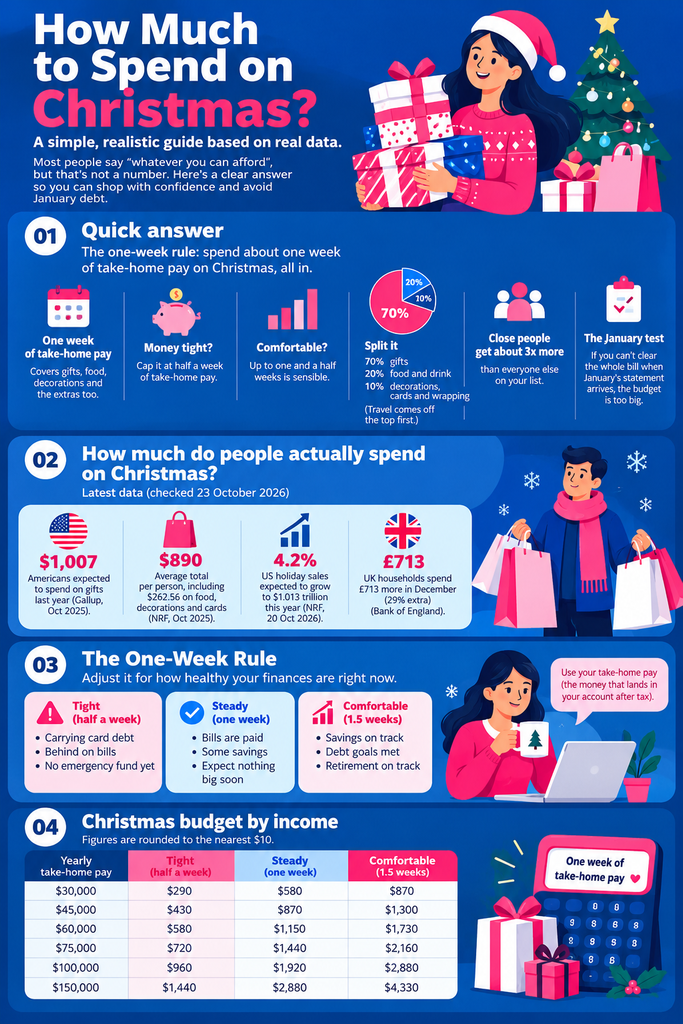
Quick answer
- The one-week rule: spend about one week of take-home pay on Christmas in total. For example, a household taking home $60,000 a year would spend about $1,150 on Christmas.
- Money tight? If you’re paying off card debt or have no emergency fund yet, cap it at half a week of take-home pay.
- Comfortable? When your savings goals are on track, one and a half weeks is a sensible ceiling.
- Split it: roughly 70% on gifts, 20% on food and drink, 10% on decorations, cards and wrapping. However, travel comes off the top first.
- Close people get about three times more than everyone else on your list.
- The January test: if you can’t clear the whole bill when January’s statement arrives, the budget is too big.
How Much Do People Actually Spend on Christmas?
Before you set your own number, it helps to know what normal looks like.
Latest data (checked 23 October 2026)
- Americans expected to spend $1,007 on Christmas gifts last year, almost the same as $1,014 the year before (Gallup, October 2025).
- Shoppers planned to spend $890.49 each on the winter holidays in total, including $262.56 on food, decorations and cards (NRF, October 2025). However, NRF is not publishing a per-person figure this year (NRF).
- Meanwhile, NRF expects US holiday sales to grow 4.2% this year, to $1.013 trillion. 56% of shoppers say the economy will affect their plans, and 43% will start before November (NRF, 20 October 2026).
- UK households spend about £713 more in December than in a typical month, around 29% extra (Bank of England).
- Also, credit cards charged an average of 22.15% interest on accounts that paid interest (Federal Reserve G.19, Q2 2026).
In the United States, the typical adult expects to spend about $1,000 on Christmas gifts alone. Gallup asks this every autumn, and the answer has stayed near that level for three years. In addition to gifts, the National Retail Federation found that people spend roughly $260 more on food, decorations and cards. So the full picture is about $1,250 to $1,300 per adult.
Income makes a big difference, though. For example, in Gallup’s poll, people earning under $50,000 a year expected to spend $651 on Christmas gifts. Meanwhile, middle earners expected $847, and those on $100,000 or more expected $1,479.
Similarly, the UK tells the same story. According to the Bank of England, the average household spends about £713 extra in December. That’s roughly 29% more than a normal month.
What the numbers have in common
So what do those numbers have in common? In both countries, then, Christmas costs the average household about one week of its normal income or spending. For example, the median US household earned $87,460 last year (US Census Bureau). After tax, a week of that is roughly $1,350, which sits right next to the $1,250 to $1,300 above.
That’s where our rule comes from. In other words, it isn’t a guess. Instead, it’s the average turned into a simple target you can apply to your own pay.
The One-Week Rule: How Much to Spend on Christmas Based on Your Income
So here’s the rule in full. Your total budget for Christmas is one week of take-home pay. However, you adjust it for how healthy your finances are right now.
- Tight (half a week): use this when you’re carrying credit card debt, behind on bills, or don’t have an emergency fund yet.
- Steady (one week): use this when you’ve paid your bills, have some savings and expect nothing big soon.
- Comfortable (one and a half weeks): use this only when your savings, retirement and debt goals are all on track.
Take-home pay means what lands in your account after tax and deductions. Also, if you share finances with a partner, use your combined take-home pay and make one shared budget.
Why take-home pay and not salary? Because that’s the money you actually spend. After all, two people on the same salary can take home very different amounts, so a budget should fit the real number.
Christmas budget by income
This table shows how much to spend on Christmas at different incomes. We’ve rounded all figures to the nearest $10, and the same maths also works in pounds, euros or any other currency.
| Yearly take-home pay | Tight (half a week) | Steady (one week) | Comfortable (1.5 weeks) |
|---|---|---|---|
| $30,000 | $290 | $580 | $870 |
| $45,000 | $430 | $870 | $1,300 |
| $60,000 | $580 | $1,150 | $1,730 |
| $75,000 | $720 | $1,440 | $2,160 |
| $100,000 | $960 | $1,920 | $2,880 |
| $150,000 | $1,440 | $2,880 | $4,330 |
Now notice the tight column. For example, a household taking home $30,000 a year would spend about $290 on Christmas. That can feel small next to the national average, but it’s honest. After all, spending the average on a below-average income is exactly how January debt starts.
Christmas Budget Calculator: How Much Should You Spend on Christmas?
First, enter your take-home pay, pick your situation and add the people on your list. The calculator works out your total budget, how to split it, how much each gift can cost, and how much to set aside each week until Christmas. Also, nothing you type leaves your device.
Based on the one-week rule, so it works in any currency. Also, nothing you enter leaves your device.
Rule of thumb only, not financial advice. Gift shares: close people get three times as much as everyone else. Split after travel: gifts 72%, food and drink 18%, decorations, cards and wrap 10% (62% / 28% / 10% if hosting). Card interest example uses the US average rate of 22.15% (Federal Reserve G.19, Q2 2026) over six months.
How Much to Spend on Christmas Gifts per Person
Gifts are usually the biggest part of what people spend on Christmas. Holiday shoppers in the NRF survey put about 70% of their total spending on gifts, so that's the share we use too.
So the fairest way to divide the gift money is with weights. First, give each close person (partner, children, parents) three shares. Then give everyone else (friends, siblings' families, coworkers, teachers) one share each. Finally, add up the shares, divide your gift budget by the total, and you have a price for each person.
Here's what that looks like for a list of 4 close people and 6 others:
| Total Christmas budget | Gift budget (72%) | Each close person | Each other person |
|---|---|---|---|
| $500 | $360 | $60 | $20 |
| $1,000 | $720 | $120 | $40 |
| $1,500 | $1,080 | $180 | $60 |
| $2,500 | $1,800 | $300 | $100 |
Two things stand out. First, a long list shrinks every gift. For example, ten people on a $500 budget means $20 presents for most of them. Secondly, a small cut to the list often helps more than a big cut to the budget.
What to do when the numbers feel too low
If the calculator gives you less than about $10 or £10 per person, change the list rather than buying cheap gifts nobody wants. Instead, try one of these ideas:
- Suggest a Secret Santa for friends, coworkers or the wider family. Everyone buys one better gift instead of eight small ones.
- Buy for the children only. Many families agree that adults stop swapping presents once the kids arrive, so this often feels natural.
- Give one gift per household instead of one per person.
- Give time instead. A cooked dinner, a day of babysitting or a printed photo book can mean more than a shop-bought gift.
How much to spend on Christmas presents for kids
There's no official figure, because every family is different. Still, one popular way to keep it in check is the four-gift rule: something they want, something they need, something to wear and something to read. So it limits the pile without feeling stingy.
It also helps to think beyond toys. Children often remember days out, games played together and traditions far longer than the presents themselves. Our guide to playful learning and intentional parenting also has ideas for gifts that keep giving after the wrapping is gone.
How to Split Your Christmas Budget
Gifts get the headlines, but food, travel and the small extras catch most people out. So here's the split the calculator uses.
- Travel first. If you're driving or flying to see family, take that cost off the top before anything else. After all, it's the least flexible part of Christmas.
- Gifts: about 70% of what's left (72% if you're not hosting).
- Food and drink: about 20% (around 28% if you're hosting the big meal).
- Decorations, cards and wrapping: about 10%.
So, on a $1,150 budget with no travel and no hosting, that's about $830 for gifts, $210 for food and drink, and $115 for everything else.
If travel takes more than about 40% of your total, the calculator will flag it. That's often a sign to agree on smaller gifts this year, rather than cutting the food. Staying with family? Our Airbnb vs hotels cost comparison shows when a rental beats a hotel for a group. Heading to a Christmas market abroad? Then budget for the city's tourist tax too.
The January Test: Spend Only What You Can Pay Off
Before you spend anything on Christmas, try this quick check. When your January card statement arrives, could you pay the whole thing that day?
If the answer is no, the budget is too big. That's because holiday debt is expensive. For example, at the average card rate of about 22%, a $1,000 Christmas paid off over six months costs roughly $66 in interest. That's another gift you didn't get to give.
Buy now, pay later deals can look gentler, but they come with their own traps. The US credit union regulator warns that late fees still apply, and that disputing a faulty item can be harder than with a card (MyCreditUnion.gov). It also points out how easy it is to overspend when every price is split into four.
Another way to feel the real cost of a gift is to price it in hours of work. A $150 present costs a lot more than it seems once you count tax, commuting and work expenses. Our real hourly wage calculator then shows how many hours each purchase really takes.
How to Save for Christmas in the Weeks You Have Left
Once you have your number, the hard part is having the cash ready. So start now, while the weekly amount stays small.
For example, from late October there are about nine weeks until Christmas. So a $1,150 budget means setting aside roughly $128 a week. But start in mid-November and it jumps to about $200 a week.
These habits also make it easier:
- Use a separate account or pot. Move the weekly amount on payday, so you never see it as spending money.
- Then pay with that account only. When it's empty, your Christmas shopping is over.
- Shop from a list with prices next to each name. Cross off each name as you buy, then write down what you actually paid.
- Keep receipts in one place. Then returns, gift receipts and January budgeting all get easier.
Meanwhile, the calculator works out your weekly saving target automatically, based on today's date and anything you've already saved.
12 Ways to Spend Less on Christmas Without Feeling Cheap
A smaller budget doesn't have to mean a smaller Christmas. These ideas cut the bill but keep the warmth.
- Agree on a price limit early. When families set a cap in October, they avoid the awkward mismatch in December.
- Run a Secret Santa for adults, with a clear price limit.
- Buy the big items when they're cheapest. Our month-by-month guide to the best time to buy everything shows which categories really drop in November.
- Check whether a Black Friday deal is real before you buy. Many "discounts" match prices from earlier in the year, as our look at whether Black Friday deals are actually cheaper explains.
- Give gift cards wisely. After all, they topped wish lists in the latest NRF survey, at 47%. So a gift card isn't lazy if someone has asked for one.
- Host a potluck. When each guest brings one dish, the food bill can drop by half.
- Reuse decorations. Then buy cards, wrap and ornaments in the January sales for next year.
- Swap gifts for experiences. A shared day out, a cooking lesson or a long walk and lunch can mean more than another object.
- Make one thing yourself. Cookies, a playlist, a framed photo or a handwritten letter often get the warmest reaction, because they show effort.
- Delete saved cards from shopping apps until January. Those few seconds of friction also stop a lot of impulse buys.
- Unsubscribe from sale emails for the season. After all, offers you never see can't tempt you.
- Plan one quiet, free tradition. A film night, a lights walk or a morning off screens costs nothing but still anchors the season. Our guide to slow living also has more ideas.
How to Talk to Family About Spending Less
Often, though, the hardest part of a smaller Christmas is the conversation, not the maths. These steps make it easier, especially if money is a sensitive topic.
- Go early. October or early November is ideal, before anyone has bought anything.
- Make it about the plan, not about money worries. For example: "We're trying to keep Christmas simpler this year. Could we do a Secret Santa for the adults?"
- Offer an alternative. People accept a change more easily when there's something to say yes to.
- Expect relief. That's because many relatives are quietly feeling the same pressure and are glad someone spoke first.
Also, if money talk tends to get tense in your family, our guide to healthy boundaries and better communication has scripts that help.
The season can also be hard on mental health, especially when money is tight. A two-minute daily mental health check-in is a simple way to notice stress before it builds up. Finally, if the darker days hit your mood, here's how to tell seasonal affective disorder from the winter blues.
Frequently Asked Questions
How much should I spend on Christmas?
A good rule is to spend about one week of your take-home pay on Christmas in total, covering gifts, food and decorations. However, spend half a week if you have card debt or no emergency fund, and up to one and a half weeks if your savings goals are on track.
What is the average amount people spend on Christmas?
In the US, adults expected to spend about $1,007 on Christmas gifts last year, according to Gallup. In addition, food, decorations and cards add roughly $260 more, based on NRF data. Meanwhile, UK households spend about £713 more in December than in a typical month, according to the Bank of England.
What percentage of my income should I spend on Christmas?
Spend about 2% of your yearly take-home pay on Christmas, which is the same as one week's pay. However, if money is tight, aim for about 1%. On the other hand, if your finances are in great shape, up to about 3% is reasonable.
How much should I spend on each family member?
Give close family (partner, children, parents) about three times as much as everyone else on your list, so the people who matter most get more. For example, on a $1,000 budget with 4 close people and 6 others, that works out at about $120 for each close person and $40 for each of the others.
How much should I spend on Christmas gifts for coworkers?
Usually very little, because most workplaces keep it simple. For example, a small treat or a group Secret Santa with a $10 to $25 limit is normal. Also, there's no need to buy for your manager, since gifts flowing up the chain can feel awkward.
Is it OK to put Christmas on a credit card?
It's fine if you pay the full balance when the January statement arrives. But if you can't, the interest adds up quickly. For example, at around 22% interest, a $1,000 Christmas paid off over six months costs about $66 extra.
How do I tell my family I'm spending less this Christmas?
Raise it early, frame it as a plan rather than a money problem, and suggest an alternative such as a Secret Santa or gifts for the children only. Most relatives feel relieved, because many are feeling the same pressure.
When should I start saving for Christmas?
As early as you can, because the weekly amount stays small. For instance, starting in January means saving about a fiftieth of your budget each week. From late October you have about nine weeks, so a $1,150 budget means setting aside roughly $128 a week.
The Bottom Line
So, how much to spend on Christmas? Start with one week of take-home pay, then adjust it. Cut it to half a week if money is tight, and stretch to one and a half weeks only if everything else is on track.
Then take travel off the top, split the rest about 70/20/10 between gifts, food and extras, and give close people about three times more than everyone else. Finally, save the money in advance and make sure you could pay the whole bill in January.
After all, nobody measures Christmas by the pile under the tree. Instead, a budget you can afford leaves room for the parts people actually remember: time together, good food and a January without regret.
Sources
- Gallup, Holiday Shoppers Plan to Spend Briskly (October 2025): https://news.gallup.com/poll/697061/holiday-shoppers-plan-spend-briskly.aspx
- National Retail Federation, Consumers to Spend Second-Highest Amount on Record (October 2025): https://nrf.com/media-center/press-releases/consumers-to-spend-second-highest-amount-on-record-according-to-nrf-holiday-survey
- National Retail Federation, Affordability Shapes Winter Holiday Shopping (20 October 2026): https://nrf.com/media-center/press-releases/affordability-shapes-winter-holiday-shopping-according-to-nrf-holiday-survey
- National Retail Federation, Winter Holiday FAQs: https://nrf.com/research-insights/holiday-data-and-trends/winter-holidays/winter-holiday-faqs
- Bank of England, How much do we spend at Christmas?: https://www.bankofengland.co.uk/explainers/how-much-do-we-spend-at-christmas
- US Census Bureau, Income in the United States: 2025 (September 2026): https://www.census.gov/library/publications/2026/demo/p60-289.html
- Federal Reserve, G.19 Consumer Credit (7 October 2026): https://www.federalreserve.gov/releases/g19/current/default.htm
- MyCreditUnion.gov (NCUA), Buy Now, Pay Later: https://mycreditunion.gov/life-events/consumer-loans/buy-now-pay-later



Join the Lifoholic community conversation. We welcome thoughtful insights, questions, and authentic experiences from our readers.
RECOMMENDED DISCUSSIONS
ColorOS 17 Update: Is Your Phone Getting It, When, and What Actually Changes
Are Black Friday Deals Actually Cheaper? What Price Tracking Shows