

You found a great hotel price for Barcelona, booked it, and then at check-in the receptionist asks for another €67. Nobody tricked you. That’s the tourist tax, and in a growing number of European cities it’s charged on top of the price you booked and paid at the desk.
Tourist taxes (also called city taxes, visitor levies or overnight stay taxes) have risen fast. Barcelona doubled its rates in April 2026, Edinburgh started the UK’s first city-wide levy in July 2026, Vienna raised its rate the same month, and Amsterdam now takes 12.5% of your room price.
In our Airbnb vs hotels cost guide we showed that the nightly rate is the wrong number to compare. Tourist tax is one of the biggest reasons why. This guide gives you every current rate for 10 popular cities, explains the rules that change what you pay (age limits, night caps, per-room charges), and includes a free calculator for your own trip.
Quick answer
- Most European cities charge a tourist tax, either a fixed amount per person per night (Paris, Rome, Barcelona, Lisbon) or a percentage of your room price (Amsterdam, Berlin, Vienna, Edinburgh).
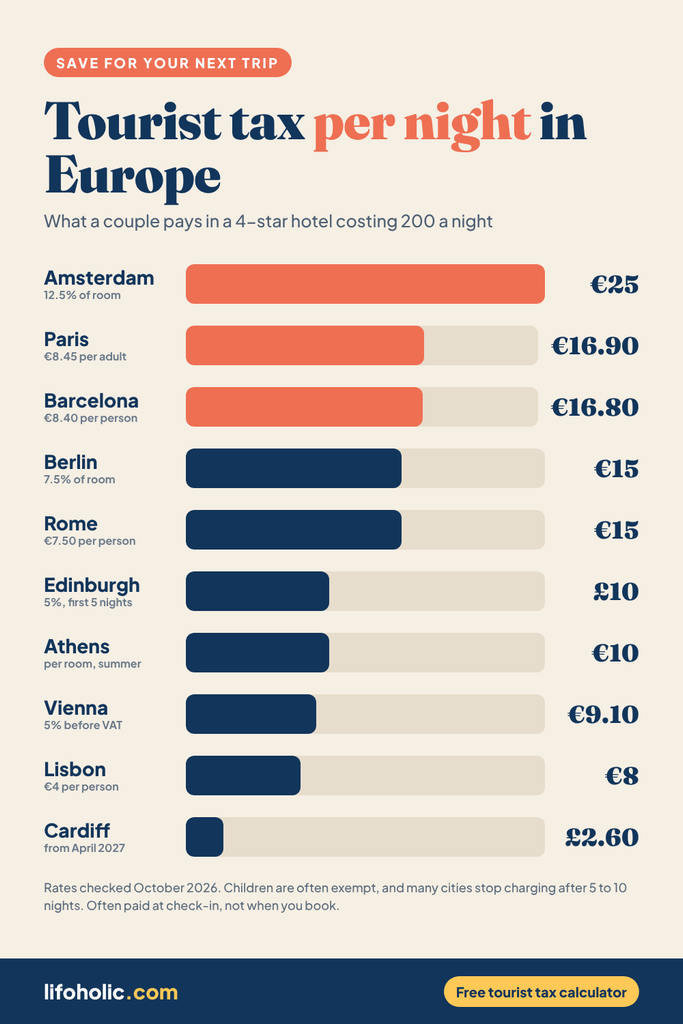
- The most expensive for a typical couple in a 4-star hotel is Amsterdam, at up to €25 a night on a €200 room. Barcelona and Paris come next at about €17 a night for two.
- It’s often not in the price you booked. Many hotels and rentals collect it at check-in or ask for it separately, so check the booking page for “city tax excluded.”
- Children are usually exempt, but the age varies: under 10 in Rome, under 13 in Lisbon, under 17 in Barcelona, and under 18 in Paris.
- Long stays pay less per night, because many cities stop charging after a set number of nights: 5 in Edinburgh, 7 in Barcelona and Lisbon, 10 in Rome.
Latest changes (checked 22 October 2026)
- Barcelona doubled the Catalan tourist tax on 1 April 2026, and the city’s own surcharge is €5 a night in 2026, rising by €1 a year to €8 by 2029 (Catalan municipalities association, 3Cat).
- Edinburgh has charged a 5% visitor levy since 24 July 2026, on the first 5 nights of a stay (City of Edinburgh Council).
- Vienna raised its tax from 3.2% to 5% on 1 July 2026, and it rises to 8% on 1 July 2027 (Vienna Chamber of Commerce).
- Paris published new rates from 1 January 2026 (Paris je t’aime).
- Amsterdam keeps 12.5% through 2026, and the city plans to raise it gradually towards 20% by 2031 (CMS law firm, IamExpat).
- Wales starts a visitor levy of £1.30 per person per night from 1 April 2027, beginning in Cardiff (Welsh Government).
Tourist Tax by City: The Full Table
Here’s what you pay per night in each city, from the most to the least expensive for a typical couple. The last column uses the same example everywhere: two adults in a 4-star hotel that costs 200 a night in the local currency.
| City | How it’s charged | Rate per night | Couple, 4-star, 200 a night |
|---|---|---|---|
| Amsterdam | % of room price | 12.5% | up to €25.00 |
| Paris | Per adult, by star rating | €5.53 (3★) to €11.70 (5★); rentals 5% of the price per person, max €15.93 | €16.90 |
| Barcelona | Per person, by type, incl. city surcharge | €7.00 (3★ and below) to €12.00 (5★); rentals €9.50 | €16.80 |
| Berlin | % of room price | 7.5% | up to €15.00 |
| Rome | Per person, by star rating | €6 (3★) to €10 (5★); short-term rentals €6 | €15.00 |
| Edinburgh | % of room price | 5% (first 5 nights only) | £10.00 |
| Athens (all of Greece) | Per room, by star rating and season | €5 (3★) to €15 (5★) April to October; rentals €8 | €10.00 (summer), €3.00 (winter) |
| Vienna | % of the price excluding VAT and breakfast | 5% (8% from July 2027) | about €9.10 |
| Lisbon | Per person, flat | €4 (first 7 nights only) | €8.00 |
| Cardiff (from April 2027) | Per person, flat | £1.30 (hostels and campsites 75p) | £2.60 |
“Up to” means the city works out the tax on the room price before VAT in some cases, so your real charge can be a little lower. The Vienna figure is our estimate after taking off 10% VAT. Hotels may round slightly differently.
How Tourist Taxes Work (and Why Two Cities Can Be So Different)
There are three ways cities charge, and they change which trip comes out cheapest.
1. A fixed amount per person per night. Paris, Rome, Barcelona and Lisbon charge each guest a set amount for each night, usually higher for more stars. A family of four pays four times what a solo traveller pays, even in the same room. This is where age exemptions matter most.
2. A percentage of the room price. Amsterdam, Berlin, Vienna and Edinburgh take a percentage of what you pay for the room. It doesn’t matter how many people share it, but the more expensive your room, the more you pay. Four friends splitting a €300 apartment in Amsterdam pay the same tax as a couple in it.
3. A charge per room. Greece charges a “climate resilience fee” per room or rental per night, which changes with the season. It’s €10 a night for a 4-star hotel from April to October and €3 from November to March (Greek City Times).
So the same holiday can cost very different amounts in tax. A family of four in a 3-star Rome hotel pays €12 a night (the parents only) if the children are under 10, but €24 if they’re teenagers. The same family in a €200 Amsterdam apartment pays up to €25 regardless of their ages.
The Rules That Change What You Pay
Age exemptions
| City | Who doesn’t pay |
|---|---|
| Paris | Under 18 |
| Barcelona | Under 17 |
| Lisbon | Under 13 |
| Rome | Under 10 |
| Cardiff (Wales) | Under 18 at the lower 75p rate; check the higher rate with your host |
| Amsterdam, Berlin, Vienna, Edinburgh, Greece | No age exemption in practice, because the tax is on the room, not the person |
Night caps
Some cities stop charging after a certain number of nights, which makes long stays cheaper per night:
- Edinburgh: first 5 consecutive nights
- Barcelona: first 7 nights
- Lisbon: first 7 nights
- Rome: first 10 nights
- Amsterdam, Berlin, Vienna, Paris, Greece: no cap. Berlin dropped its old 21-night limit in January 2025 and now charges business travellers too (Berlin Senate Department for Finance).
Season
Greece is the main place where the season matters, with the fee dropping by about 70% from November to March. Elsewhere, the rate is the same all year.
Free Calculator: How Much Tourist Tax Will You Pay?
Pick your city and accommodation, enter your nights and guests, and the calculator works out your total, including the age exemptions and night caps above.
Is the Tourist Tax Included in My Airbnb or Hotel Price?
Sometimes, and it’s the most common surprise at check-in.
- Hotels in Europe often show it as “excluded.” Look for “city tax,” “tourist tax” or “local tax” under the price breakdown before you book. If it says excluded, budget for paying it at the desk, often by card but sometimes in cash.
- Airbnb collects the tax automatically in some cities and adds it to your total, but in others the host collects it separately (Airbnb Help Centre). Read the listing’s “house rules” or “additional charges,” or message the host before booking.
- Package holidays and tours may or may not include it. Check the “not included” list.
That’s why we recommend comparing the full trip cost, not the nightly rate. Our Airbnb vs hotels guide has a five-step method for doing exactly that, including cleaning fees, resort fees and parking.
Airbnb or Hotel: Which Pays Less Tourist Tax?
It depends on the city, and in some it decides which is cheaper.
- Barcelona: a holiday rental pays €9.50 per person per night, more than a 4-star hotel at €8.40. For a couple staying 7 nights, that’s €15.40 more in tax for the rental.
- Rome: a short-term rental pays €6 per person, the same as a 3-star hotel and €1.50 less than a 4-star.
- Paris: unclassified rentals pay 5% of the price per person per night, capped at €15.93. On a €250 apartment for two, that’s €6.25 per person, less than a 4-star hotel’s €8.45. On a €400 apartment for two it’s €10 per person, which is more.
- Amsterdam, Berlin, Vienna, Edinburgh: it’s a percentage either way, so the cheaper place to stay also pays less tax.
- Greece: a short-term rental pays €8 a night in summer, less than a 4-star hotel (€10) but more than a 3-star (€5).
If you’re travelling as a group, a per-person tax adds up fast in a rental. If you’re in an expensive room, a percentage tax hurts more.
The Venice Day-Trip Fee (Not a Hotel Tax, But You Might Pay It)
Venice is different. If you visit for the day without staying overnight, you may need to pay an access fee on busy days. In 2026 it applied on 60 days between 3 April and 26 July, from 8:30 am to 4 pm, at €5 if you booked at least four days ahead or €10 if you booked later. Under-14s and people staying overnight in the city were exempt, because overnight guests pay the regular tourist tax instead (The Local Italy).
If you’re planning Venice for 2027, check the new calendar before you go, and book early to pay the lower price.
6 Legal Ways to Pay Less Tourist Tax
- Stay longer in one place. In cities with night caps (Edinburgh, Barcelona, Lisbon, Rome), nights after the cap are tax-free.
- Go one star lower. In star-based cities, dropping from 4 to 3 stars saves €2.92 per adult per night in Paris and €1.50 per person in Rome, and often the room is cheaper too.
- Stay just outside the city. Barcelona’s €5 surcharge only applies within the city itself, and many cities’ rates stop at the city boundary. Check transport costs first, as we explain in the Airbnb vs hotels guide.
- Travel off-season in Greece. The fee drops by about 70% from November to March.
- Bring the right ID for children. Exemptions are usually claimed at check-in, so have passports ready to show ages.
- Book Venice day trips early. It halves the fee.
Remember the tax is usually small next to the room itself. Don’t book a place far from everything to save €10 and then spend €40 on taxis.
What’s Changing Next
- Vienna: rises from 5% to 8% on 1 July 2027.
- Barcelona: the city surcharge goes up by €1 a year until it reaches €8 in 2029. The Catalan regional tax for the rest of Catalonia rises again in April 2027.
- Amsterdam: the city plans gradual increases towards 20% by 2031, starting no earlier than January 2027.
- Wales: £1.30 per person per night from 1 April 2027, starting in Cardiff, with other councils consulting.
We’ll update this page as new rates are confirmed.
Frequently Asked Questions
Which European city has the highest tourist tax?
For most travellers, Amsterdam, at 12.5% of the room price. On a €200 room that’s up to €25 a night. For luxury hotels, Paris palace hotels (€15.93 per adult per night) and Barcelona 5-star hotels (€12 per person per night) are among the highest fixed rates.
Do I have to pay tourist tax in cash?
Not usually. Most hotels take card payments for the tax at check-in or check-out. Some smaller guesthouses and rental hosts still ask for cash, so check with the host or keep some local currency for the first night.
Is tourist tax included in the Airbnb price?
In some cities Airbnb collects and adds it to your total automatically. In others, the host collects it separately, sometimes on arrival. Check the listing’s additional charges or ask the host before you book.
Do children pay tourist tax in Europe?
It depends on the city. Children are exempt under 18 in Paris, under 17 in Barcelona, under 13 in Lisbon and under 10 in Rome. In cities that charge a percentage of the room price, such as Amsterdam and Berlin, the tax is the same however many children are with you.
How much is the tourist tax in Barcelona?
From 1 April 2026, including the €5 city surcharge, it’s €12 per person per night for 5-star hotels, €8.40 for 4-star hotels, €9.50 for holiday rentals and €7 for most other accommodation. Under-17s are exempt, and only the first 7 nights are charged.
How much is the tourist tax in Paris?
For 2026, per adult per night: €11.70 in 5-star hotels, €8.45 in 4-star, €5.53 in 3-star and €3.25 in 2-star. Unclassified rentals pay 5% of the price per person per night, up to €15.93. Under-18s don’t pay.
Does the UK have a tourist tax?
Edinburgh introduced the UK’s first city-wide visitor levy on 24 July 2026: 5% of the accommodation cost for the first 5 nights. Wales will charge £1.30 per person per night from 1 April 2027, starting in Cardiff. Most of England has no general tourist tax.
Why do cities charge tourist taxes?
To pay for the costs tourism adds: cleaning, transport, policing and maintaining historic centres. Some cities, such as Barcelona and Amsterdam, also use higher taxes to limit visitor numbers and fund housing for residents.
The Bottom Line
A tourist tax rarely ruins a holiday budget, but it can easily add €50 to €150 to a week away, and it’s often left out of the price you booked. Before you book, check whether it’s included, work out your total with the calculator above, and remember the rules that work in your favour: children’s exemptions, night caps and the off-season in Greece.
For the full picture of what a trip really costs, read our Airbnb vs hotels cost comparison, see when to book flights and travel for the lowest prices, and pack smarter with our guide to the best travel backpacks.
Sources
- Paris je t’aime (Paris tourist office): Taxe de séjour Paris 2026 rate grid
- Associació Catalana de Municipis: Note on the law amending the tax on stays in tourist establishments (Llei 2/2026)
- 3Cat: Tourist tax increase approved: prices in Barcelona and the rest of Catalonia
- City of Edinburgh Council: Edinburgh declares Scotland’s first visitor levy
- Welsh Government: Visitor levy Wales
- Vienna Chamber of Commerce (WKO): Current Ortstaxe Vienna
- Berlin Senate Department for Finance: FAQ Übernachtungsteuer (City Tax)
- CMS: Amsterdam tightens the screw on tourism: a further update
- IamExpat: Amsterdam to raise tourist tax to 20% by 2031
- Lisbon City Council: Taxa Municipal Turística
- QuiFinanza: Tourist tax: where you pay the most (Rome rates)
- Greek City Times: Greece increases climate resilience fee for hotels and short-term rentals
- The Local Italy: Calendar: when you need to pay a fee to visit Venice in 2026
- Airbnb Help Centre: Occupancy tax collection and remittance by Airbnb


Join the Lifoholic community conversation. We welcome thoughtful insights, questions, and authentic experiences from our readers.
RECOMMENDED DISCUSSIONS
Airbnb vs Hotels: Which Is Actually Cheaper
The 7 Most Scenic Coastal Drives Around the World