

The short answer
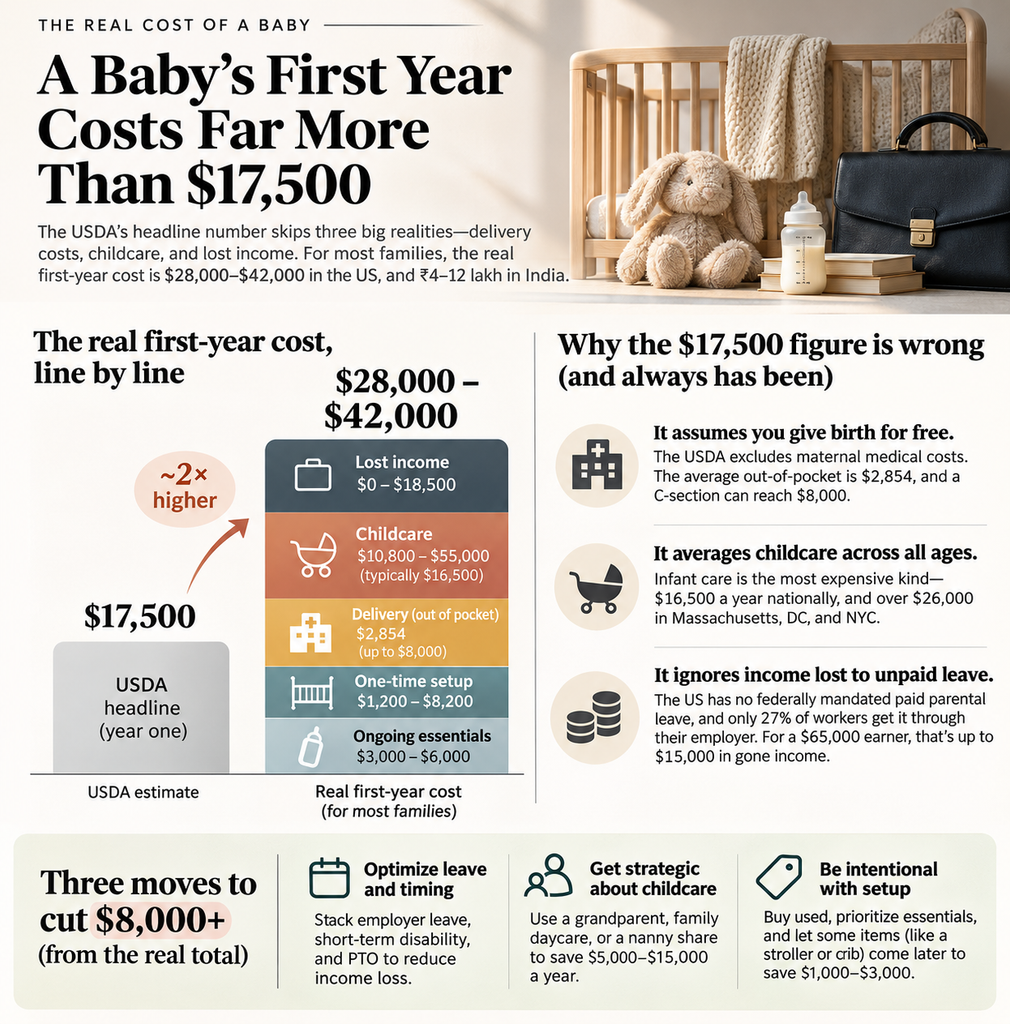
The USDA’s often-cited figure for a baby’s first year sits around $17,500. Parents who actually tracked every expense and included the two biggest line items the headline leaves out — out-of-pocket delivery and lost income — report $28,000 to $42,000 in the US, and ₹4 lakh to ₹12 lakh in India.
The gap between the official number and the real one isn’t waste. It’s three categories no spreadsheet asks about:
- The delivery bill after “good” insurance (median $2,854 out of pocket)
- Infant childcare ($16,500 a year nationally; over $26,000 in Massachusetts, DC and NYC)
- The unpaid-leave gap (only 27% of US workers have paid family leave through their employer)
This piece breaks down the real cost, gives you a calculator that takes 90 seconds to fill in with your own numbers, and shows you three moves that cut the total by $8,000+ without anyone noticing.
Why the $17,500 figure is wrong (and always has been)
The USDA last published its detailed “Cost of Raising a Child” report based on 2015 data, with annual inflation adjustments bolted on since. Adjusted to 2026 prices, year-one costs sit around $17,500.
The problem isn’t inflation. It’s what the number counts.
- It assumes you give birth for free. The USDA’s figure excludes maternal medical costs. In reality, the average out-of-pocket for a vaginal delivery with employer insurance is $2,854. A C-section with a high-deductible plan can reach $8,000.
- It averages childcare across all ages. Infant care is the most expensive kind. A spreadsheet that smooths it into a “birth to 17” average makes year one look cheaper than it is.
- It ignores income lost to unpaid leave. The US is one of six countries in the world with no federally mandated paid parental leave. FMLA covers 12 unpaid weeks for about 60% of workers. For a parent earning $65,000, that’s up to $15,000 of gone income.
- It ignores one-time setup. Cribs, car seats, a stroller, bottles, a breast pump, the first 20 onesies: $1,500 at a minimum, $4,500 if you buy new.
Add those back, and the headline figure doubles.
The real first-year cost, line by line
Here is what first-year spending actually looks like in 2026, from the most recent industry data.
Birth and medical
| Line | US median | Range |
|---|---|---|
| Vaginal delivery (before insurance) | $18,865 | $10,000–$30,000 |
| C-section (before insurance) | $26,280 | $15,000–$45,000 |
| Delivery out of pocket, employer PPO | $2,854 | $1,500–$5,000 |
| Delivery out of pocket, HDHP | $5,000 | $4,000–$8,000 |
| Delivery out of pocket, Medicaid | $50 | $0–$200 |
| Prenatal visits (co-pays) | $500 | $200–$1,000 |
| First-year pediatric co-pays | $600 | $360–$960 |
Reality check: 1 in 3 US births is a C-section. If you have an HDHP and an unplanned C-section, your delivery alone can run $8,000 before you leave the parking lot.
One-time setup
| Line | Budget | Realistic | Premium |
|---|---|---|---|
| Crib + mattress | $200 | $500 | $1,200 |
| Car seat (infant + convertible) | $200 | $450 | $900 |
| Stroller | $150 | $400 | $1,200 |
| Breast pump (often covered by insurance) | $0 | $0 | $400 |
| Bottles, bibs, swaddles, monitor | $150 | $350 | $800 |
| Nursery (paint, dresser, rocking chair) | $300 | $800 | $2,500 |
| Clothes for year one | $200 | $600 | $1,200 |
| Total setup | $1,200 | $3,100 | $8,200 |
Monthly ongoing costs
| Line | Monthly | Annual |
|---|---|---|
| Diapers and wipes | $80–$120 | $960–$1,440 |
| Formula (if formula-feeding) | $100–$200 | $1,200–$2,400 |
| Baby food / purees | $40–$80 | $480–$960 |
| Clothing (as they grow) | $50–$100 | $600–$1,200 |
| Health insurance premium (adding baby) | $120–$300 | $1,440–$3,600 |
| Pediatric co-pays | $30–$80 | $360–$960 |
Childcare: the number that changes everything
| Option | Monthly | Annual |
|---|---|---|
| One parent at home | $0 | $0 (plus lost income) |
| Grandparent or relative | $0–$500 | $0–$6,000 |
| Family daycare | $900 | $10,800 |
| Daycare center (national average) | $1,375 | $16,500 |
| Daycare center (Massachusetts, NYC, SF) | $2,200+ | $26,400+ |
| Nanny share | $1,500–$2,300 | $18,000–$28,000 |
| Full-time nanny | $2,900–$4,600 | $35,000–$55,000 |
Infant daycare costs more than in-state college tuition in 36 US states. In Massachusetts it costs 73% more than UMass Amherst.
The number nobody adds: income lost to unpaid leave
The US is one of a handful of countries worldwide with no mandated paid parental leave. Here is what that costs a family earning the US median household income ($80,000), depending on their employer’s policy.
| Employer policy | Weeks paid at 100% | Income lost over 12 weeks |
|---|---|---|
| Fortune 500 generous (Netflix, Google, Microsoft) | 16–52 | $0 |
| Typical large employer | 6 | $8,800 |
| Small employer with short-term disability | 2 | $14,700 |
| No paid leave, FMLA only | 0 | $18,500 |
| No FMLA (under 50 employees) | 0 | $18,500 + job risk |
Only 27% of US workers get any paid family leave through their employer, according to the Bureau of Labor Statistics. Everyone else uses savings, PTO, short-term disability or unpaid leave.
Latest data box (last updated 7 November 2026)
- USDA baseline (inflation-adjusted to 2026 prices): $17,500 year one.
- WealthVieu “Cost of Having a Baby in America” (March 2026 update): $18,000–$32,000 year one.
- National infant daycare average (Wonderschool 2026 report): $1,560–$1,800 per month.
- Bureau of Labor Statistics (March 2026): 27% of US private-sector workers have access to paid family leave.
- Bankrate motherhood penalty analysis (Census 2024 data): full-time mothers earn $17,000 less per year than fathers; lifetime loss of $500,000+ over 30 years.
- Median out-of-pocket for an employer PPO vaginal delivery (Peterson-KFF Health System Tracker): $2,854.
Refresh in March each year (USDA, BLS data releases) and after any major Medicaid or ACA policy change.
Your personal baby cost (calculator)
Your first-year baby cost, calculated
Enter five numbers. The tool shows your total, your out-of-pocket at the hospital, and where to cut first.
Enter your delivery type, insurance tier, feeding plan, childcare plan and employer leave policy. The tool calculates:
- Your first-year total
- The “Monday morning hospital bill” (out-of-pocket delivery only)
- The childcare share
- The income gap during leave
- Your three biggest line items (so you know where cutting matters)
The three biggest numbers people forget
1. The insurance deductible resets twice
If your baby is born in November, you pay your deductible for that calendar year. In January the deductible resets and the baby’s one-month pediatric visit, vaccinations and any sick visit hit the new deductible. Planning a delivery for early in a calendar year is worth $2,000–$4,000 for families on a high-deductible plan.
2. Childcare waitlists cost $500 before you’ve seen the inside
Highly rated infant centers in cities have waitlists of 6–18 months. The deposit to hold a spot is typically $100–$500 — non-refundable. Smart parents pay deposits at two or three centers before birth, because 50% of centers that call back have moved their start date or their rate.
3. The career cost is a one-time shock and a 30-year drag
Bankrate’s 2026 analysis of Census data put the full-time motherhood gap at $17,000 a year and the 30-year total at over $500,000. Most of that comes from slower promotion after returning, not from the leave itself.
Two moves cut it:
- Negotiate your return in writing before leave starts, including specific project ownership.
- Keep a visible side output (writing, a specific deliverable, a conference talk) during leave if health and family allow.
Neither is possible for every parent. But both move the number from “$500,000” to “much smaller than that.”
How to cut $8,000 from year one without anyone noticing
- Compare delivery costs before you pick a hospital. Within the same metro area, prices for the same vaginal delivery vary by 5x. Ask the billing office for the cash price and the insurance-negotiated rate for CPT code 59400 (vaginal) or 59510 (C-section).
- Max your HSA contribution before the baby arrives. Delivery costs qualify. In 2026 you can put up to $4,400 (single) or $8,750 (family) in pre-tax. If you’re in the 24% bracket, the HSA saves $2,100.
- Buy a convertible car seat, not two seats. It works from birth to age 4+. Infant-only seats are convenient but cost $300 extra you’ll replace in 12 months anyway.
- Skip the nursery. Babies don’t sleep in the nursery for the first 6 months. A corner of your bedroom with a bassinet ($80–$150) works.
- Use a pediatric dental/vision rider instead of a separate plan. Most pediatric visits run through medical. Dental starts at age 1, and most pediatric dental is cheap.
- Put the baby on the lower-income parent’s insurance. It’s often cheaper to add them to a family plan than to pay premiums on two.
- Get the breast pump through insurance. The ACA requires it, and they run $300–$400 retail.
Combined, these moves typically save a middle-income family $6,000–$10,000 in year one.
What babies really cost in other countries
| Country | Year one (rough) | What’s different |
|---|---|---|
| US | $18,000–$32,000 | Delivery out of pocket, no paid leave, expensive childcare |
| UK | £7,000–£15,000 | NHS birth free; 39 weeks statutory maternity pay |
| Germany | €8,000–€14,000 | Free delivery; 14 months paid parental leave at 65% salary (split) |
| Canada | C$12,000–C$20,000 | Free delivery; 12 months paid leave at 55% (EI) |
| India | ₹4–₹12 lakh | Private delivery ₹60k–₹2 lakh; nanny/maid ₹10–25k/month; 26 weeks paid for women in large firms |
| Australia | A$15,000–A$25,000 | Medicare covers public births; 22 weeks paid leave |
Delivery alone is the single biggest variable. In countries with universal coverage, year-one costs roughly halve.
The money you need in the bank before baby
A sensible pre-baby runway is three line items, not one:
- Out-of-pocket maximum for your health plan ($4,000–$9,000 depending on tier). Delivery can and does hit the full OOP max.
- Three months of baseline expenses (rent/mortgage, food, insurance, debt minimums) to cover the unpaid-leave gap.
- $3,000 for setup (car seat, crib, stroller, clothes) regardless of what friends give you.
For a typical US household this is $18,000–$25,000 sitting in a high-yield savings account before conception if you have the option to plan.
If you don’t — most parents don’t plan the timing precisely — the three categories to prioritise are the OOP max, two months of baseline expenses, and a $500 car seat. Everything else can wait, be bought used, or come from a registry.
FAQ
How much does it really cost to have a baby in the first year?
In the US, $18,000 to $32,000 is the realistic range from current 2026 data, depending on your insurance tier, childcare choice and parental leave policy. The commonly cited USDA figure of $17,500 leaves out delivery costs, lost income during leave and the premium for infant-specific childcare.
How much do you pay out of pocket to have a baby with insurance?
The median out-of-pocket for a vaginal delivery on an employer PPO is $2,854, according to the Peterson-KFF Health System Tracker. On a high-deductible health plan it’s $4,000–$8,000. Medicaid births are typically $0–$200.
How much does infant daycare cost?
Nationally, $1,560–$1,800 per month in 2026 (Wonderschool 2026 report). In high-cost cities like Boston, NYC and San Francisco, over $2,200 per month. Family daycare runs about 30% less than a center. A full-time nanny runs $35,000–$55,000 a year.
How much money should I save before having a baby?
Three buckets: the full out-of-pocket maximum on your health plan ($4,000–$9,000), three months of baseline household expenses to cover unpaid leave, and $3,000 for setup. For most US households that totals $18,000–$25,000.
Is it cheaper to have a baby in a hospital or at home?
Hospital deliveries are more expensive in sticker price but almost always cheaper for insured parents because insurance negotiates the rate and covers most of it. A home birth with a midwife runs $3,000–$6,000, usually not covered by insurance, so it’s often more expensive out of pocket than a covered hospital birth.
What’s the biggest hidden cost of having a baby?
Lost income during unpaid parental leave. The US is one of the few countries without mandated paid leave. Only 27% of workers have access to paid family leave through their employer. For a median-income household, 12 weeks of unpaid leave is roughly $18,500 in gone income.
How much does raising a child cost in total until age 18?
USDA figures adjusted to 2026 prices put the total at around $310,000 to $340,000 for a middle-income US family, excluding college. Add roughly $108,000 for in-state public university or $240,000 for a four-year private college.
Related reading on Lifoholic
- How Much Emergency Fund Do You Actually Need?
- How to Choose a Health Plan: HMO vs PPO vs HDHP
- Your Real Hourly Wage Calculator
- How to Negotiate a Salary Raise
- One-Person Business: The True Expense Breakdown
- How to Start Homeschooling
- Playful Learning: Intentional Parenting
- Things You Wish You Learned in School
External sourcesYour personal baby cost (calculator)
- US Department of Agriculture — Expenditures on Children by Families (historical baseline, inflation-adjusted)
- Peterson-KFF Health System Tracker — Health costs associated with pregnancy, childbirth and postpartum care
- Bureau of Labor Statistics — National Compensation Survey: Employee Benefits in the United States (paid leave access, March 2026)
- US Census Bureau — Median earnings by parental status
- Bankrate — Motherhood Penalty Report 2026
- Child Care Aware of America — The US and the High Cost of Child Care (2026 report)



Join the Lifoholic community conversation. We welcome thoughtful insights, questions, and authentic experiences from our readers.
RECOMMENDED DISCUSSIONS
How Much to Spend on Christmas: The One-Week Rule (and a Free Calculator)
How to Start Homeschooling: The Complete Guide for Parents Who Don’t Know Where to Begin