
How much do you spend on subscriptions each month? Take a guess before you read on, because the number in your head is probably wrong.
In a survey by C+R Research, people first guessed they spent about $86 a month. Then they listed every service one by one, and the real total was $219. That’s more than two and a half times the guess.
Meanwhile, prices keep rising. Netflix, Spotify, YouTube Premium, Apple Music, Peacock, Disney+ and Hulu have all raised US prices since January. So this guide gives you a calculator to find your real total, the current price of every big service, and a simple test for which ones to cancel.
- Most people spend 2.5 times what they think. Survey respondents guessed $86 a month but really paid $219. So multiply your own guess by 2.5 for a rough reality check. We call it the 2.5x rule.
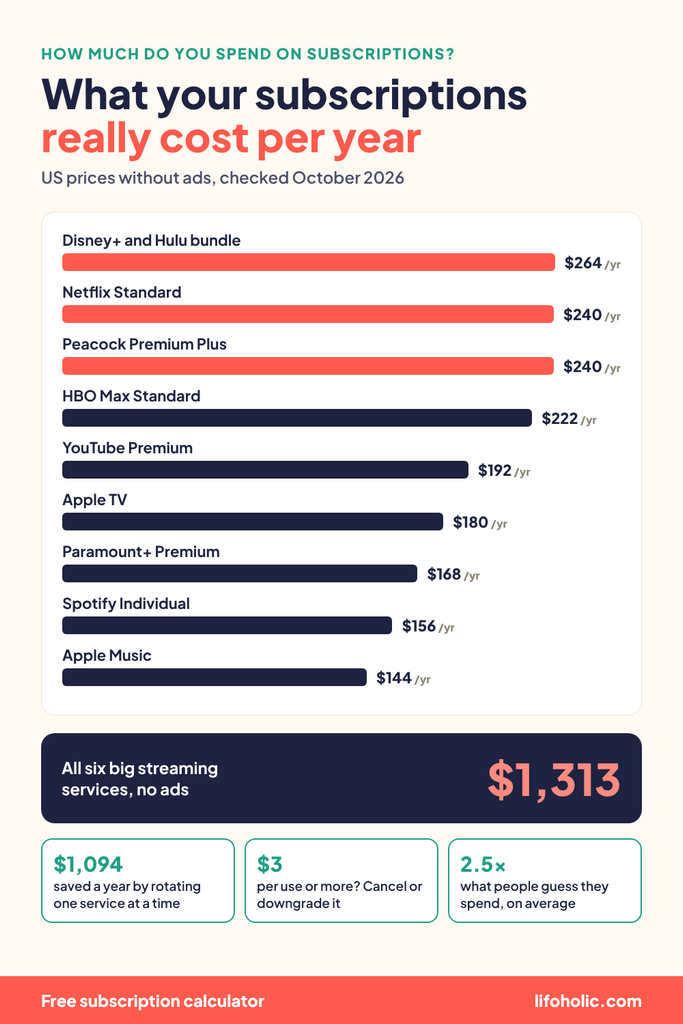
- Every major streaming service at once costs $1,313 a year without ads, or $839 with ads, at today’s US prices.
- Use the $3 per use test. Divide the monthly price by how many times you used it last month. If it costs more than $3 per use, cancel it or downgrade.
- Rotating streaming services saves about $1,094 a year. Keep one at a time, binge what you want, then switch.
- $100 a month in subscriptions is $12,000 over ten years. Invested at 7% a year instead, it would grow to about $17,300.
Subscription Calculator: How Much Do You Spend on Subscriptions?
First, type your guess. Next, tick every service you pay for and pick your plan. The prices are current US prices, but you can change any of them to match your bill.
Optionally, add how many times you used each one last month. The calculator then flags anything that costs more than $3 per use. Finally, copy your result and see how close your guess was.
Did the answer to how much you spend on subscriptions surprise you? If so, you’re in good company. Below, we explain why almost everyone guesses low and how to cut the bill without giving up the services you love.
How Much Do People Spend on Subscriptions on Average?
The most quoted study comes from C+R Research. It surveyed 1,000 US adults in 2022 and found these numbers:
- People guessed they spent $86 a month on subscriptions.
- After listing each service, the real average was $219 a month, or $2,628 a year.
- 42% had kept paying for a service they no longer used.
- 74% said recurring charges are easy to forget.
- 72% paid every subscription on autopay.
Since then, prices have only gone up. In addition, Deloitte’s 2026 Digital Media Trends survey found that US households pay about $69 a month for streaming video alone. It also found that about 60% of people would cancel their favorite service if it went up by $5.
| Service | Change | New US price (top plan shown) | When |
|---|---|---|---|
| Paramount+ | Up | $13.99 Premium | January 2026 |
| Spotify | Up $1 to $2 | $12.99 Individual, $21.99 Family | February 2026 bills |
| Netflix | Up | $19.99 Standard, $26.99 Premium | March 2026 |
| Xbox Game Pass Ultimate | Down $7 | $22.99 | April 2026 |
| YouTube Premium | Up $1 to $4 | $15.99 Individual | June 2026 bills |
| Apple Music | Up $1 | $11.99 Individual | July 2026 |
| Apple TV | Up $2 | $14.99 | August 2026 |
| Peacock | Up $1 to $3 | $12.99 Premium, $19.99 Premium Plus | August 2026 |
| Disney+ and Hulu | Up $0.50 to $2.50 | $21.49 without ads | September 2026 |
How Much You Spend on Streaming Subscriptions Now
Streaming is where most subscription money goes. So here’s what the big US services cost today, cheapest plan first.
| Service | With ads | Without ads |
|---|---|---|
| Netflix | $8.99 | $19.99 (Standard), $26.99 (Premium) |
| Disney+ | $12.49 | $21.49 |
| Hulu | $12.49 | $21.49 |
| Disney+ and Hulu bundle | $12.99 | $21.99 |
| HBO Max | $10.99 | $18.49 (Standard), $22.99 (Premium) |
| Peacock | $8.99 (Select), $12.99 (Premium) | $19.99 (Premium Plus) |
| Paramount+ | $8.99 | $13.99 (Premium) |
| Apple TV | No ad plan | $14.99 |
| YouTube Premium | Not applicable | $15.99 |
Now add the six main video options together: Netflix, the Disney+ and Hulu bundle, HBO Max, Peacock, Paramount+ and Apple TV. Without ads, that comes to $109.44 a month, or $1,313 a year. With ads (Apple TV has no ad plan), it’s still $69.94 a month, or $839 a year.
For most households, streaming is the biggest part of how much they spend on subscriptions. In fact, that $69.94 is almost exactly what Deloitte found the typical household pays. In other words, plenty of people already pay for nearly everything, often without noticing.
Why We Underestimate How Much We Spend on Subscriptions
You’re not bad with money if your guess was low. Subscriptions are designed to fade into the background, for these five reasons.
Small charges don’t register
A $9.99 charge doesn’t feel like spending. However, ten of them add up to about $100 a month. Your brain remembers the big purchases and quietly skips the small, regular ones.
Yearly renewals disappear
Annual plans are cheaper, but they’re also easy to forget. A $139 Amazon Prime renewal or a $99.99 Microsoft 365 charge happens once a year, so it rarely makes it into your mental total.
Free trials turn into payments
Many trials ask for a card up front. If you forget the end date, the trial quietly becomes a paid plan. That’s exactly how many of the “forgotten” subscriptions in the C+R survey began.
Prices creep up
Most price rises arrive in an email you skim. For example, a household with Spotify Family, YouTube Premium Family and Netflix Standard now pays $8 more a month this year without changing anything.
They’re spread across many accounts
Some charges go through Apple, others through Google Play, PayPal, Amazon or your phone bill. As a result, no single statement shows the full picture.
How to Check How Much You Spend on Subscriptions
The calculator gives you a quick total. However, a proper audit shows exactly how much you spend on subscriptions, including the charges you’ve forgotten. Here’s the order we suggest.
- Check three months of bank and card statements. Search for words like “subscription”, “renewal”, “monthly”, “membership” and “auto-pay”. Three months catches charges that bill every month or every quarter.
- Open your app store subscriptions. On an iPhone, go to Settings, tap your name, then Subscriptions. On Android, open Google Play, tap your profile, then Payments and subscriptions.
- Check PayPal and Amazon. Both keep their own lists of automatic payments, separate from your card.
- Search your email. Look for “your receipt”, “renewal” and “trial ending”. This turns up yearly plans you forgot.
- Ask your household. Family members often sign up for things on a shared card.
- Put every charge in one list. Then run each one through the test below.
The $3 per Use Test: Stop Spending on Unused Subscriptions
Once you know how much you spend on subscriptions, decide what stays. For that, we use one simple rule.
Divide the monthly price by the number of times you used the service last month. If the answer is more than $3, cancel it, pause it or move to a cheaper plan. For instance:
- A $15 gym membership you used twice costs $7.50 per visit. That fails.
- A $12.99 music plan you used every day costs about $0.43 per use. That passes easily.
- A $21.49 streaming service you opened once costs $21.49 for one evening. In that case, renting or buying the one film you wanted is cheaper.
Why $3? It’s our rule of thumb, roughly the price of a coffee. Above it, a subscription usually costs more than paying only when you need it. You can, of course, set your own line. The point is to judge each service by use, not by its monthly price.
How to Spend Less on Subscriptions Without Losing What You Love
Cancelling isn’t the only option. These seven moves keep what you enjoy for less.
Rotate your streaming services
This is the biggest saving. Instead of paying for six services at once, keep one or two. Watch the shows you want, then cancel and switch to the next. With all six ad-free services, the average is about $18 a month each. So one at a time costs about $219 a year instead of $1,313, a saving of roughly $1,094.
Switch to the ad plan
On most services, the ad plan costs about half as much. Netflix with ads is $8.99 instead of $19.99, for example, which saves $132 a year on one service. Deloitte found that two in three subscribers now choose ad plans.
Pay yearly for the services you keep
If you’ll keep a service all year anyway, the annual plan is usually cheaper:
| Service | 12 monthly payments | Yearly plan | You save |
|---|---|---|---|
| Amazon Prime | $179.88 | $139.00 | $40.88 |
| HBO Max Standard | $221.88 | $184.99 | $36.89 |
| YouTube Premium | $191.88 | $159.99 | $31.89 |
| Peacock Premium | $155.88 | $129.99 | $25.89 |
However, only pay yearly for things you use every month. Otherwise, a yearly plan locks in the waste.
Share family plans properly
Spotify Family costs $21.99 for up to six people, or $3.67 each if six people share it. That’s against $12.99 for one Individual plan. Just make sure everyone actually lives at the same address, since most family plans require it.
Bundle what you already pay for
The Disney+ and Hulu bundle without ads costs $21.99. Buying both separately costs $42.98, so the bundle saves $20.99 a month. Also check your phone plan, internet provider and credit card, because many include a streaming service for free.
Ask for a discount before you cancel
Many services offer a cheaper price when you start to cancel. It doesn’t always work, but it costs nothing to try.
Pause instead of cancel
Some services, including YouTube Premium, let you pause for a few months. That’s useful when you’ll want a service again, for example during a sports season.
How Much Your Subscriptions Cost Over Ten Years
Monthly prices hide the long-term cost. That’s why the yearly view of how much you spend on subscriptions matters more than any single price. This table shows what different subscription bills add up to, and what the same money could grow to if you invested it instead.
| Monthly subscriptions | Per year | Over 10 years | If invested at 7% a year |
|---|---|---|---|
| $50 | $600 | $6,000 | $8,654 |
| $100 | $1,200 | $12,000 | $17,308 |
| $150 | $1,800 | $18,000 | $25,963 |
| $219 (survey average) | $2,628 | $26,280 | $37,906 |
The 7% return is an assumption for illustration, not a promise. You can test your own numbers with the compound interest calculator from Investor.gov, the SEC’s investor education site.
Of course, the goal isn’t zero subscriptions. Some are great value. Instead, the goal is to pay only for the ones you’d happily sign up for again today. To see what that money is worth in hours of your life, try our real hourly wage calculator.
How to Cancel a Subscription (and Your Rights)
Knowing how much you spend on subscriptions only helps if cancelling is easy. Luckily, most cancellations take two minutes, and the fastest route depends on how you signed up:
- Through Apple: follow Apple’s guide to cancelling a subscription.
- Through Google Play: follow Google’s guide to cancelling, pausing or changing a subscription.
- Directly with the company: go to the account or billing page on its website. Take a screenshot of the confirmation.
What the law says in the US
The federal Restore Online Shoppers’ Confidence Act requires sellers to disclose terms clearly, get your consent before charging you, and give you a simple way to stop recurring charges.
In 2024, the FTC also passed a stronger “click to cancel” rule. However, a federal appeals court struck it down in July 2025 on procedural grounds. In early 2026, the FTC started the process of writing a new version, but it isn’t in force yet.
Meanwhile, many states have their own automatic renewal laws. California, for example, requires companies to let you cancel online if you signed up online.
If a company won’t let you cancel
First, ask your card issuer to block or dispute the charge. Then report the company to the Consumer Financial Protection Bureau or the FTC. Both reports are free and take about ten minutes.
Spend Your Subscription Savings Wisely
Once you know how much you spend on subscriptions, cutting even a quarter of a $219 bill frees up about $650 a year. That’s real money, especially with the holidays ahead.
For example, it could cover a large share of a typical gift budget. Our guide on how much to spend on Christmas shows how to set one that fits your income. Or you could use it during the sales, once you know the best time to buy everything and whether Black Friday deals are actually cheaper.
If you run a small business, do the same audit on your software tools. Our breakdown of one-person business expenses lists the ones most people overpay for. And if you’d rather earn more than cut, see which side hustles actually pay.
Finally, cancelling a few apps can help your focus as well as your wallet. Our digital detox blueprint is a good next step. Checking your subscriptions is also one of the things you wish you learned in school, so it’s worth teaching your kids, too.
Frequently Asked Questions About Subscription Spending
How much does the average person spend on subscriptions?
In C+R Research’s survey of US adults, the average was $219 a month once people listed every service. Yet the same people first guessed only $86. Streaming video alone costs the typical US household about $69 a month, according to Deloitte.
How much should I spend on subscriptions?
There’s no fixed rule. Still, a useful limit is about 2% to 3% of your take-home pay. On $4,000 a month, that’s $80 to $120. More importantly, every subscription should pass the $3 per use test.
How do I find all my subscriptions?
Check three months of bank and card statements, your Apple or Google Play subscription list, PayPal automatic payments and your email for “receipt” or “renewal”. Then add them all to one list or to our calculator.
What are the most common subscriptions people forget?
Free trials that turned into paid plans, yearly renewals, gym memberships, cloud storage, app subscriptions billed through Apple or Google, and services a family member signed up for on a shared card.
Do you spend less paying for subscriptions yearly?
Usually, yes. For example, Amazon Prime costs $139 a year against $179.88 paid monthly. But it only saves money if you’d keep the service all year anyway.
Can a company refuse to let me cancel a subscription?
In the US, federal law requires sellers to give you a simple way to stop recurring charges, and many states go further. If a company makes cancelling hard, dispute the charge with your card issuer and report it to the CFPB or the FTC.
Is rotating streaming services worth it?
Yes, if you mostly watch a few shows at a time. Keeping one service instead of six ad-free ones costs about $219 a year instead of $1,313, a saving of roughly $1,094.
Sources
- C+R Research, Subscription service statistics and costs (survey of 1,000 US adults, April to May 2022)
- Deloitte, Digital Media Trends (2026 survey of more than 3,500 US consumers)
- Official plan pages: Netflix, Spotify, YouTube Premium, Apple Music, Amazon Prime
- Federal Trade Commission, Restore Online Shoppers’ Confidence Act
- Investor.gov (US Securities and Exchange Commission), Compound interest calculator



Join the Lifoholic community conversation. We welcome thoughtful insights, questions, and authentic experiences from our readers.
RECOMMENDED DISCUSSIONS
ColorOS 17 Update: Is Your Phone Getting It, When, and What Actually Changes
The Real Cost of Upgrading to the iPhone 18 Pro