

The lights go off, your body is tired, and your brain decides this is the perfect moment to replay a conversation from 2019, rehearse tomorrow’s meeting and wonder whether that mole looks bigger than it used to.
You are not broken, and you are not alone. In the most recent US government survey, more than 1 in 7 adults said they had trouble falling asleep most days or every day. A racing mind is one of the most common reasons why.
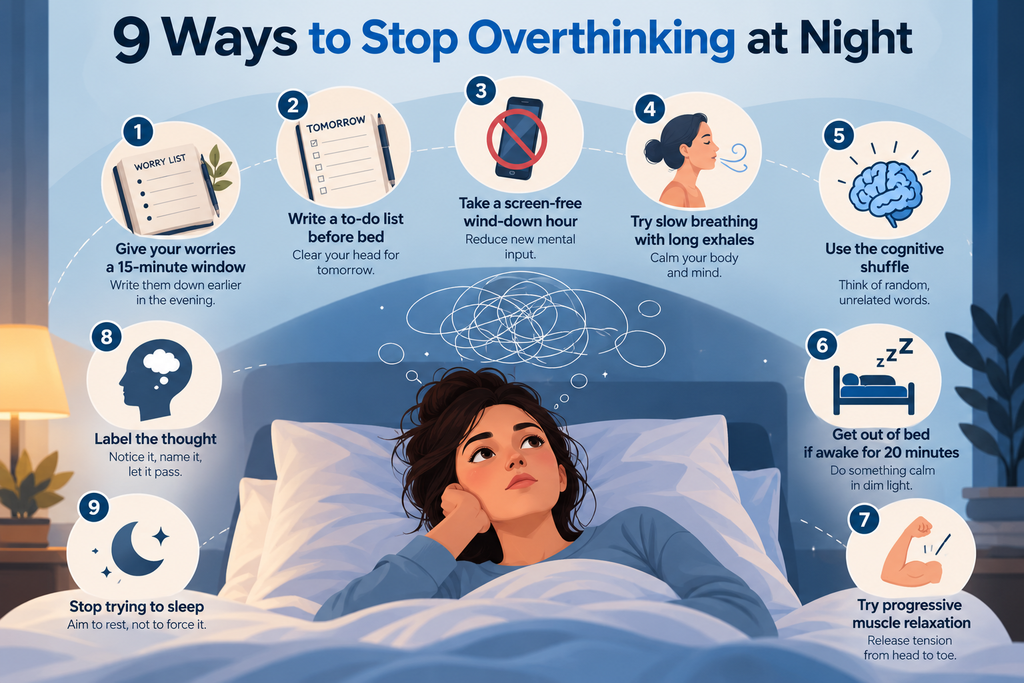
The good news is that night-time overthinking is a habit, not a personality trait, and habits respond to practice. This guide ranks nine techniques by how good the evidence is, tells you when to use each one (before bed, in bed, or when you’re still awake at 2 am), and gives you a free tool to empty your head in three minutes tonight.
Quick answer
- Before bed: give your worries their own 15-minute slot in the early evening, then spend 5 minutes writing a specific to-do list for tomorrow. In one sleep-lab study, people who did this fell asleep about 9 minutes faster.
- In bed: give your brain something boring but absorbing to do. The cognitive shuffle (imagining random, unrelated objects) and slow breathing with long exhales both work this way.
- Still awake after about 20 minutes? Get up, go somewhere dim, do something calm, and go back only when you feel sleepy. This is the core of the most recommended insomnia treatment.
- Stop trying so hard. Effort keeps you awake. Aim to rest, not to sleep.
- See a doctor if it has gone on for three months or more, or is making daytime hard to cope with.
Latest data (checked 20 October 2026)
- 15.4% of US adults had trouble falling asleep most days or every day in 2024, rising to 18.5% of women and 18.3% of 18 to 34 year olds (CDC National Center for Health Statistics, April 2026).
- 18.1% had trouble staying asleep most days, and 30.5% slept less than 7 hours on average (same source).
- The NHS defines insomnia lasting 3 months or more as long-term insomnia, and recommends seeing a GP if changing your habits hasn’t helped (NHS).
- Clocks go back on Sunday 25 October 2026 in the UK and EU and on Sunday 1 November 2026 in the US. Changes to your sleep schedule are a classic trigger for a few nights of lying awake.
Why Your Brain Gets Louder at Night
During the day your attention is full. Work, people, screens and noise all compete for it. At night all of that disappears, and whatever you haven’t dealt with gets the stage to itself.
Three things make it worse:
- Unfinished business. Your brain keeps open loops (unanswered emails, unpaid bills, unresolved arguments) active until it trusts they are handled. Lying still in the dark is when they come back.
- A tired brain is a worse editor. When you’re exhausted, small problems look bigger and catastrophic thoughts feel more believable. The thought “I’ll be useless tomorrow if I don’t sleep” is itself a big source of night-time arousal.
- Your bed becomes the worry place. If you regularly lie in bed thinking, your brain learns that bed means thinking. Sleep specialists call this conditioned arousal, and it’s why many people feel sleepy on the sofa and wide awake the moment their head hits the pillow.
It also helps to know which kind of overthinking you’re doing. Worry looks forward (“What if I lose my job?”). Rumination looks back (“Why did I say that?”). Both keep you awake, and the techniques below work on both.
The 9 Techniques, Ranked by Evidence
Not every sleep tip on the internet has been tested. Here’s how the main ones stack up, from the strongest evidence to the weakest.
| Technique | When to use it | Evidence | Time it takes |
|---|---|---|---|
| 1. The 20-minute rule (get up) | Still awake in bed | Strong: core part of CBT-I | As long as needed |
| 2. Worry window | Early evening | Moderate: used in CBT for insomnia and anxiety | 15 minutes |
| 3. 5-minute to-do list | Just before bed | Moderate: sleep-lab experiment | 5 minutes |
| 4. Progressive muscle relaxation | In bed | Moderate: recommended relaxation therapy | 10 minutes |
| 5. Mindful labelling | In bed | Moderate: randomised trial in older adults | Any time |
| 6. A screen-free wind-down hour | The hour before bed | Moderate: NHS advice | 60 minutes |
| 7. Slow breathing with long exhales | In bed or before | Early: calms the body, sleep not yet proven | 5 minutes |
| 8. The cognitive shuffle | In bed | Early: small studies | Until you drift off |
| 9. Stop trying to sleep | In bed | Early: used within CBT-I | Any time |
“Strong” means it’s recommended in clinical guidelines. “Early” means promising and low-risk, but backed by smaller or fewer studies. All nine are safe to try together.
1. The 20-minute rule: get out of bed
This is the one most people resist, and the one with the best evidence. If you’ve been lying awake for what feels like about 20 minutes (don’t check the clock), get up. Go to another room with dim light and do something calm and boring: read a paper book, fold laundry, listen to a quiet podcast. Go back to bed only when you feel sleepy. Repeat as often as you need to.
It works because it breaks the link between bed and worry. Over a week or two, your brain relearns that bed is for sleep. The American Academy of Sleep Medicine calls this stimulus control, and it’s a central part of cognitive behavioural therapy for insomnia (CBT-I), the treatment its guideline gives its strongest recommendation (AASM guideline, Journal of Clinical Sleep Medicine). The full version also includes getting up at the same time every morning and not napping, even after a bad night.
2. Give your worries a 15-minute window in the early evening
Overthinking at night is often worrying that didn’t get a slot during the day. So give it one.
Once a day, ideally in the early evening and at least two hours before bed, sit down for 15 minutes with a notebook. Draw two columns:
- Worry: write each one down in a single line.
- Next step: write the smallest action that would help, even if it’s “ask Sam on Thursday” or “nothing I can do; let it go.”
Then close the notebook. When a worry turns up in bed, remind yourself: “That’s in the book. I’ll deal with it at worry time.” Psychologists call this constructive worry or scheduled worry time. It’s a standard part of CBT for insomnia and anxiety, and it has been tested alongside imagery distraction in pilot trials with students (Digdon and Koble, Applied Psychology: Health and Well-Being).
Our free tool below does a quick version of this for you.
3. Write tomorrow’s to-do list before bed (5 minutes)
This is the simplest technique with a real experiment behind it. Researchers at Baylor University brought 57 young adults into a sleep lab. Half spent five minutes before bed writing a to-do list for the next few days. The other half wrote about tasks they had already finished. The to-do list group fell asleep about 9 minutes faster, and the more specific their lists were, the faster they fell asleep (Baylor University; study published in the Journal of Experimental Psychology: General).
The key is specific. “Work stuff” doesn’t help. “Send Priya the budget file by 10 am” does, because your brain can stop holding it.
Use paper, not your phone, so you don’t end up in your inbox.
4. Progressive muscle relaxation
Overthinking and physical tension feed each other. Progressive muscle relaxation breaks the loop from the body side.
Lying in bed, start at your feet. Tense the muscles hard for about 5 seconds while breathing in, then let go completely while breathing out and notice the difference for 10 to 15 seconds. Move up: calves, thighs, stomach, hands, arms, shoulders, face. Relaxation therapy like this is one of the single techniques the AASM guideline suggests for chronic insomnia.
5. Label the thought, don’t argue with it
When a thought shows up, you don’t have to solve it or push it away. Just give it a one-word label: “planning,” “worrying,” “remembering,” “judging.” Then bring your attention back to the feeling of your breath or the weight of your body on the mattress.
Arguing with a 2 am thought (“No, it’ll be fine, because…”) keeps you engaged. Labelling it lets it pass. This is the core skill in mindfulness meditation. In a randomised trial of 49 older adults with sleep problems, a six-week mindfulness course improved sleep quality more than a sleep hygiene education class (Black et al., JAMA Internal Medicine).
6. Take a screen-free wind-down hour
The NHS recommends winding down for about an hour before bed, with a bath or a book, and avoiding screens just before bed because they keep you more alert (NHS).
The bigger issue with your phone isn’t just the light. It’s the content. Emails, news and group chats hand your brain fresh material to chew on just as you’re trying to switch off. If cutting your phone at night feels impossible, our 7-day digital detox plan makes it gradual.
A wind-down hour also works better when it starts at the right time. Use our bedtime calculator to find yours, and set an alarm one hour before it.
7. Slow breathing with long exhales
Breathing out slowly is one of the fastest ways to calm your body down. One easy version is the cyclic sigh: breathe in through your nose, take a second short sip of air to fill your lungs, then breathe out slowly and fully through your mouth. Repeat for five minutes.
In a Stanford trial of 108 people, five minutes a day of cyclic sighing improved mood and slowed breathing more than the same time spent on mindfulness meditation (Balban et al., Cell Reports Medicine). The study didn’t find a difference in sleep, so treat this as a way to calm down, not a sleeping pill. It’s most useful when your heart is racing along with your thoughts.
8. Try the cognitive shuffle
The cognitive shuffle gives your brain a task that is engaging enough to crowd out worry but too random to keep you awake. It was developed by Luc Beaudoin, a cognitive scientist at Simon Fraser University.
How to do it:
- Pick a calm, random word, like “bedtime.”
- Take its first letter, B, and think of as many words as you can that start with B: banana, bicycle, balloon, beach.
- Picture each one for a few seconds before moving on.
- When you run out, move to the next letter of your word, E, and repeat.
It works on the idea that falling asleep involves your thoughts becoming loose and unconnected, and the shuffle imitates that. In a study of 154 students with a racing mind at bedtime, it was about as effective as structured problem-solving at reducing pre-sleep arousal, with the advantage that you can do it in bed (Sleep Review). The evidence is still early, but it’s free, harmless and many people find it surprisingly effective. Our tool below includes a random-word version so you don’t have to come up with the words yourself.
9. Stop trying to sleep
Sleep is one of the few things that gets harder the more effort you put in. Trying to force it makes you more alert.
So change the goal. Tell yourself you’re going to lie in the dark and rest with your eyes open for a while, and that resting is fine. Some sleep therapists go further and ask people to gently try to stay awake, a technique called paradoxical intention. The evidence is limited, but the principle behind it is sound: when sleep stops being a test you’re failing, it tends to arrive.
Free Tool: Empty Your Head in 3 Minutes
What’s on your mind?
Type each worry or task on its own line. Don’t edit or explain. Then sort them and you’ll get tomorrow’s list, so your brain can let go for tonight. Nothing you type leaves this page.
What to Do If You Wake Up at 3 am and Start Thinking
Waking in the night is normal. Everyone surfaces briefly between sleep cycles. The problem is when your brain grabs the chance to start worrying. Try this order:
- Don’t check the time. Doing the maths on how much sleep you have left is the fastest way to wake yourself fully.
- Label the thought and go back to your breath or body (technique 5).
- Shuffle (technique 8) if the thoughts keep coming.
- Still awake after about 20 minutes? Get up and follow the 20-minute rule (technique 1). Keep the lights low.
- If it’s a real problem, write one line on a notepad by the bed and leave it for the morning.
The next day, get up at your usual time anyway. Sleeping in or napping makes the next night harder.
What Makes Overthinking at Night Worse
- Caffeine late in the day. The NHS suggests avoiding tea and coffee for at least 6 hours before bed.
- Alcohol. It can help you drop off, but it fragments sleep later in the night, which is often when the 3 am thinking starts.
- Doom-scrolling in bed. News and social feeds hand your brain new problems.
- Lying in bed for hours trying. This teaches your brain that bed is a place to be awake.
- A heavy workload with no end point. If your mind keeps going back to work, it’s worth asking whether you’re overloaded. Our burnout or boredom self-test helps you tell which it is, and whether it’s time to think about leaving.
- Darker evenings. If your mood drops along with the light from October onwards, read our guide to seasonal affective disorder vs the winter blues.
A 7-Night Plan to Quiet a Busy Mind
Trying all nine techniques on the first night is too much. Add one at a time:
| Night | Add this | Takes |
|---|---|---|
| 1 | Pick a fixed wake-up time and stick to it every day, weekends included | 0 minutes |
| 2 | 5-minute specific to-do list before bed, on paper | 5 minutes |
| 3 | Phone out of the bedroom, or on the far side of the room | 0 minutes |
| 4 | 15-minute worry window in the early evening | 15 minutes |
| 5 | Progressive muscle relaxation once you’re in bed | 10 minutes |
| 6 | The cognitive shuffle if thoughts start racing | Until asleep |
| 7 | The 20-minute rule if you’re still awake | As needed |
Most people notice a difference within one to two weeks. The 20-minute rule can make the first few nights feel worse before they get better, which is normal and a sign it’s working.
This Season’s Clock Change: Don’t Let It Start a Bad Habit
The clocks go back on Sunday 25 October 2026 in the UK and EU, and on Sunday 1 November 2026 in the US. You get an extra hour, but your body clock will still wake you at the old time for a few days, and lying awake early in the morning is prime overthinking time.
To make it easier:
- Shift your bedtime and wake-up time 15 minutes later on each of the last few nights before the change. Our bedtime calculator has a 4-night plan.
- Get outside in daylight on the Sunday and Monday mornings.
- If you wake early, don’t lie there planning your week. Label, shuffle, or get up.
When Overthinking at Night Is More Than Overthinking
Talk to your doctor or GP if:
- you’ve had trouble sleeping three or more nights a week for three months or more
- changing your habits hasn’t helped
- poor sleep is making it hard to cope during the day
- your night-time thoughts are mostly about feeling hopeless, worthless or anxious most of the day, too.
The first-line treatment for long-term insomnia is cognitive behavioural therapy for insomnia (CBT-I), not sleeping pills, and it’s often available as a digital programme. Ongoing worry or low mood can also be signs of anxiety or depression, which are very treatable. Our daily mental health check-in is a quick way to see how you’re really doing.
If you ever have thoughts of harming yourself, please talk to someone now. In the US, call or text 988 (988 Suicide & Crisis Lifeline). In the UK and Ireland, call Samaritans free on 116 123 (Samaritans). Elsewhere, contact your local emergency number.
This article is for general information and isn’t a substitute for advice from a doctor.
Frequently Asked Questions
Why do I overthink at night?
Because it’s the first time all day your attention isn’t busy. Unresolved worries, a tired brain that makes problems look bigger, and a habit of lying in bed thinking all combine. If you regularly worry in bed, your brain learns to link bed with being alert, which makes it more likely to happen again.
How do I stop racing thoughts so I can sleep?
Deal with worries before bed with a 15-minute worry window and a specific to-do list. In bed, give your brain a neutral task such as the cognitive shuffle or slow breathing. If you’re still awake after about 20 minutes, get up and do something calm in dim light until you feel sleepy.
Is overthinking at night a sign of anxiety?
Not necessarily. Most people overthink at night sometimes, especially during stressful periods. If it happens most nights, lasts for months, or you also feel anxious or low during the day, it can be a sign of an anxiety disorder, depression or chronic insomnia, and it’s worth talking to a doctor.
What is the cognitive shuffle?
It’s a technique where you pick a random word, then think of and picture unrelated words that start with each of its letters. It keeps your mind busy with loose, unconnected images, which resembles the way thoughts drift as you fall asleep. It was developed by cognitive scientist Luc Beaudoin.
Should I get out of bed if I can’t sleep?
Yes. If you’ve been awake for about 20 minutes, get up, go somewhere dim, do something calm and return when you feel sleepy. This is called stimulus control, and it’s a core part of cognitive behavioural therapy for insomnia, the treatment sleep medicine guidelines recommend most strongly.
Does writing a to-do list before bed help you sleep?
It can. In a sleep-lab study at Baylor University, young adults who spent five minutes writing a to-do list before bed fell asleep about 9 minutes faster than those who wrote about tasks they had already completed. The more specific the list, the faster they fell asleep.
What should I do if I wake up at 3 am and can’t stop thinking?
Don’t check the time. Label the thought (“worrying,” “planning”) and return to your breathing, or try the cognitive shuffle. If you’re still awake after about 20 minutes, get up in dim light until you feel sleepy. Get up at your normal time the next morning instead of sleeping in.
How long does it take for these techniques to work?
Some, like the to-do list and slow breathing, can help the same night. Habits that retrain your brain, such as the 20-minute rule and a fixed wake-up time, usually take one to two weeks to make a noticeable difference, and can feel harder for the first few nights.
The Bottom Line
You can’t think your way to sleep, but you can stop feeding the thinking. Give your worries a time slot earlier in the evening, write tomorrow’s list before bed, give your mind something boring to hold in bed, and get up rather than wrestle with it. Start with one technique tonight, add another each night, and give it two weeks.
For more on building nights that actually restore you, read the science of restorative sleep, and for calmer mornings after a better night, try these morning rituals.
Sources
- CDC National Center for Health Statistics: Short Sleep Duration and Sleep Difficulties Among Adults: United States, 2024 (Data Brief No. 559, April 2026)
- NHS: Insomnia
- Edinger JD et al.: Behavioral and psychological treatments for chronic insomnia disorder in adults: an American Academy of Sleep Medicine clinical practice guideline, Journal of Clinical Sleep Medicine, 2021
- Scullin MK et al.: The effects of bedtime writing on difficulty falling asleep, Journal of Experimental Psychology: General, 2018 (Baylor University summary)
- Black DS et al.: Mindfulness Meditation and Improvement in Sleep Quality and Daytime Impairment Among Older Adults With Sleep Disturbances, JAMA Internal Medicine, 2015
- Balban MY et al.: Brief structured respiration practices enhance mood and reduce physiological arousal, Cell Reports Medicine, 2023
- Digdon N, Koble A: Effects of Constructive Worry, Imagery Distraction, and Gratitude Interventions on Sleep Quality: A Pilot Trial, Applied Psychology: Health and Well-Being, 2011
- Sleep Review: Need Better Sleep? Consider the Cognitive Shuffle



Join the Lifoholic community conversation. We welcome thoughtful insights, questions, and authentic experiences from our readers.
RECOMMENDED DISCUSSIONS
Am I Burned Out or Just Bored? A 2-Minute Self-Test (and What to Do Next)
What Time Should I Go to Bed? A Bedtime Calculator Based on Sleep Science