
Maybe school isn’t working for your child. Maybe it’s bullying, a learning difference the classroom can’t handle, a move abroad, or simply a feeling that there must be a better way. Whatever brought you here, you’ve probably already noticed the problem: there’s a lot of homeschooling advice online, and most of it assumes you already know what you’re doing.
This guide assumes you don’t. It walks you through the whole thing in order: whether it’s legal where you live, how to take your child out of school properly, how to choose a style and curriculum without overspending, what a realistic day looks like, what it costs, how to handle friendships and exams, and what the research honestly says about how homeschooled children do.
It’s written for parents anywhere in the world, so where the rules differ by country we say so and link to the official source.
Quick answer: how to start homeschooling in 8 steps
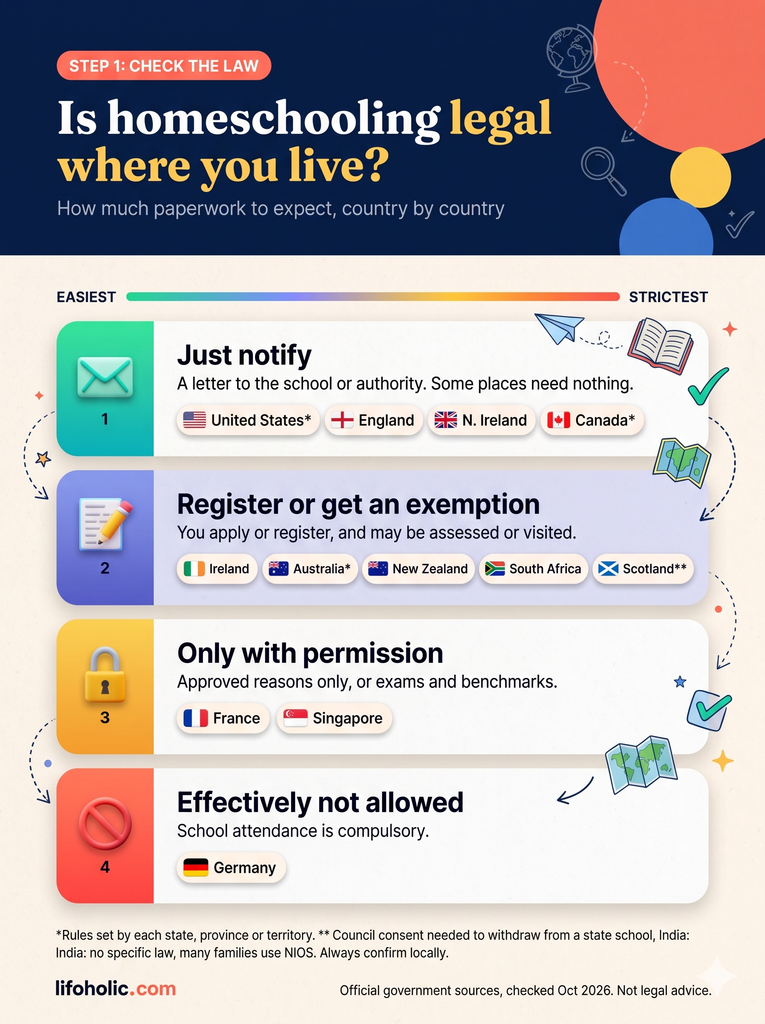
- Check the law where you live. Homeschooling is legal in the US, UK, Canada, Australia, New Zealand, Ireland and many other countries, but rules range from “tell nobody” to “get permission first”. It’s effectively banned in Germany.
- Take the readiness test below to see whether your time, money and support are there.
- Withdraw from school properly, usually with a short letter, before your child stops attending.
- Take a few weeks to “deschool” before starting formal lessons.
- Pick a style (structured, relaxed or somewhere in between) and start with free resources before buying a curriculum.
- Plan short days. One-to-one teaching is efficient: 1 to 3 focused hours is plenty for most primary-age children.
- Build a social life on purpose: co-ops, clubs, sport, library groups.
- Keep simple records and review every term.
What Homeschooling Is (and What It Isn’t)
“Homeschooling” (called home education or elective home education in the UK and Ireland) means the parent takes full responsibility for a child’s education instead of a school. That doesn’t mean you must teach every subject yourself. Many families use tutors, online classes, co-ops and community groups. What matters is who’s in charge.
It helps to know the difference between a few things that often get lumped together:
| Option | Who’s responsible | Typical cost | Good to know |
|---|---|---|---|
| Homeschooling / home education | You | Low to moderate | You choose the curriculum, pace and schedule within your country’s rules |
| Online or virtual school | The school | Free (public) to high (private) | In many places, a state-run online school counts as school, not homeschooling, and comes with its timetable and tests |
| Hybrid or flexi-schooling | Shared | Varies | Part-time in school, part-time at home. Some schools allow it; in England the school can refuse |
| Unschooling | You | Low | A child-led style of homeschooling, not a separate legal category |
| Tutoring pods or micro-schools | Varies | Moderate to high | Small groups sharing a teacher; legal status depends on how they’re set up |
Why this matters: if you enrol in an online school, you usually aren’t homeschooling legally, and you won’t have the same freedom over what and when your child learns. If you homeschool and add online classes, you keep that freedom.
How Many Families Homeschool, and Why
You’d be joining a lot of people. Homeschooling grew sharply during the pandemic and, unlike many pandemic habits, it has largely stuck.
- United States: about 2 to 3% of K–12 students were homeschooled before 2020. The U.S. Census Bureau found the share of households homeschooling jumped from 5.4% in spring 2020 to 11.1% that autumn. Johns Hopkins University’s Homeschool Hub now puts participation at roughly 5 to 6% of students.
- England: 126,000 children were registered as home educated in autumn 2025, about 1.5% of 5 to 16-year-olds and 13% more than a year earlier, according to the House of Commons Library. Because registration hasn’t been compulsory, the real number is probably higher.
Families homeschool for very different reasons. In the U.S. government’s most recent detailed survey (NCES, 2019), parents said these mattered to them:
| Reason | Parents who said it was important |
|---|---|
| Concern about the school environment (safety, drugs, peer pressure) | 80% |
| Wanting to provide moral instruction | 75% |
| Emphasis on family life together | 75% |
| Dissatisfaction with academic instruction at other schools | 73% |
The single most common main reason was the school environment (25%), followed by academics (15%) and religious instruction (13%). Johns Hopkins researchers also found that today’s homeschoolers are far more diverse than the stereotype suggests, that up to 40% left school because of special learning needs, and that more than a third of homeschooling families also have children in regular school (Johns Hopkins Magazine).
Takeaway: there’s no single “type” of homeschooling family. Knowing your reason is the most useful thing you can do before you start, because it shapes every choice that follows.
Is Homeschooling Right for Your Family? Take the 2-Minute Readiness Test
Before the legal and practical steps, it’s worth an honest check. Homeschooling usually works best when four things line up: time, money, support, and your child’s needs. This 10-question test scores each one and tells you whether to start now, start with a plan, try a trial term, or wait.
[The interactive readiness test goes here in the WordPress version. Ten questions, four answer options each. It scores Time, Money, Support and Child fit, then shows one of four results with a next-step plan.]
The four results:
| Result | What it means |
|---|---|
| Ready to Start | The basics are in place. Follow the steps below and start with a light first month |
| Ready, With a Plan | You can make it work, but one area (usually time or money) needs sorting first |
| Try a Trial Term | Commit to one term or 12 weeks, then decide. Keep the option of returning to school open |
| Not Right Now | Two or more areas are weak. Look at hybrid options, a school move or extra support at school first |
Step 1: Check the Law Where You Live
This is the step people skip, and it’s the one that can cause real trouble. Homeschooling law is set by country, and in the US, Canada and Australia by each state, province or territory.
Homeschooling laws by country (at a glance)
| Country | Legal? | What you usually have to do |
|---|---|---|
| United States | Yes, in all 50 states | Rules vary by state, from no notice at all to annual notices, required subjects and testing. See below |
| England | Yes | Tell the school in writing. Council permission is needed only for a special school or a school attendance order (GOV.UK). A compulsory register is coming (see below) |
| Scotland | Yes | Council consent is needed to withdraw a child from a state school they’ve attended (gov.scot) |
| Northern Ireland | Yes | Tell the principal so your child is taken off the register; for a special school, tell the Education Authority too (nidirect) |
| Ireland | Yes | Register each child with Tusla’s AEARS before or as you begin (Tusla) |
| Canada | Yes | Set by province. In Ontario, send the school board a letter of intent (Ontario Ministry of Education) |
| Australia | Yes | Register with your state or territory authority. In NSW the program must follow NESA syllabuses and you must keep records (NSW Government) |
| New Zealand | Yes | Apply to the Ministry of Education for a Certificate of Exemption, showing your child will be taught “at least as regularly and well” as at school (ERO) |
| South Africa | Yes | Register with the provincial education department. The BELA Act adds curriculum and assessment requirements (BusinessTech) |
| Singapore | Only with an exemption | Apply to MOE; most children must sit the PSLE and meet a benchmark (MOE) |
| France | Only with prior permission | Since 2022, authorisation is granted only for four reasons, such as health or intensive sport (Eduscol) |
| India | No specific law | Many families use the National Institute of Open Schooling for recognised certificates (NIOS) |
| Germany | Effectively no | School attendance is compulsory. The European Court of Human Rights has upheld Germany’s approach several times (Wunderlich v. Germany, 2019) |
Laws change. Always confirm with your local education authority before you withdraw your child. This table is a starting point, not legal advice.
If you’re in the United States
Every state allows homeschooling, but states fall into roughly three groups:
- Little or no regulation: you may not even need to tell anyone.
- Moderate: you send a notice of intent and may need to cover set subjects or keep attendance records.
- High regulation: annual notices, required subjects, regular reports and periodic testing or an outside evaluation. New York, for example, requires a yearly notice plus quarterly reports.
According to the Education Commission of the States, 29 states and D.C. require instruction in certain subjects, 14 states and D.C. have some requirement for the parent’s qualifications (usually a high school diploma), and no state requires a specific curriculum. The best plain-English, state-by-state summaries are on the Johns Hopkins Homeschool Hub. Then check your state department of education’s own page.
If you’re in England: what’s changing
The Children’s Wellbeing and Schools Act 2026 became law on 29 April 2026. Once it’s brought into force, councils will keep a “children not in school” register and parents will have to register home-educated children. Parents will also need council permission to withdraw a child from a special school, or a child who has been the subject of child-protection enquiries in the last five years. As of this guide’s last update, the register isn’t running yet, and the government has promised to consult on guidance first.
What hasn’t changed: you still don’t have to follow the National Curriculum, and the education must be “efficient” and “suitable” to your child’s age, ability and any special needs. You also pay for any exams yourself.
Step 2: Withdraw From School the Right Way
If your child is already at school, don’t just stop sending them. Unexplained absence can lead to attendance action. Instead:
- Check whether you need permission (see the table above).
- Write a short letter or email to the head teacher or principal, and keep a copy.
- Wait for confirmation that your child has been taken off the roll (or that your notice was accepted) before they stop attending.
- Ask for copies of records: reports, any special-needs assessments, and work samples.
Sample withdrawal letter (adapt it to your local rules):
Dear [Head Teacher / Principal],
I am writing to tell you that I have decided to educate my child, [full name, date of birth, class], at home from [date]. Please remove [him/her/them] from the school’s admission register from that date and confirm when you have done so.
[If required where you live: I understand my responsibility to provide a suitable, full-time education.]
Thank you for everything the school has done for [child’s first name].
Yours sincerely,
[Your name, address, phone]
Keep it short and friendly. You don’t have to explain your reasons unless your local law asks for them, and a calm, brief letter keeps the door open if you ever want to return.
Step 3: Give Everyone Time to “Deschool”
Most experienced home educators give the same advice: don’t start formal lessons on day one. Children coming out of school, especially if school was stressful, often need time to recover, rediscover curiosity and adjust to a very different rhythm. Parents need it too, to drop the idea that home must look like a classroom.
A common rule of thumb is a few weeks, sometimes described as a week for every year spent in school. It doesn’t mean doing nothing. Use the time to:
- read together every day and visit the library
- go to museums, parks, a farm or a science centre
- cook, build, garden and play games that involve maths without calling it maths
- notice what your child chooses to do when no one is telling them what to do
That last point matters most. What your child gravitates towards is your best clue for the style and resources that will work.
Step 4: Choose a Homeschooling Style
You don’t need to pick one approach forever. Most families end up eclectic, mixing what works. But knowing the main styles helps you shop for resources without wasting money.
| Style | What it looks like | Works well for | Watch out for |
|---|---|---|---|
| Structured (“school at home”) | Set subjects, textbooks or a boxed curriculum, a timetable | Parents who want a clear plan; children who like routine | Burnout from copying a full school day |
| Classical | Grammar, logic and rhetoric stages; lots of reading, history and language | Strong readers; families who like a traditional, book-rich approach | Can be heavy for children who need hands-on learning |
| Charlotte Mason | Short lessons, “living books”, nature study, narration | Younger children; families who value time outdoors | Needs a parent who enjoys reading aloud |
| Montessori | Child-led, hands-on materials, mixed activities | Early years and primary; active learners | Materials can be expensive (DIY versions help) |
| Unschooling | Learning follows the child’s interests, no set curriculum | Self-motivated children; families comfortable with uncertainty | Harder to show progress where the law requires it |
| Online and hybrid | Live or recorded online classes, often for maths, science and languages | Older children; working parents | Screen time; cost of paid providers |
| Eclectic | A mix: e.g. structured maths, interest-led science, library-based history | Most families, eventually | Gaps if you don’t review coverage each term |
A simple way to choose: pick a structured approach for the subjects that build step by step (reading, writing and maths), and a relaxed, interest-led approach for everything else.
Step 5: Choose a Curriculum Without Overspending
The most common beginner mistake is buying an expensive full-year curriculum in the first week, then discovering it doesn’t suit your child. Start with free, high-quality resources for the first month, and buy only once you know what works.
Free resources that are genuinely good
- Your country’s national curriculum. It’s free and tells you what children of each age usually learn: England’s National Curriculum, the Australian Curriculum, Ontario’s curriculum, or your US state’s standards. You don’t have to follow it, but it’s a useful checklist.
- Khan Academy: free maths, science, grammar and more from early primary to university level, from a non-profit.
- Oak National Academy: free, full video lessons for every subject in England’s curriculum, funded by the UK government.
- BBC Bitesize: short lessons and revision for all ages, especially useful for UK exams.
- OpenStax: free, peer-reviewed textbooks from Rice University, great for high school science and maths.
- Project Gutenberg: more than 70,000 free classic books for literature and history.
- NASA’s learning resources and the Smithsonian Learning Lab: free science and history projects.
- Your public library: books, audiobooks, often free access to online learning platforms and language apps, and children’s events.
When it’s worth paying
- Maths, if free resources aren’t clicking. A well-sequenced programme is worth the money, because gaps build up.
- Phonics and early reading, for the same reason.
- Specialist subjects you can’t teach yourself, such as a foreign language, music or upper-level science.
- Exam preparation for older teens.
Tip: buy second-hand. Homeschooling families resell curricula constantly through local groups and marketplaces, often at half price or less.
Step 6: Plan a Realistic Day
This is where most new homeschoolers relax. You don’t need six hours a day. A lot of a school day goes on registration, moving between rooms, waiting and managing a class of 30. Teaching one or two children is far more efficient.
As a rough guide to focused, sit-down learning time (not counting reading for fun, play, sport, trips and projects):
| Age | Focused learning per day |
|---|---|
| 5 to 7 | 1 to 2 hours |
| 8 to 11 | 2 to 3 hours |
| 12 to 14 | 3 to 4 hours |
| 15 to 18 | 4 to 5 hours, much of it independent study |
These are typical ranges, not legal minimums. Some US states and other countries set a number of days or hours per year, so check yours.
A sample day (ages 8 to 11)
| Time | What happens |
|---|---|
| 9:00 | Read-aloud or quiet reading (20 min) |
| 9:20 | Maths (40 min) |
| 10:00 | Snack and outside break |
| 10:30 | Writing or spelling (30 min) |
| 11:00 | Topic of the week: science, history or geography (45 min) |
| 12:00 | Lunch |
| Afternoon | Free time, a club, sport, a library trip, a project, or a co-op day |
Routines beat timetables. A predictable order (“reading, then maths, then outside”) holds up far better than fixed clock times when someone has a doctor’s appointment or a bad morning.
A good routine also protects sleep. If you’re shifting to later starts, our bedtime calculator helps you find a bedtime that fits your child’s age and wake-up time, and the ideas in Morning Rituals That Set a Positive Tone for the Day translate well to a home-learning start.
Step 7: Work Out What It Will Cost
Homeschooling can be close to free or as expensive as private school. These are typical yearly costs per child, based on common prices for curricula, classes and activities. They’re Lifoholic estimates, not survey data.
| Budget level | Typical cost per child per year | What it includes |
|---|---|---|
| Low cost | Under $300 / £250 | Library, free online resources, printed worksheets, second-hand books |
| Moderate | $500 to $1,500 / £400 to £1,200 | A paid maths and reading programme, some workbooks, a co-op or one weekly class |
| High | $2,000 to $5,000+ / £1,600 to £4,000+ | Several online classes or tutors, specialist subjects, exam fees, frequent trips |
The cost most families forget: income
For many households, the biggest cost isn’t books. It’s that one parent works fewer hours or stops working altogether. Before you decide:
- Work out what that income is really worth after tax, commuting and childcare. Our real hourly wage calculator does the maths, and the answer is often lower than people expect.
- Build a cushion before you switch to one income.
- Check whether your area offers support. Some US states have education savings accounts or other funding that can be used for home education, and some charter schools fund homeschool-style programmes, but these often come with conditions that make them legally “school”.
Other costs to plan for
- Exams. In England, home-educating parents pay exam fees themselves and must find a centre that accepts private candidates. Book early: places can be limited.
- Supplies. Notebooks, a printer and ink, art materials, science kits. The back-to-school sales covered in our Best Time to Buy Everything guide are as useful to homeschoolers as anyone.
- Activities. Sport, music and clubs often replace what school would have provided.
Step 8: Plan Your Child’s Social Life (Socialisation)
“What about socialisation?” is the question every homeschooling parent gets, usually from a relative. It’s a fair question, and the honest answer is: it depends on what you do about it.
The most thorough review of homeschooling research, by Robert Kunzman and Milton Gaither, published in the journal Other Education in 2020, found that most studies don’t show homeschoolers doing clearly worse on social skills. But it also found that some homeschoolers experience more isolation and fewer peer interactions, and that those with more peer contact tend to do better. In other words, friendships don’t happen automatically. You plan for them.
Ways to build a social life:
- Homeschool co-ops: groups of families who meet weekly to share teaching. Search “[your town] homeschool co-op” or ask at the library.
- Sports teams, swimming, martial arts, dance and drama: often in the late afternoon, which suits homeschoolers well.
- Scouts, Guides, cadets and youth groups.
- Library, museum and science-centre programmes, many of which run daytime sessions specifically for home-educated children.
- Volunteering for older children: animal shelters, community gardens, charity shops.
- Part-time classes at a local school or college where allowed.
Aim for regular, repeated contact with the same children, at least two or three times a week. One-off events are fun, but friendships come from seeing the same faces.
Keeping Records and Tracking Progress
Even where the law doesn’t require records, keep some. They help you spot gaps, show progress if your council or state asks, and build a transcript later.
A simple system that takes 10 minutes a week:
- A weekly log: a notebook or spreadsheet with what you covered in each subject.
- A portfolio: three or four pieces of work per subject per term (photos are fine).
- A reading list: every book your child reads or you read together.
- A term review: what went well, what didn’t, what to change. Ask your child too.
Tests are optional in most places, but useful. Some families use a free online placement test or a standardised test once a year simply to check that nothing important has been missed, especially in maths.
Can You Homeschool While Working Full Time?
Yes, but it takes deliberate planning, and it’s much easier with older or more independent children. Families who make it work usually combine several of these:
- Split shifts between two parents, or one parent working evenings or weekends.
- Concentrated learning hours: two or three focused hours early in the day or in the evening.
- Online classes and tutors for core subjects.
- Co-ops and day programmes that cover one or two days a week.
- Grandparents or a shared arrangement with another homeschooling family.
- Independent work for children aged 11 and up, with a daily check-in.
Remote and hybrid jobs have made this much more realistic than it was a decade ago, which is one reason Johns Hopkins researchers say families now move in and out of homeschooling more often. If you’re weighing a job change to make it possible, our guide to deciding whether to quit your job walks through the money questions first.
Homeschooling a Child With Special Educational Needs
Many families start homeschooling because school isn’t meeting their child’s needs. Home education can work very well here: you can go at your child’s pace, cut sensory overload and focus on strengths. A few things to know first:
- You may lose some support. In many countries, specialist services, therapies and assessments are tied to school enrolment. Find out what you’d keep before you withdraw.
- In England, if your child has an Education, Health and Care plan and attends a special school, you need council permission to withdraw them. For a mainstream school you don’t, but the council still has duties under the plan unless you’ve arranged suitable education yourself.
- In New Zealand, the exemption application must explain how special education needs will be met.
- In Singapore, children with moderate to severe needs follow an Individualised Education Plan instead of the PSLE benchmark.
Ask for every report and assessment before you leave, and keep a record of what helps. If you return to school later, it will be invaluable.
High School, Exams and University
Homeschooling teenagers is very doable. It just needs more planning around qualifications.
- In the US, parents usually issue the high school diploma and create the transcript. Many homeschoolers also take the SAT or ACT, AP exams, or dual-enrolment classes at a community college to give colleges outside evidence.
- In the UK, home-educated teens can sit GCSEs, IGCSEs and A levels as private candidates at an exam centre that accepts them. IGCSEs are popular because many don’t need coursework.
- In India, the National Institute of Open Schooling offers recognised Secondary (Class 10) and Senior Secondary (Class 12) qualifications.
- In Australia and New Zealand, options include distance education, TAFE or polytechnic courses, and adult or mature-age university entry routes.
How do homeschoolers do at university? Studies of individual colleges often find homeschooled students earn similar or slightly higher grades than comparable classmates, with similar graduation rates. But Kunzman and Gaither note that larger, more representative surveys found formerly homeschooled young adults, on average, had lower SAT scores and attended less selective colleges. They also found homeschoolers tend to be stronger in reading and writing than in maths. The practical lesson: don’t let maths slip, and get outside help early if it isn’t your strength.
What the Research Really Says About Homeschooling
You’ll find claims online that homeschoolers outscore everyone by 30 percentile points. Be careful. Kunzman and Gaither’s review explains that the most-quoted studies used volunteer families and parent-supervised tests, so they tell you about motivated, well-resourced families, not homeschooling in general.
When studies compare similar families, the honest summary is:
- Academic results: homeschooling makes little difference on average. Results are more spread out: some children do exceptionally well, and some fall behind.
- Reading vs maths: homeschoolers tend to do relatively better in reading and writing than in maths.
- Social skills: usually no clear disadvantage, but isolation is a real risk without planning.
- The biggest factor is the family: how engaged, organised and well supported the parent is, and how well the approach fits the child.
That’s actually encouraging. It means homeschooling isn’t magic and isn’t dangerous. It’s a tool, and it works when it’s done well.
The 10 Mistakes New Homeschoolers Make
- Copying the school day hour for hour, then burning out.
- Buying a full curriculum before knowing your child’s learning style.
- Skipping the legal step or withdrawing without a letter.
- Trying to teach every subject yourself instead of using tutors, co-ops and online classes.
- Letting maths slide because it’s the subject you enjoy least.
- Leaving friendships to chance.
- No records at all, then panicking when a council or state asks.
- Comparing your child to school year groups week by week, instead of term by term.
- Ignoring your own wellbeing. You’re now teacher, parent and often employee too. A regular mental health check-in is worth the five minutes.
- Treating it as permanent. You can review every term, and returning to school is always an option.
Your First 30 Days: A Week-by-Week Plan
| Week | Focus | To do |
|---|---|---|
| Week 1 | Legal and admin | Confirm your local rules, send the withdrawal letter or notice, get school records, tell your child’s doctor or support services if needed |
| Week 2 | Deschool | Library, museums, outdoors, games, cooking, lots of reading. Notice your child’s interests |
| Week 3 | Explore | Try free resources for maths and reading. Visit a co-op or homeschool group. Draft a simple routine |
| Week 4 | Start gently | Two short sessions a day (reading and maths), plus one interest project. Start your weekly log |
| Day 30 | Review | What worked? What didn’t? Only now buy any paid curriculum you’re sure you need |
When Homeschooling Isn’t Working
It’s okay if it doesn’t work. Signs it’s time to change something:
- your child is consistently unhappy, withdrawn or isolated
- they’ve fallen well behind in reading or maths and aren’t catching up
- you’re exhausted or resentful most days
- money worries are straining the family
Before giving up, try changing one thing: a different maths programme, a co-op, an online class, a tutor, or less structure. If it still isn’t right, returning to school is a normal choice, not a failure. Contact your local school or education authority about a place; in many countries, your child is entitled to one. Your records and portfolio will help the school place them well.
Latest Data: Homeschooling by the Numbers
Last checked: 17 October 2026
| Measure | Latest figure | Source |
|---|---|---|
| Share of US students homeschooled (current) | Roughly 5 to 6% | Johns Hopkins Homeschool Hub |
| Share of US households homeschooling, autumn 2020 | 11.1% (up from 5.4% in spring 2020) | U.S. Census Bureau |
| Registered home-educated children in England, autumn 2025 | 126,000 (about 1.5%), up 13% in a year | House of Commons Library |
| Children home educated in England at some point in 2024/25 | 175,900 (about 2.1%) | House of Commons Library |
| England’s compulsory home education register | Law passed 29 April 2026; not yet in force | House of Commons Library |
| US states requiring specific subjects | 29 plus D.C. (2015 data) | Education Commission of the States |
Frequently Asked Questions
Is homeschooling legal?
Homeschooling is legal in most English-speaking countries, including the US (all 50 states), the UK, Ireland, Canada, Australia, New Zealand and South Africa. Rules vary from simply notifying the school to registering and being assessed. It’s restricted in France and Singapore and effectively banned in Germany. Always check with your local education authority.
How do I start homeschooling?
Check your local law, send a withdrawal letter or notice to the school, and wait for confirmation before your child stops attending. Then take a few weeks to adjust, pick a style, start with free resources for reading and maths, and plan short daily sessions. Keep simple records from the start.
Do I need a teaching qualification to homeschool?
Usually not. In the UK, Ireland, Canada, Australia and New Zealand, parents don’t need teaching qualifications. In the US, about 14 states have some requirement, usually a high school diploma or equivalent, and no state requires a teaching licence.
How many hours a day should you homeschool?
Much less than a school day. As a guide, plan 1 to 2 hours of focused learning for ages 5 to 7, 2 to 3 hours for ages 8 to 11, 3 to 4 hours for ages 12 to 14 and 4 to 5 hours for teenagers, plus reading, play, sport and projects. Check whether your area sets minimum days or hours.
How much does homeschooling cost?
It can cost under $300 (about £250) a year per child using libraries and free online resources, $500 to $1,500 with a paid maths and reading programme and a weekly class, and $2,000 to $5,000 or more with tutors and online classes. The biggest cost is often lost income if a parent cuts their work hours.
Can I homeschool if I work full time?
Yes, with planning. Working families often combine split shifts between parents, focused learning in the early morning or evening, online classes and tutors, co-op days and independent work for older children. It’s easier with children aged 11 and up who can work on their own.
Do homeschooled children get enough socialisation?
They can, but it needs planning. Research generally finds no clear disadvantage in social skills, but some homeschooled children are more isolated, and those with regular peer contact do better. Co-ops, sport, clubs, scouts and library groups two or three times a week help most.
Can homeschoolers go to university?
Yes. Universities in the US, UK and elsewhere regularly admit homeschooled students. US homeschoolers typically submit a parent-made transcript plus SAT/ACT, AP or community college results. UK home-educated students sit GCSEs or IGCSEs and A levels as private candidates.
Can my child go back to school after homeschooling?
Yes. You can apply for a school place at any time, and in many countries your child is entitled to one. Keeping records and a portfolio of work helps the school place your child in the right year and group.
What is deschooling?
Deschooling is a break of a few weeks between leaving school and starting formal home lessons. It gives children, and parents, time to recover from school routines and stress, rediscover curiosity and find out how the child learns best. It usually involves reading, outings, play and everyday learning.
The Bottom Line
Homeschooling isn’t about recreating school at your kitchen table. It’s about taking responsibility for how your child learns, and then building the support around you to do it well. Get the legal step right, start slowly, lean on free resources before spending, plan friendships on purpose, and review every term.
Do that, and the research suggests what really decides how your child does isn’t the label “homeschooled”. It’s the care and attention you bring to it. Over the coming weeks we’ll be adding detailed guides on each step, from choosing a curriculum to homeschooling teenagers, all linked from this page.
If you’re the kind of parent who likes to understand how learning works, you may also enjoy What Is Sequential Learning? The Science Behind Learning That Sticks, How to Remember Everything You Read and Playful Learning: Intentional Parenting in the Modern Age.
How we researched this
We used official government guidance and legislation for each country’s rules (GOV.UK, gov.scot, nidirect, Tusla, the Ontario Ministry of Education, the NSW Government, New Zealand’s Education Review Office, Singapore’s Ministry of Education and France’s Ministry of Education), official statistics (U.S. Census Bureau, NCES, the House of Commons Library), and independent academic research (Johns Hopkins University’s Homeschool Hub and Kunzman and Gaither’s 2020 review of homeschooling research). We avoided curriculum sellers and advocacy groups as sources for numbers. Cost ranges are our own estimates from typical prices and are labelled as such. This guide is general information, not legal advice.
Sources
- U.S. Census Bureau: Homeschooling on the Rise During COVID-19 Pandemic
- National Center for Education Statistics: Fast Facts: Homeschooling
- Johns Hopkins Institute for Education Policy: Homeschool Hub
- Johns Hopkins Magazine: The Homeschool Trend
- House of Commons Library: Home education in England (research briefing, June 2026)
- GOV.UK: Educating your child at home
- Scottish Government: Home education guidance: withdrawing a child from school
- nidirect: Educating your child at home
- Tusla: Home education registration
- Ontario Ministry of Education: Policy/Program Memorandum 131: Home Schooling
- NSW Government: Home schooling registration requirements
- Education Review Office (New Zealand): About homeschool reviews
- Ministry of Education Singapore: Exemptions from compulsory education
- Ministère de l’Éducation nationale (France): L’instruction dans la famille
- National Institute of Open Schooling (India): Open Basic Education
- European Court of Human Rights: Wunderlich v. Germany (2019)
- Education Commission of the States: Homeschool state policies
- Kunzman, R. & Gaither, M. (2020). Homeschooling: An updated comprehensive survey of the research. Other Education, 9(1), 253–336.
Join the Lifoholic community conversation. We welcome thoughtful insights, questions, and authentic experiences from our readers.
RECOMMENDED DISCUSSIONS
Playful Learning & Intentional Parenting in the Modern Age