
Most of us set an alarm with great precision and then drift towards bed whenever the episode ends.
That’s backwards. Your wake-up time is usually fixed by school, work or a small child. Your bedtime is the only part of the night you really control, and it’s the one most people never plan.
The cost of getting it wrong is bigger than a groggy morning. About 1 in 3 US adults report not getting enough rest or sleep, according to the National Heart, Lung, and Blood Institute, and long-term sleep deficiency is linked to heart disease, high blood pressure, diabetes, obesity and depression.
The good news: the right bedtime is simple arithmetic. You need three numbers, and the calculator below does the work.
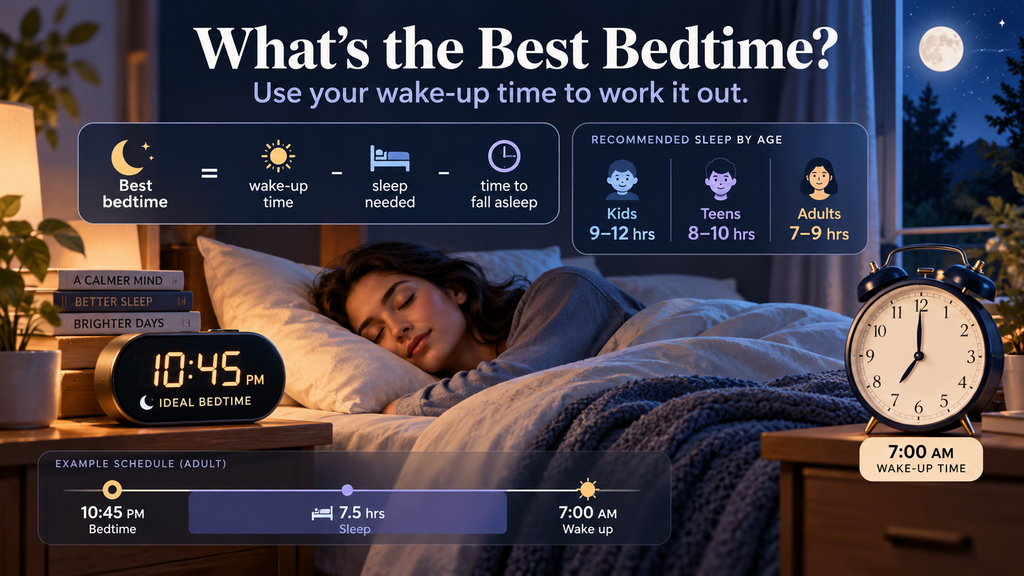
Quick answer: Your bedtime = your wake-up time − the sleep your age group needs − the time it takes you to fall asleep (we use 15 minutes as a default). If you wake at 7:00 am and you’re an adult who needs 7 to 9 hours, aim to be in bed with the lights out between 9:45 pm and 11:45 pm, and closer to 10:45 pm if you want a solid 8 hours.
How Much Sleep Do You Need? (By Age)
Start here, because “8 hours” is an average, not a rule. The official recommendations from the Centers for Disease Control and Prevention, which follow the consensus statements of the American Academy of Sleep Medicine, are:
| Age group | Age | Recommended sleep per day |
|---|---|---|
| Newborn | 0–3 months | 14–17 hours |
| Infant | 4–12 months | 12–16 hours (including naps) |
| Toddler | 1–2 years | 11–14 hours (including naps) |
| Preschool | 3–5 years | 10–13 hours (including naps) |
| School age | 6–12 years | 9–12 hours |
| Teen | 13–17 years | 8–10 hours |
| Adult | 18–60 years | 7 or more hours |
| Adult | 61–64 years | 7–9 hours |
| Adult | 65 and older | 7–8 hours |
Two things stand out. First, teenagers need more sleep than adults, not less, which is worth remembering the next time someone calls a teen lazy for sleeping in. Second, there’s no age at which less than 7 hours is the recommendation. Nobody “needs” only five hours; some people are just used to being tired.
The Bedtime Formula
Here it is in one line:
Bedtime = Wake-up time − Hours of sleep you need − Time to fall asleep
Step 1: Fix your wake-up time
Pick the time you actually need to get up on workdays, and try to keep it within about an hour on weekends. The NHLBI’s healthy sleep habits guidance recommends going to bed and waking up at the same time every day and limiting the difference between weeknights and weekends to no more than about an hour. A consistent wake time is the anchor everything else hangs on.
Step 2: Choose your sleep target
Use the table above. If you’re an adult, start at 8 hours: it sits comfortably inside the recommended range and leaves a buffer for bad nights. Adjust after a week based on how you feel at 3 pm, not at 7 am.
Step 3: Add the time it takes you to fall asleep
You don’t fall asleep the second your head hits the pillow, and pretending you do is how a “10:30 bedtime” quietly becomes 6 hours 45 minutes of sleep. Our calculator assumes 15 minutes by default. If you usually read in bed or lie awake for a while, change it to match your real nights.
Step 4: Subtract
Wake-up time minus sleep target minus falling-asleep time. That’s when the lights go out. Getting into bed with your phone at that time doesn’t count.
Bedtime Calculator
[The interactive calculator appears here in the WordPress version. Readers choose their wake-up time, age group and how long they take to fall asleep. It shows their bedtime window, their best bedtime, sleep-cycle-friendly alternatives and a four-night plan for the next clock change.]
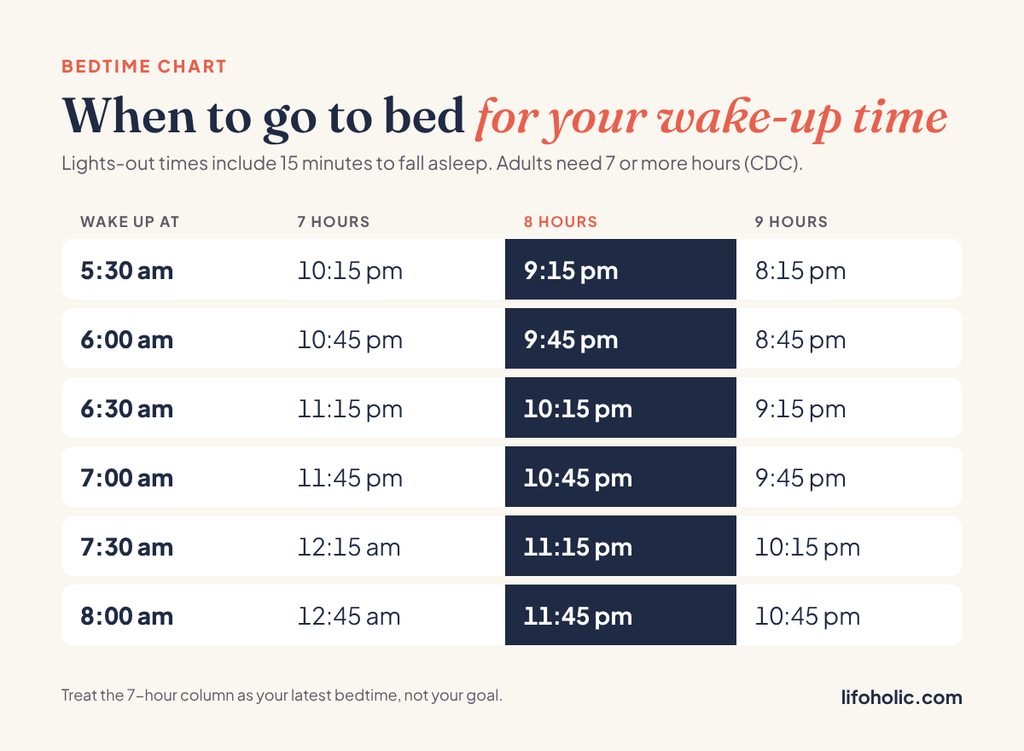
Bedtime Chart: When to Go to Bed for Your Wake-Up Time
No calculator handy? Find your wake-up time below and read across. Each time includes 15 minutes to fall asleep.
| If you wake up at… | Lights out for 7 hours | Lights out for 8 hours | Lights out for 9 hours |
|---|---|---|---|
| 5:30 am | 10:15 pm | 9:15 pm | 8:15 pm |
| 6:00 am | 10:45 pm | 9:45 pm | 8:45 pm |
| 6:30 am | 11:15 pm | 10:15 pm | 9:15 pm |
| 7:00 am | 11:45 pm | 10:45 pm | 9:45 pm |
| 7:30 am | 12:15 am | 11:15 pm | 10:15 pm |
| 8:00 am | 12:45 am | 11:45 pm | 10:45 pm |
Treat the 7-hour column as your latest bedtime, not your target. It’s the minimum for adults, so any night later than that is a short night.
Do Sleep Cycles Matter? The Truth About the 90-Minute Rule
You’ve probably seen sleep calculators that count backwards in 90-minute blocks and promise you’ll wake up refreshed if you land at the end of one.
There’s real science underneath this. Through the night you move through non-REM sleep, including deep sleep, and REM sleep, and you cycle through them several times. According to the National Institute of Neurological Disorders and Stroke, REM sleep first occurs about 90 minutes after you fall asleep. Waking from deep sleep is what leaves you feeling thick-headed, so timing your alarm around lighter sleep can help.
But here’s what the 90-minute calculators don’t tell you:
- 90 minutes is an average. Cycle length varies from person to person and changes through the night, so no calculator can know exactly where yours end.
- Total sleep matters more than timing. Getting 7.5 hours “on cycle” beats 6 hours “on cycle” every time. Never cut sleep short to hit a cycle boundary.
- Your falling-asleep time throws the maths off. If it takes you 25 minutes one night and 5 the next, the cycle count shifts.
How to use cycles sensibly: pick your bedtime from your sleep target first. Then, if you like, nudge it slightly so you get five cycles (7.5 hours) or six cycles (9 hours). Our calculator shows both options. If you wake at 7:00 am and take 15 minutes to fall asleep, that’s 11:15 pm for five cycles or 9:45 pm for six.
This Season’s Clock Change: A 4-Night Plan
Updated October 2026. Dates are checked against official sources each spring and autumn.
- UK and most of Europe: clocks go back one hour on Sunday 25 October (GOV.UK).
- US: daylight saving time ends at 2:00 am on Sunday 1 November, when clocks fall back one hour (NIST).
“Falling back” sounds like a free hour in bed. For many people it isn’t. Your body clock doesn’t move with the clock on the wall, so for days afterwards you wake an hour “early,” get sleepy before your usual bedtime and feel slightly off. The American Academy of Sleep Medicine says the effects of moving into or out of daylight saving time on sleep last about 5 to 7 days, and recommends that adults get at least 7 hours of sleep a night before and after the change.
The fix is to move gradually, before the change. The AASM’s Sleep Education guidance suggests shifting your bedtime 15 to 20 minutes later each night for a few nights before the autumn change. Here’s what that looks like for someone who usually sleeps 10:30 pm to 6:30 am, with the UK date:
| Night | Go to bed | Wake up |
|---|---|---|
| Wednesday 21 October | 10:45 pm | 6:45 am |
| Thursday 22 October | 11:00 pm | 7:00 am |
| Friday 23 October | 11:15 pm | 7:15 am |
| Saturday 24 October | Set clocks back before bed. Go to bed at 10:30 pm new time (11:30 pm on the old clock) | 6:30 am new time |
For the US change, run the same plan from Wednesday 28 October to Saturday 31 October.
For kids: use the same steps with their bedtime, in 15-minute moves. A 7:30 pm bedtime becomes 7:45, 8:00 and 8:15 on the three nights before, then back to 7:30 on the new clock on Saturday night. The calculator builds this plan for any bedtime.
Three more things that help:
- Manage morning light. In the autumn, Sleep Education advises limiting your exposure to light until your target wake-up time, so keep the curtains closed if you wake early that first week.
- Move meals and routines too. Shift dinner and other daily routines along with your bedtime, and change the clocks on Saturday evening so you go to bed at your normal time on the new clock.
- Skip the shift if you’re already short on sleep. If you regularly sleep too little, Sleep Education says not to push your bedtime later. Just enjoy the extra hour when the clocks go back.
Signs Your Bedtime Is Wrong
Your bedtime is probably too late if you:
- Need an alarm and hit snooze most mornings
- Rely on caffeine to get through the morning, or crash in the mid-afternoon
- Sleep two or more hours longer on weekends (a sign you’re paying back debt)
- Fall asleep without meaning to when you sit still. The NHLBI reports that nearly 40% of adults fall asleep during the day without meaning to at least once a month.
Your bedtime may be too early if you routinely lie awake for a long time before sleep or wake well before your alarm and can’t drop off again. Try moving it 15 minutes later for a week.
How to Actually Hit Your Bedtime
Knowing the number is the easy part. These habits, all from the NHLBI’s healthy sleep habits guidance and the NINDS, make it stick:
- Set a wind-down alarm, not just a wake-up alarm. Put it 45 to 60 minutes before lights out. That’s when screens dim and the day ends. Our nighttime routine guide has a full wind-down sequence.
- Watch your caffeine curfew. The NHLBI notes that caffeine’s effects can last up to 8 hours, so a 3 pm coffee can still be working at 11 pm.
- Dim the screens. Bright light from a TV, laptop or phone can signal your brain to stay alert, so turn them down in the hour before bed. If the phone is the problem, our digital detox blueprint can help you break the late-night scroll.
- Keep naps short and early. The NHLBI suggests adults nap for no more than 20 minutes, earlier in the afternoon.
- Finish hard workouts a few hours before bed, and skip alcohol as a nightcap: it may help you drop off, but the NINDS advises avoiding it before bed.
- Get daylight every day. Spending time outside helps set your body clock, which makes a consistent bedtime easier to keep. It matters even more as the evenings get darker; if winter tends to drag your mood down, read our guide to seasonal affective disorder vs the winter blues.
- Protect the morning, too. A calm, consistent start makes an early night feel like a choice rather than a sacrifice. Here are morning rituals that set the tone for the day.
For parents, a predictable evening routine is often the whole battle. Our piece on playful, intentional parenting has ideas for making wind-down time something children look forward to.
And if your alarm is set brutally early because of a long commute, it’s worth knowing what that commute really costs you. Our real hourly wage calculator puts a number on it.
When to See a Doctor
A better bedtime fixes a lot, but not everything. The NINDS advises seeing a doctor if sleep problems persist or you’re unusually tired during the day, and notes that most sleep disorders are treatable. An estimated 50 to 70 million Americans have chronic sleep disorders, according to the NHLBI.
Talk to your doctor if:
- You regularly struggle to fall asleep or stay asleep, even with a consistent bedtime
- You get enough hours but still wake up exhausted
- A partner says you snore loudly, gasp or stop breathing during sleep
- You feel sleepy while driving. The NHLBI warns that drowsy driving causes serious crash injuries and deaths.
If poor sleep is tangled up with stress or low mood, our 2-minute daily mental health check-in is a gentle place to start noticing patterns.
Frequently Asked Questions
What time should I go to bed if I wake up at 6 am?
For 7 hours of sleep, be in bed with the lights out by 10:45 pm. For 8 hours, aim for 9:45 pm. Both times include 15 minutes to fall asleep. Most adults should treat 10:45 pm as the latest bedtime, not the goal.
What time should I go to bed if I wake up at 7 am?
Aim for lights out between 9:45 pm and 11:45 pm, depending on whether you need 9 or 7 hours. For a solid 8 hours, go to bed at 10:45 pm.
Is 10 pm a good bedtime?
For many adults, yes. If you wake between 6:15 am and 8:15 am, a 10 pm lights-out gives you about 8 to 10 hours of sleep. The “best” bedtime is the one that gives you enough sleep for your wake-up time and that you can keep every night, not a particular hour on the clock.
Is it better to sleep 6 hours or 7.5 hours?
7.5 hours. It’s within the recommended 7 or more hours for adults and lines up with five average 90-minute sleep cycles. Six hours falls short of the adult recommendation, however neatly it fits the cycle count.
How do I fix my sleep schedule fast?
Pick a fixed wake-up time and keep it every day, including weekends, for at least a week. Get daylight soon after you wake and dim screens in the hour before bed. Move your bedtime in 15-minute steps rather than all at once.
How much sleep does a teenager need?
The CDC recommends 8 to 10 hours for teens aged 13 to 17. That’s more than adults need, so a teen who wakes at 6:45 am for school should have the lights out by about 10:30 pm at the latest.
How do I adjust to the clocks going back?
For a few nights before the change, move your bedtime 15 to 20 minutes later each night, along with meals and routines. Change the clocks on Saturday evening, go to bed at your normal time on the new clock and keep the curtains closed until your usual wake time. If you’re already short on sleep, skip the shift and use the extra hour.
The Bottom Line
Your bedtime isn’t a personality trait. It’s a calculation: wake-up time, minus the sleep your body needs, minus the time it takes you to drift off.
Work out your number tonight. Set a wind-down alarm an hour before it. And if the clocks are about to change where you live, start moving 15 minutes at a time this week, so the extra hour feels like a gift rather than a week of jet lag.
Sources
- Centers for Disease Control and Prevention, About Sleep: recommended sleep by age and Adults Sleep Facts and Stats
- National Heart, Lung, and Blood Institute (NIH), Sleep Deprivation and Deficiency and Healthy Sleep Habits
- National Institute of Neurological Disorders and Stroke (NIH), Brain Basics: Understanding Sleep
- American Academy of Sleep Medicine, Daylight Saving Time Health Advisory and Sleep Education, Daylight Saving Time
- GOV.UK, When do the clocks change?
- National Institute of Standards and Technology, Daylight Saving Time
This article is for general information and isn’t medical advice. If you have ongoing sleep problems or daytime sleepiness, talk to a doctor or a sleep specialist.



Join the Lifoholic community conversation. We welcome thoughtful insights, questions, and authentic experiences from our readers.
RECOMMENDED DISCUSSIONS
World Mental Health Day 2026: A 10-Minute Daily Check-In You Can Actually Keep
Seasonal Affective Disorder vs. Winter Blues: Signs, Causes, and 12 Science-Backed Ways to Feel Better