

You’re lying there. The ceiling is very interesting. Your heart feels loud. You have promised yourself, three times now, that you will not look at the clock, and you have looked at the clock three times.
If you came here looking for a trick that knocks you out in 60 seconds, the truth is a little kinder than that, and a little more useful.
Humans are not meant to switch off like a lamp. A healthy adult takes 10 to 20 minutes to fall asleep. Any faster, and you are probably running on an empty tank. Any longer, night after night, and something is getting in your way: your body, your bedroom or your brain. The job tonight is to figure out which, and to use the method that has the most evidence for that specific problem.
This guide ranks 9 methods by what the sleep research actually supports, shows you which one to try first, and tells you honestly what not to bother with. Plus a 1-minute test below that asks three questions and prescribes your technique.
What “falling asleep fast” really means
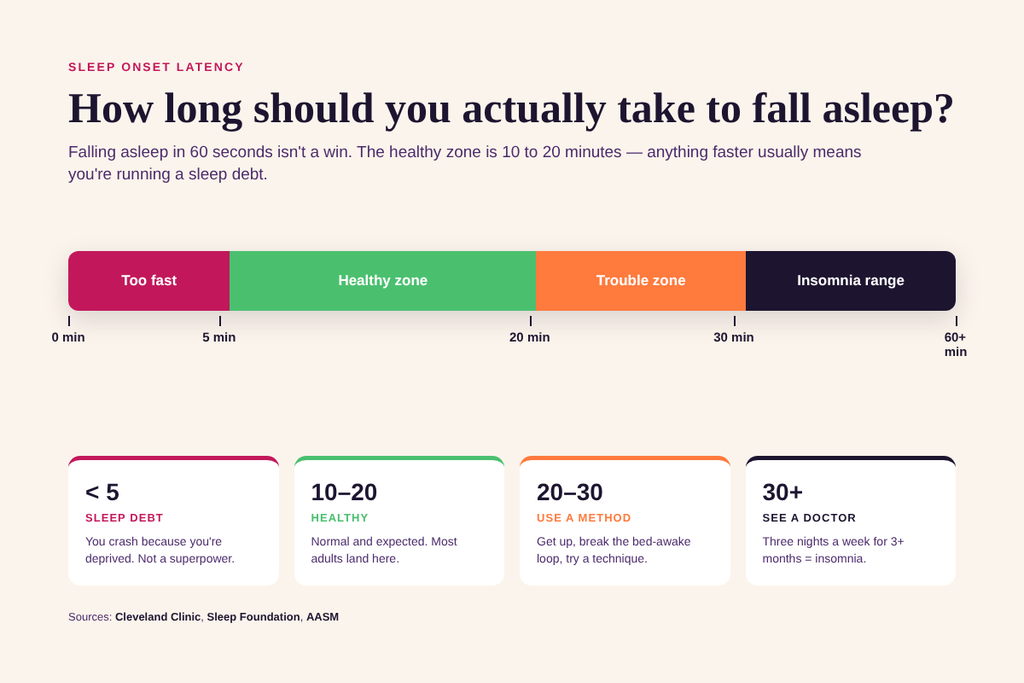
The time between your head hitting the pillow and your brain sliding into real sleep is called sleep onset latency. Sleep clinicians measure it in minutes, and there is a healthy range.
The Cleveland Clinic puts it plainly: “Most people need about 10 to 20 minutes to fall asleep.”
The Sleep Foundation agrees: “A normal sleep latency generally hovers between 10 and 20 minutes.”
Two numbers to keep in your head:
- Under 5 minutes: not a superpower. The Cleveland Clinic calls this a sign of “sleep deprivation or sleep deficiency.” Soldiers, new parents and people who pull all-nighters crash this fast because the debt has to be paid.
- Over 30 minutes, three nights a week, for more than three months: the clinical threshold for insomnia.
So if you are reading this at 1am, the realistic goal is not “zero minutes.” The goal is: stop fighting, trigger the right off-switch for what is keeping you up, and let sleep come in its own time.
The 1-minute test: what’s actually keeping you awake?
Different problems need different methods. A racing mind needs a mental trick. A tense body needs a physical one. A hot bedroom needs a cold shower, not deep breathing.
Below is a short, free test. Three questions. It routes you to the method that has the best evidence for your specific flavour of restlessness. Nothing you answer is saved or sent anywhere.
1 minute. 3 questions. The method that fits you.
Nothing you answer is saved or sent anywhere.
The 9 methods, ranked by the evidence
Here are the techniques with the strongest research support, roughly in order of how reliably they work for most adults.
1. Stimulus control — get out of bed after 20 minutes (the gold standard)
This is the one sleep physicians recommend first, and it is the one people least want to hear.
The rule: if you have been in bed for about 20 minutes and you are not asleep, get up. Leave the bedroom. Sit somewhere dimly lit and do something quietly boring (read a paper book, fold laundry) until you feel sleepy. Then go back to bed. Repeat if you still cannot sleep.
Why it works: your brain is an association machine. If you spend hours in bed awake, worrying, scrolling or staring at the ceiling, it learns that bed = thinking place. Stimulus control was developed by Richard Bootzin in the 1970s and is the backbone of Cognitive Behavioural Therapy for Insomnia (CBT-I), which has stronger long-term evidence than any sleep medication.
Do this tonight if: your mind is actively racing, you’ve been in bed over 20 minutes, or you dread bedtime because you associate it with lying awake.
2. The 4-7-8 breath (slow it down, fast)
Popularised by Dr. Andrew Weil, this is the breath pattern that calms your nervous system by lengthening the exhale, which is the branch of your autonomic nervous system that handles “rest and digest.”
How to do it:
- Exhale fully through your mouth, making a whoosh.
- Close your mouth and inhale through your nose for a count of 4.
- Hold for 7.
- Exhale through your mouth, whoosh, for 8.
- That’s one cycle. Do four.
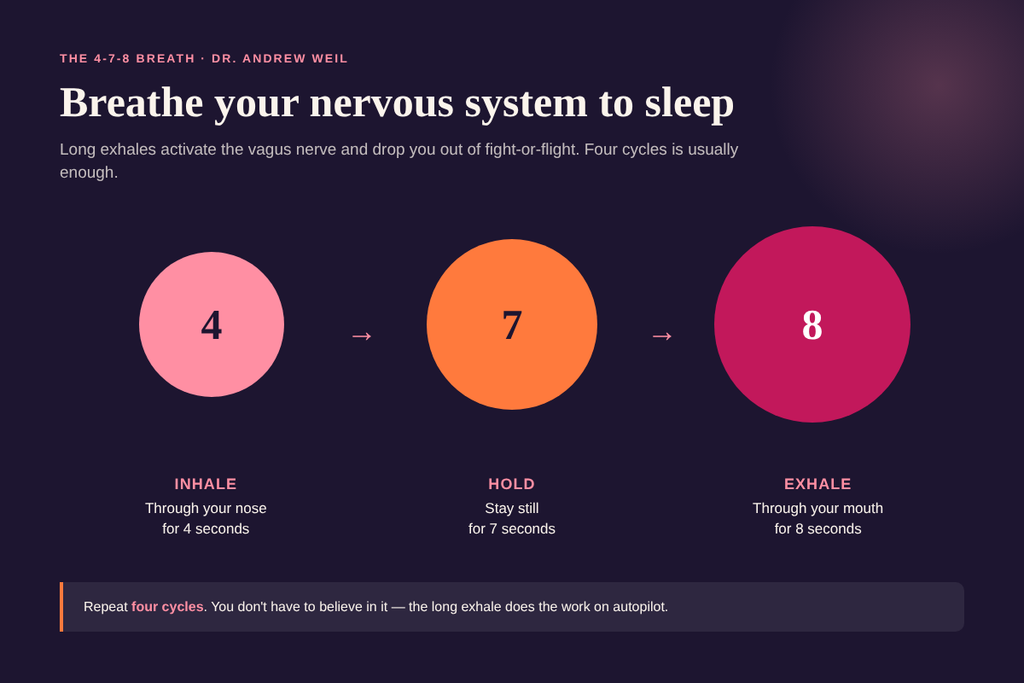
Why it works: long exhales (longer than inhales) activate the vagus nerve, drop your heart rate and push you out of fight-or-flight. It is the same principle as the “physiological sigh” Stanford neuroscientists talk about.
Do this tonight if: your heart feels fast, your chest feels tight, or you’ve just had a stressful conversation or screen session.
3. The military method — train your body to switch off in 2 minutes
Taught to US Navy pre-flight pilots in the 1940s so they could sleep in combat zones and seats of planes. According to Lloyd Bud Winter’s book Relax and Win: Championship Performance, which documented the technique, 96% of pilots who practised for six weeks could fall asleep in two minutes, even in noise, even sitting up, even after coffee.
The sequence:
- Relax your face. All of it. Forehead, jaw, tongue, the tiny muscles around your eyes. Let your cheeks feel heavy.
- Drop your shoulders. Let them fall. Then your upper arms, forearms, hands. One side at a time.
- Breathe out, relax your chest. Then relax your legs, from thighs to feet.
- Clear your mind for ten seconds. If thoughts come back, picture one of these three for ten seconds: lying in a canoe on a calm lake, hammock in the pitch dark, or just repeating “don’t think, don’t think, don’t think.”
The catch: it is a trained skill. You will not nail it tonight. Give it six weeks of nightly practice.
Do this tonight if: you want one method to practise and own long-term, and you are willing to put in a few weeks.
4. Cognitive shuffle — give your brain nonsense to chew on
Invented by Dr. Luc Beaudoin, a cognitive scientist at Simon Fraser University, cognitive shuffling (sometimes called Serial Diverse Imagining) hijacks the exact mental state your brain naturally enters as it drifts off: loose, random, picture-like thoughts.
How to do it:
- Pick a random, neutral word with no emotional charge. Example: bread.
- For each letter, think of a word starting with that letter and picture it for a few seconds. B → balloon (picture a red balloon). R → rhinoceros (picture one). E → elephant. A → apple. D → desk.
- When you run out of ideas for one letter, move to the next.
- When the first word is finished, pick another neutral word and keep going.
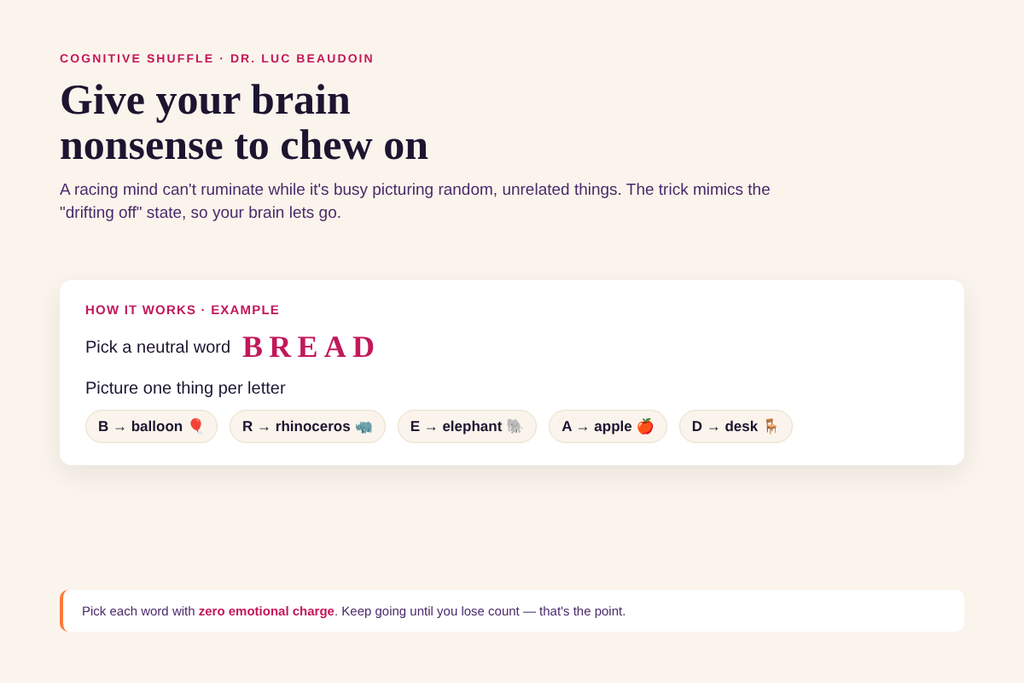
Why it works: your brain cannot plan, worry or ruminate while it is being pushed to picture unrelated things. It mimics the “sleep onset” mind, so your brain decides you are already drifting and the lights go out.
A 2026 small study by Beaudoin’s group found participants fell asleep faster and reported quieter minds versus a control group using standard advice.
Do this tonight if: your problem is a loud, racing, won’t-stop-thinking mind, and breathing exercises just give you more time to think.
5. Progressive muscle relaxation (PMR)
Developed by Edmund Jacobson in 1929 and used in CBT-I protocols today. You tense and release every muscle group in order, head to toe (or toe to head, it does not matter much).
How to do it:
- Tense the muscles in your forehead for 5 seconds. Release for 10.
- Tense your jaw for 5. Release for 10.
- Shoulders, arms, hands, chest, stomach, hips, thighs, calves, feet.
- Notice the contrast between tense and loose. That contrast is the point.
Why it works: tense muscles signal threat to the brain. By forcing them to release one by one, you send the signal that the threat is over. It is especially effective if your “I can’t sleep” shows up as a body thing, not a mind thing: clenched jaw, hunched shoulders, restless legs.
Do this tonight if: you notice you are physically tense, grinding your teeth, or your body feels wired.
6. Paradoxical intention — tell yourself to stay awake
Counterintuitive, well-evidenced, and surprisingly effective for insomnia.
How to do it: get comfortable in bed, eyes open or closed, and gently tell yourself “I am going to stay awake as long as I can.” No reading, no scrolling, no clock-watching. Just lie there and try to stay awake.
Why it works: the harder you try to fall asleep, the more performance pressure you create. That pressure is the enemy. By removing the goal of sleep, you remove the anxiety around not sleeping. Studies on paradoxical intention for insomnia show it reduces sleep onset latency about as well as stimulus control.
Do this tonight if: you have become anxious about sleep itself. You dread bed because you dread not sleeping.
7. Body scan meditation
Close cousin of PMR, but without the tensing. You just move your attention slowly across your body, noticing each part without trying to change anything: scalp, forehead, jaw, neck, each shoulder, each arm, each hand, chest, belly, each hip, each thigh, each shin, each foot.
Why it works: attention on body sensation competes with attention on thoughts. You are using your bandwidth on something calming instead of your 2am problems.
Do this tonight if: you like meditation generally, or you want something gentler than tense-and-release.
8. Guided imagery / visualisation
Picture a specific, detailed, calm place. Not “a beach” — your beach. The temperature of the sand under your left heel. The specific green of the water. The sound of one gull. The salt smell. The hotter the detail, the better the result. A Sleep Foundation review found guided imagery reduced sleep onset in insomnia patients compared with controls.
Do this tonight if: you are a visual thinker and the cognitive shuffle feels too random.
9. Counting backwards from 1,000 by 7s
Low-tech, surprisingly effective. 1,000, 993, 986, 979… It requires just enough concentration to crowd out other thoughts, and it is boring enough to put you under.
Note: counting sheep does not work. A University of Oxford study found visualising a calming scene beat counting sheep, and counting sheep took longer than doing nothing.
Do this tonight if: you are travelling, cannot reach the lights, and want something you can do with zero setup.
The environment levers (do these before you need the tricks)
You can do all nine methods above, but if your room is 76°F and bright, none of them will stick. Three environment levers matter more than any breathing exercise.
Temperature: cool the room, warm then cool the body
The key signal that it is time to sleep is a small drop in your core body temperature. You can engineer that drop two ways.
- Keep the bedroom between 65°F and 68°F (18–20°C). Open a window, run a fan, turn the thermostat down.
- Take a warm shower or bath 60 to 90 minutes before bed. Counter-intuitive but well-evidenced: the warm water pulls blood to your skin, your body dumps heat into the surrounding air as you cool down afterwards, and your core temperature drops faster than it would otherwise. A University of Texas meta-analysis found this timing reduced sleep onset by an average of 10 minutes.
Light: bright by day, dim by night
Your circadian rhythm — the 24-hour clock that decides when you feel sleepy — runs on light. Give it the right signals and you will feel sleepy at the right time.What falling asleep fast really means
- In the morning: get 5–10 minutes of outdoor light within an hour of waking. Not through a window. Outside. Even cloudy days are brighter than any lamp.
- In the evening: dim everything 2 hours before bed. Warm bulbs, not bright white. Phone on night mode or, better, out of the bedroom.
Caffeine: the 8-hour rule
Caffeine has a half-life of around 5 to 6 hours. A 2pm coffee is still ~25% active in your system at 10pm. For most people, a hard cut-off 8 hours before bed fixes it. If you sleep at 11pm, that means last caffeine at 3pm.
What NOT to do
Skip these. They feel productive and they are not.
- Scrolling your phone. Each notification is a small shot of dopamine. You are training your brain to expect reward when it should be winding down. Also: blue light suppresses melatonin, but the content is usually a bigger problem than the light.
- A large megadose of melatonin. Melatonin is a signal, not a sledgehammer. 0.3–1 mg about an hour before bed is the dose that has evidence; the 5 mg and 10 mg gummies on shelves are 10–30× what your body uses, and the extra just gives you grogginess the next day.
- A nightcap. Alcohol helps you fall asleep and wrecks the second half of the night, when your brain does its most valuable repair work. You wake at 3am, heart thumping, and lose an hour.
- Lying there “trying harder.” Every minute past 20 in bed awake is a minute reinforcing the bed-equals-thinking association. Go back to stimulus control.
- Counting sheep. Oxford says it is worse than doing nothing. Use visualisation or the cognitive shuffle instead.
When “I can’t sleep” is a medical thing
These guides are not substitutes for a doctor. See one if any of these are true:
- You have trouble falling or staying asleep three or more nights a week for more than three months, and it is affecting your days.
- Your partner says you snore loudly, gasp or stop breathing in your sleep. That is sleep apnea, which is treatable and dangerous untreated.
- You fall asleep in under 5 minutes every night, even though you think you are rested. Pathological sleepiness can be a sign of sleep debt or a disorder like narcolepsy.
- Sleep problems are paired with persistent low mood, panic, or thoughts of harming yourself. Insomnia and depression often arrive together.
If you are in crisis in the US: call or text 988 (Suicide and Crisis Lifeline). In the UK: Samaritans, 116 123, free from any phone.
What to do tonight, in order
If you want one plan to try the moment you close this tab:
- Check the room. Temperature 65–68°F. Lights dim. Phone out of reach (or at least face down).
- Pick your method from the test above. Racing mind → cognitive shuffle. Tense body → PMR. Anxious about sleep → paradoxical intention. Default to the 4-7-8 breath if you’re not sure.
- Set a soft 20-minute cap. No clock-watching, just a sense. If you’re still awake, get up, read something boring in dim light, come back when sleepy.
- Tomorrow: sunlight within an hour of waking, caffeine cut-off 8 hours before bed, warm shower 90 minutes before bed.
Sleep is a habit, not a pill. Give it two weeks and the nights get shorter.
FAQs
How long should I actually take to fall asleep?
Between 10 and 20 minutes is normal and healthy. Under 5 minutes, routinely, is a sign of sleep deprivation, not a sign that you are a “good sleeper.” Over 30 minutes, three nights a week, for more than three months, is the clinical threshold for insomnia.
Does the military method really work in 2 minutes?
According to Lloyd Bud Winter’s book that documented the technique, about 96% of US Navy pre-flight pilots could do it in 2 minutes after six weeks of nightly practice. It is a trained skill, not a party trick. Night one will not be it.
What is the fastest way to fall asleep tonight if I’ve never done any of this before?
The 4-7-8 breath. Four cycles. It requires no setup, no learning, and it works on your nervous system directly, so you don’t have to believe in it for it to help.
Is counting sheep actually useful?
No. A University of Oxford study found visualising a specific calming scene beat it, and counting sheep took longer to work than doing nothing at all. Try the cognitive shuffle or guided imagery instead.
Does melatonin help you fall asleep faster?
A little, at the right dose. 0.3 to 1 mg about an hour before bed, used short-term, has evidence behind it. The 5 and 10 mg gummies are 10 to 30 times the useful dose and often leave you groggy the next morning. Melatonin is a timing signal, not a sedative.
What temperature should my bedroom be?
Between 65°F and 68°F (18–20°C) for most adults. Cooler helps your core body temperature drop, which is the signal your brain uses to start sleep.
I keep waking up at 3am. Is that the same problem?
No, that is a different problem called sleep maintenance insomnia. The techniques above still help you fall back asleep (especially stimulus control and 4-7-8). But if it is happening nightly, check caffeine, alcohol, room temperature and stress levels, and see a doctor if it continues for more than a month.
Sources
- Cleveland Clinic: “How Long Should It Take To Fall Asleep?”
- Sleep Foundation: “Sleep Latency”
- Winter, Lloyd Bud. Relax and Win: Championship Performance, 1981 (documented the US Navy pre-flight sleep technique).
- Beaudoin, L. P. et al.: Serial Diverse Imagining (cognitive shuffling), Simon Fraser University.
- Bootzin, R. R.: Stimulus Control Therapy for Insomnia.
- Weil, A.: 4-7-8 breath method, University of Arizona Center for Integrative Medicine.
- Haghayegh, S. et al.: “Before-bedtime passive body heating by warm shower or bath to improve sleep: A systematic review and meta-analysis,” Sleep Medicine Reviews, 2019.
- American Academy of Sleep Medicine: clinical guidelines on insomnia.
- National Sleep Foundation: light, temperature and caffeine recommendations.
Related: How to Stop Overthinking at Night · What Time Should I Go to Bed? · Daily Mental Health Check-In

Join the Lifoholic community conversation. We welcome thoughtful insights, questions, and authentic experiences from our readers.
RECOMMENDED DISCUSSIONS
How to Choose a Health Plan Without Overpaying: HMO vs PPO vs HDHP
How to Stop Overthinking at Night: 9 Things That Actually Help