
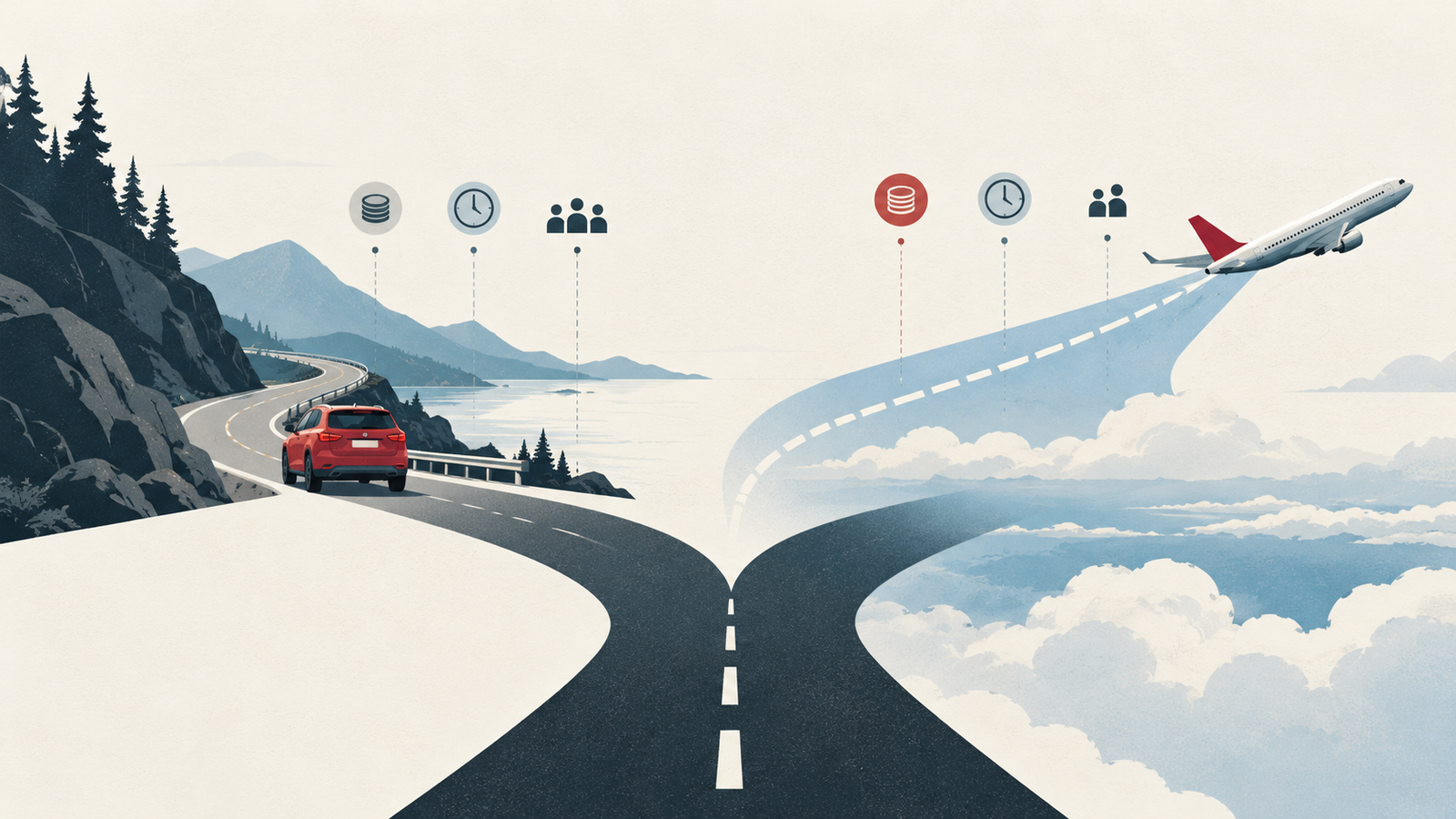
Drive or fly? Every holiday season, millions of people ask this question at the kitchen table. Yet most answer it with just two numbers: the price of a ticket and the cost of a tank of gas.
But that comparison is broken, because it leaves out your car’s wear and tear, the bag fees, the airport parking, the rides at the other end, and the hours you spend getting there. So we rebuilt the drive or fly comparison with current government and AAA data. Then we ran it on real trip lengths and group sizes.
As a result, you get a simple rule you can use in ten seconds, plus a calculator for when the answer is close.
Quick answer
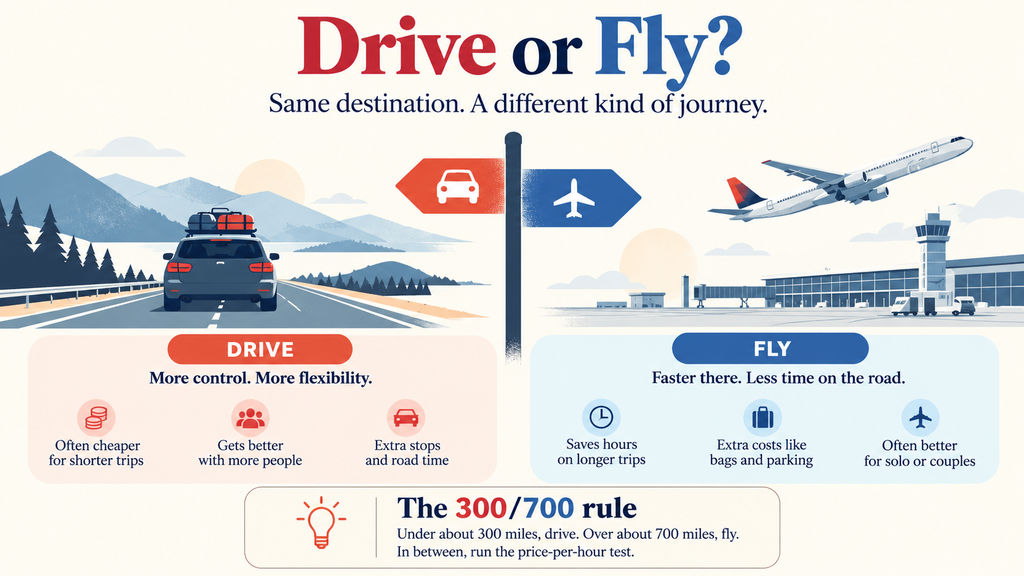
- The 300/700 rule: under about 300 miles, drive. Over about 700 miles, fly, unless you’re a family on a tight budget. In between, run the price-per-hour test.
- A mile of driving really costs about 28 cents at today’s gas prices: around 16 cents in fuel plus 11.7 cents in tires, maintenance and repairs.
- Every extra passenger favors the car. One more person costs nothing to drive and a full fare to fly.
- The price-per-hour test: divide the extra cost of flying by the hours it saves. If that’s less than an hour of your time is worth, fly.
- Break-even fare: flying only wins on cost if the round-trip fare is below (driving cost − bags − parking − rides) ÷ travelers.
The Short Answer: Should You Drive or Fly?
So here’s the verdict for the most common trips. It assumes a 4-day trip, a $250 round-trip fare, one checked bag for every two people, $80 of airport parking and $80 of rides at the other end. Of course, your numbers will differ, so the calculator below lets you change every one of them.
| One-way distance | Solo | Couple | Family of 4 |
|---|---|---|---|
| 250 miles (about 4.5 hours) | Drive | Car wins easily | Drive |
| 500 miles (about 9 hours) | Close: price-per-hour test | Drive, unless your time is worth $32+ an hour | Drive |
| 750 miles (overnight stop) | Fly | Close: fly if fares are under $242 | Drive if budget comes first |
| 1,000 miles (overnight stop) | Fly | Plane wins | Fly if fares are under $133, otherwise drive |
Notice the pattern here. Distance pushes you toward the plane, while group size pulls you back to the car. That’s why one family’s obvious answer is another family’s mistake.
The Latest Drive or Fly Numbers
Prices change fast, so here are the figures this guide uses. We check them regularly.
Latest data (checked 24 October 2026)
- Regular gas averaged $4.284 a gallon in the week of 19 October, up $1.27 on a year ago (US Energy Information Administration).
- AAA puts maintenance, repairs and tires at 11.7 cents a mile and fuel at 17.3 cents in its latest study (AAA Your Driving Costs 2026).
- New vehicles average a record 27.2 mpg in real-world driving (US EPA).
- The average US domestic airfare was $445 in the second quarter, including taxes. One-way tickets averaged $312, and round trips $549. Bag fees and seat fees are extra (Bureau of Transportation Statistics, 29 September 2026).
- A first checked bag now costs $45 each way on American and Delta (when paid online on American) (American Airlines, Delta).
Drive or Fly: What a Mile of Driving Really Costs
Most people only count gas when they decide whether to drive or fly, so let’s start there and then add what they miss.
First, at $4.28 a gallon and 27 miles per gallon, fuel costs about 16 cents a mile. That’s the part you see at the pump.
But every mile also wears your tires, uses up oil and brings the next repair a little closer. In fact, AAA’s latest study puts those costs at 11.7 cents a mile. You don’t pay them on the day, yet you do pay them eventually.
So the real cost of a road-trip mile is about 28 cents. For example, a 500-mile trip each way costs about $160 in fuel but about $275 in total.
What about the IRS mileage rate?
You may have seen the IRS business rate of 76 cents a mile. The IRS raised it from 72.5 cents on 1 July 2026 because of rising fuel prices (IRS Announcement 2026-11). However, that rate includes insurance, registration and depreciation. You pay those whether or not you take the trip, so they don’t belong in a drive or fly decision.
Instead, the IRS medical and moving rate is a better guide. It’s based “only on the variable costs” of driving, according to the IRS, and it now stands at 23.5 cents a mile. That’s close to our 28 cents, so the estimate looks fair.
Electric car?
In that case, the math gets even friendlier to driving. AAA’s study assumes electricity at 18 cents per kWh. At about 3.5 miles per kWh, that’s roughly 5 cents a mile in “fuel” when charging at home. Fast chargers on the highway cost more, though, so check the prices on your route.
What It Really Costs to Fly Instead of Drive
The fare is only the start when you fly. Here’s what the ticket price leaves out.
- Bag fees. A first checked bag costs $45 each way on American (online) and Delta. So one bag on a round trip adds $90. Southwest started charging for bags in 2025, at $35 for a first bag when the fees launched (ABC7).
- Getting to the airport. For example, economy parking at Atlanta’s Hartsfield-Jackson now costs $20 a day, up from $14 (Atlanta News First). A four-day trip adds $80 before you board.
- Getting around when you land. Rides from the airport, or a rental car if you need one for the whole stay.
- Seat fees. Families who want to sit together on basic economy often pay extra.
- Airport food. It’s a small cost, but it adds up for a family.
Add those up, and a $250 fare becomes about $335 to $410 per person. That’s the real number to compare with the drive, not the fare alone.
The Break-Even Fare: When It’s Cheaper to Fly Than Drive
This is the number that settles most drive or fly debates on cost alone. It’s the highest fare at which flying still costs less than driving.
Break-even fare per person = (round-trip driving cost − bag fees − airport parking − rides at the destination) ÷ number of travelers
For example, take a couple driving 750 miles each way. The round-trip drive costs about $413 in fuel and wear. Then add $320 for a hotel night in each direction (about the US average hotel rate), because nobody should drive 13.5 hours in one go. That’s $733 in total.
Next, subtract the flying extras: $90 for one checked bag, $80 for parking and $80 for rides. That leaves $483. Finally, divide by two travelers, and the break-even fare is about $242 per person.
So if you can find round-trip fares under $242, flying is cheaper and saves a full day each way. Above that, the car wins on money, though not on time.
Better still, our calculator works out your break-even fare automatically.
Drive or Fly Calculator
Enter your distance, group and fare, and the calculator tells you whether to drive or fly. It also shows your break-even fare and the price-per-hour test, in miles or kilometers and any currency.
Compares the real round-trip cost and door-to-door time. Defaults use US averages, so change them to fit your trip. Also, nothing you enter leaves your device.
🚗 Drive
✈️ Fly
Estimates only. Assumes 55 mph (88 km/h) driving with stops, 450 mph (725 km/h) flying plus 90 minutes of taxiing and arrival time. Sources: AAA 2026, US EIA, American and Delta (October 2026).
Is It Faster to Drive or Fly? Your Time Counts Too
Money is only half of the decision, though. The other half is time, and here the plane is not as fast as it looks.
A 500-mile flight lasts just over an hour. However, the trip door to door takes much longer. You drive to the airport, arrive about two hours early, board, taxi, land, wait for bags and then find a ride. Our model counts 45 minutes to reach the airport, 2 hours before departure, 30 minutes of taxiing and an hour at the other end.
As a result, a clear pattern appears:
| One-way distance | Driving time (55 mph average) | Flying, door to door |
|---|---|---|
| 250 miles | 4h 33m | 4h 48m |
| 500 miles | 9h 05m | 5h 22m |
| 750 miles | 13h 38m (or an overnight stop) | 5h 55m |
| 1,000 miles | 18h 11m (an overnight stop) | 6h 28m |
So under about 300 miles, driving is usually just as fast. Above that, flying starts to save real hours.
The price-per-hour test
When it's cheaper to drive but faster to fly, use this test. Divide the extra cost of flying by the hours it saves. That tells you what you're paying for each hour you get back.
For example, a couple going 500 miles each way would pay $474 more to fly at $250 a ticket. In return, though, they'd save about 7.5 hours over the round trip. That works out at about $64 an hour for the pair, or $32 each.
Is an hour of your time worth more than that? To find out, first work out your real hourly wage after tax and work costs. If it's higher, and the time matters to you, flying makes sense. If not, drive and enjoy the extra money.
Not every hour is equal, though. Driving hours with your family and a good playlist feel different from hours lost in a security line. In fact, some people even count the road trip as part of the holiday.
Drive or Fly? Five Real Trips Run Through the Numbers
Here's how the drive or fly math plays out for five common situations. Each one also uses the same defaults as the table above.
- Solo, 250 miles to a work meeting. Driving costs about $138 and takes 4.5 hours. Flying costs about $410 and takes slightly longer door to door. Verdict: drive, and it isn't close.
- Couple, 500 miles for a long weekend. Driving costs about $276, while flying costs about $750 at $250 fares. Flying saves 7.5 hours, at $64 an hour. Verdict: drive, unless the time is worth more to you than that.
- Family of four, 500 miles for Thanksgiving. Driving still costs about $276, whereas flying costs about $1,340. Each hour saved costs $143. Verdict: drive, and leave early in the morning.
- Solo, 1,000 miles to see family. Driving costs about $871, including two hotel nights, and takes two days each way. Flying costs about $410. Verdict: fly, and it saves both money and two days.
- Family of four, 1,000 miles. Driving costs about $871, compared with $1,340 to fly at $250 fares. The break-even fare is about $133 each. Verdict: drive if money is tight, fly if the fares drop or the days off are precious.
Driving for the Holidays? Timing Matters More Than Route
Around 82 million Americans traveled over last year's Thanksgiving week, and nearly 90% of them went by car, according to INRIX and AAA. Only about 6 million flew.
As a result, the roads fill up at predictable times. Last year, the worst traffic hit on Tuesday and Wednesday afternoons before Thanksgiving, and Sunday's return was busy almost all day. So leave in the morning if you can, and consider coming back on Monday.
Safety matters too, especially on long holiday drives. Drowsy driving killed 644 people in the US in 2024, according to NHTSA. The agency's advice is simple: sleep properly before a long drive, avoid driving between midnight and 6 am, and take a 20-minute nap at a safe stop if you feel sleepy. Coffee alone doesn't fix tiredness. If you need help getting to bed earlier the night before, our bedtime calculator works backwards from your wake-up time.
Insider Tips to Cut the Cost Either Way
Whether you drive or fly, these tips make the trip cheaper.
If you drive
- Check your tire pressure before you leave. It's free, and it helps both fuel economy and safety.
- Pack light. That's because extra weight and roof boxes both raise fuel use at highway speeds.
- Plan fuel stops. Prices often vary a lot between neighboring states, so a quick check of your route can save several dollars a tank.
- Choose the scenic route when the time difference is small. Our favorite coastal drives around the world show how much a road trip can add.
- Share the driving. Swap drivers every two hours, and stop before you feel tired.
If you fly
- Travel carry-on only. One good bag saves $90 a round trip. Our guide to the best travel backpacks helps you pick one that fits the airline's limits.
- Pay bag fees online. On American, it's $5 cheaper per bag than at the airport.
- Check your card's perks. Some airline cards include a free first checked bag. For example, Delta waives it for eligible SkyMiles American Express cardholders.
- Get TSA PreCheck if you fly a few times a year. It costs about $78 to $85 for new enrollment, and TSA says about 99% of PreCheck passengers wait less than 10 minutes (TSA).
- Know your refund rights. Under federal rules, airlines must refund you if they cancel a flight or delay it by three hours or more on a domestic trip and you choose not to travel. They must also refund your bag fee if your bag is more than 12 hours late (US Department of Transportation).
- Book at the right time. Our month-by-month guide to the best time to buy everything includes when flight prices usually drop.
Don't Forget Where You'll Stay
The drive or fly choice often changes where you'll sleep, too. If you drive, you have a car at the other end, so a cheaper place outside the city center works. If you fly, staying central can save you rides or a rental car.
Our Airbnb vs hotels cost comparison shows when a rental beats a hotel, depending on how many nights you stay and how many people you're traveling with. And if your next trip is a European city break, check the tourist tax before you book.
Outside the US
The same drive or fly logic works anywhere, although the numbers change. In Europe and the UK, fuel costs more per mile, distances are shorter and trains are often a third option. So switch the calculator to kilometers and your currency, and enter your local prices. As a rule, the airport overhead still makes driving or the train faster on most trips under about 480 km.
Frequently Asked Questions
Is it cheaper to drive or fly?
For most trips under about 500 miles, driving is cheaper, especially with two or more people. A mile of driving costs about 28 cents in fuel and wear, while flying adds bag fees, parking and rides to the fare. Beyond about 700 miles, flying is often cheaper for one or two travelers.
At what distance does flying make more sense than driving?
Flying usually becomes faster door to door after about 300 miles, because of the time spent getting to the airport, going through security and collecting bags. Also, it usually becomes cheaper after about 700 miles for solo travelers and couples, because the drive then needs an overnight hotel stop.
How much does it cost to drive per mile?
About 28 cents a mile at current US prices. That's roughly 16 cents for fuel at $4.28 a gallon and 27 mpg, plus 11.7 cents for maintenance, repairs and tires, based on AAA's 2026 study. However, insurance and depreciation stay much the same whether or not you take the trip, so leave them out.
Should I use the IRS mileage rate to compare driving and flying?
Not the business rate. At 76 cents a mile, it includes fixed costs such as insurance and depreciation that you pay anyway. The IRS medical and moving rate of 23.5 cents a mile covers only variable costs, so it's a closer match to the real cost of one extra trip.
Is it cheaper for a family to drive or fly?
Usually it's cheaper to drive, because a car costs the same whether it carries one person or four, while every seat on a plane needs a fare. For a family of four going 1,000 miles each way, flying only beats driving on cost if round-trip fares fall below about $133 each.
How do I calculate the break-even fare?
Take the full round-trip driving cost, including fuel, wear, tolls and any hotel stops. Subtract the extra costs of flying, such as bag fees, airport parking and rides at your destination. Then divide by the number of travelers. If you can find fares below that number, flying is cheaper.
Is it faster to drive or fly 300 miles?
They're usually about the same. A 300-mile drive takes around five and a half hours, and flying takes about five hours door to door once you add the trip to the airport, the two-hour buffer and the wait for bags. Traffic, delays or a long trip to the airport can easily swing it either way.
Is it safer to drive or fly?
Statistically, commercial flying is much safer than driving per mile traveled. If you drive, the biggest risk you can control is fatigue. NHTSA recorded 644 deaths in drowsy-driving crashes in 2024, so sleep well beforehand, share the driving and stop for a short nap if you feel sleepy.
The Bottom Line
So, should you drive or fly? Start with the 300/700 rule. Under 300 miles, drive. Over 700, fly, unless a family budget says otherwise. In between, the answer depends on your group, your fare and what your time is worth.
Then count the real costs on both sides: about 28 cents a mile to drive, and the fare plus bags, parking and rides to fly. Work out your break-even fare, and if the car is cheaper but slower, run the price-per-hour test.
Most importantly, don't decide whether to drive or fly on the ticket price alone. The cheapest trip is the one where you count everything before you book.
Sources
- US Energy Information Administration, Gasoline and Diesel Fuel Update (week of 19 October 2026): https://www.eia.gov/petroleum/gasdiesel/
- AAA, Your Driving Costs 2026 fact sheet: https://newsroom.aaa.com/wp-content/uploads/2026/09/AAA_YDC-Fact-Sheet_2026.pdf
- AAA, New Vehicle Ownership Costs Hit $12,863 Annually (September 2026): https://newsroom.aaa.com/2026/09/aaa-new-vehicle-ownership-costs-hit-12863-annually/
- US EPA, Automotive Trends Report highlights: https://www.epa.gov/automotive-trends/highlights-automotive-trends-report
- IRS, Announcement 2026-11 (Internal Revenue Bulletin 2026-29): https://www.irs.gov/pub/irs-irbs/irb26-29.pdf
- IRS, 2026 standard mileage rates news release: https://www.irs.gov/newsroom/irs-sets-2026-business-standard-mileage-rate-at-725-cents-per-mile-up-25-cents
- Bureau of Transportation Statistics, Second Quarter 2026 Average Air Fare (29 September 2026): https://www.bts.gov/newsroom/second-quarter-2026-average-air-fare-decreased-002-first-quarter-2026
- American Airlines, Checked bag policy: https://www.aa.com/i18n/travel-info/baggage/checked-baggage-policy.jsp
- Delta Air Lines, Baggage overview: https://www.delta.com/us/en/baggage/overview
- ABC7, Southwest Airlines sets price for baggage fees: https://abc7.com/post/southwest-airlines-sets-price-baggage-fees-see-how-youll-have-pay-luggage/16563297/
- Atlanta News First, Hartsfield-Jackson parking rates: https://www.atlantanewsfirst.com/2025/04/21/hartsfield-jackson-airport-reveals-significant-increase-parking-rates/
- INRIX, Nearly 82 Million Americans Projected to Travel Over Thanksgiving (November 2025): https://inrix.com/press-releases/nearly-82-million-americans-projected-to-travel-over-thanksgiving/
- NHTSA, Drowsy Driving: https://www.nhtsa.gov/risky-driving/drowsy-driving
- TSA, TSA PreCheck: https://www.tsa.gov/precheck
- US Department of Transportation, What Airline Passengers Need to Know About DOT's Automatic Refund Rule: https://www.transportation.gov/briefing-room/what-airline-passengers-need-know-about-dots-automatic-refund-rule



Join the Lifoholic community conversation. We welcome thoughtful insights, questions, and authentic experiences from our readers.
RECOMMENDED DISCUSSIONS
Tourist Tax in Europe: What You’ll Pay Per Night in 10 Cities (and How to Work It Out)
Airbnb vs Hotels: Which Is Actually Cheaper