

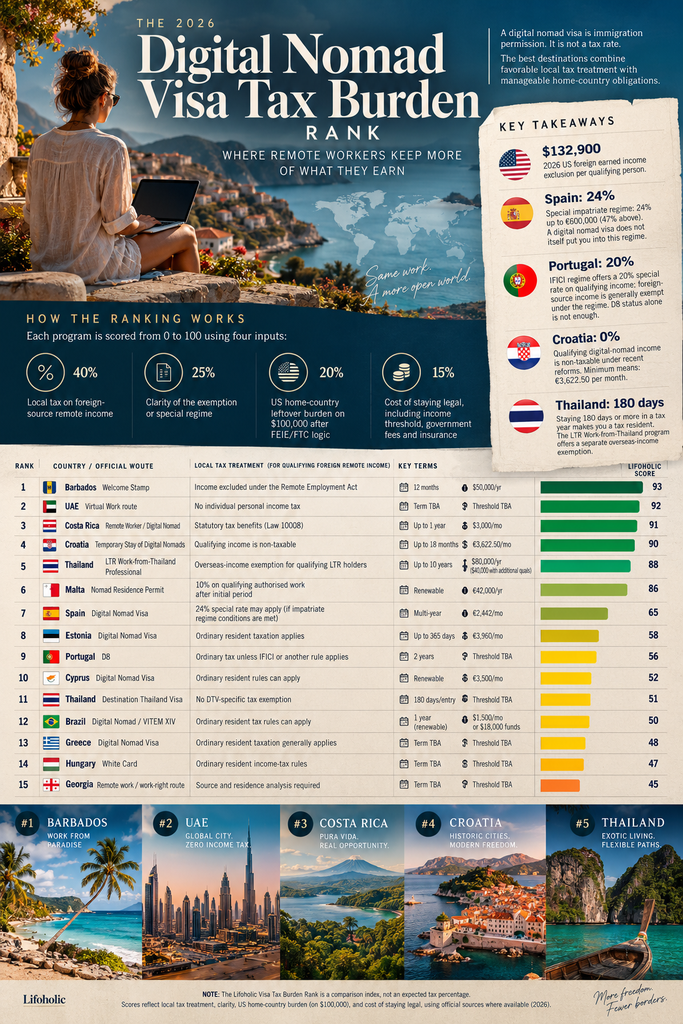
Barbados, the UAE, Croatia and Costa Rica sit near the top of the Lifoholic Visa Tax Burden Rank because qualifying remote workers can receive unusually favorable local treatment. But the $100,000 question has two parts: what the host country taxes and what your home country still claims. A digital nomad visa does not cancel IRS filing for Americans, and it does not automatically end UK tax residence for British contractors.
Key takeaways
- The 2026 US foreign earned income exclusion is $132,900 per qualifying person, according to the Internal Revenue Service.
- Spain’s special impatriate regime applies a 24% rate up to €600,000 and 47% above €600,000, but qualifying for a Spanish digital nomad visa does not itself put you into that tax regime.
- Portugal’s IFICI regime offers a 20% special rate on qualifying Portuguese Category A and B income, while qualifying foreign-source income is generally exempt under the regime; D8 immigration status alone is not enough.
- Croatia’s Ministry of the Interior lists €3,622.50 per month as the current minimum means for a digital nomad, while Croatian government tax reforms specifically made qualifying digital-nomad income non-taxable.
- Thailand treats a person staying 180 days or more in a tax year as resident under section 41 of its Revenue Code, while its LTR Work-from-Thailand program separately offers an overseas-income exemption.
Which digital nomad visas have the lowest tax?
A digital nomad visa is immigration permission. It is not a tax rate.
That distinction is the reason the Lifoholic ranking looks different from a typical “best digital nomad countries” list. A cheap application and a beach apartment are irrelevant if staying long enough turns your $100,000 foreign salary into taxable resident income.
The Lifoholic Visa Tax Burden Rank
The Lifoholic Visa Tax Burden Rank scores each program from 0 to 100 using four inputs only:
- Local tax on foreign-source remote income — 40%
- Clarity of the exemption or special regime — 25%
- US home-country leftover burden on $100,000 after FEIE/FTC logic — 20%
- Cost of staying legal, including income threshold, government fees and mandatory insurance — 15%
The score is a comparison index, not an expected tax percentage. Countries lose points where a favorable regime requires a separate election, where remote work can be treated as locally sourced, or where a current 2026 cost cannot be verified from an official source.
| Rank | Country / official route | Local tax treatment for qualifying foreign remote income | Special regime | Income floor | Max stay | Main tax-residency issue | Lifoholic score |
| 1 | Barbados — Welcome Stamp | Welcome Stamp income is excluded from Barbados-source income under the Remote Employment Act | Welcome Stamp statutory treatment | $50,000 expected annual income / means test | 12 months | Visa treatment is unusually explicit | 93 |
| 2 | UAE — Virtual Work route | No individual personal income tax; business owners require separate analysis | UAE tax system | [STAT NEEDED: current 2026 salary requirement | try: ICP, GDRFA Dubai] | [STAT NEEDED: current permit validity | try: ICP] | Tax residence and business activity are separate questions | 92 |
| 3 | Costa Rica — Remote Worker / Digital Nomad | Foreign remuneration receives statutory tax benefits for qualifying beneficiaries | Law 10008 | $3,000/month individual | Up to 1 year, renewable | Law treats beneficiaries as non-habitual residents for the relevant benefit | 91 |
| 4 | Croatia — Temporary Stay of Digital Nomads | Qualifying digital-nomad income receives a statutory exemption | Croatian digital-nomad exemption | €3,622.50/month | Up to 18 months | Other income categories remain separate | 90 |
| 5 | Thailand — LTR Work-from-Thailand Professional | Overseas-income exemption for qualifying LTR holders | LTR | $80,000/year normally; $40,000 with additional qualifications | Up to 10 years subject to continued qualification | LTR benefit is separate from ordinary Thai residence rules | 88 |
| 6 | Malta — Nomad Residence Permit | 10% on qualifying authorised work after the applicable initial period | Nomad Residence Permit tax rules | €42,000/year | Renewable | Permit does not automatically guarantee special tax treatment | 86 |
| 7 | Spain — Digital Nomad Visa | 24% special rate may apply if impatriate regime conditions are met | Special impatriate / Beckham regime | €2,442/month for a solo applicant in 2026 | Multi-year residence possible | Visa and tax election are separate | 65 |
| 8 | Estonia — Digital Nomad Visa | Ordinary resident taxation applies after residence is established | None specific to DNV | €3,960/month | Up to 365 days | Residence can arise at 183 days or from a place of residence | 58 |
| 9 | Portugal — D8 | Ordinary Portuguese tax unless IFICI or another rule applies | IFICI, separately qualified | [STAT NEEDED: current D8 income threshold, Portugal, 2026 | try: AIMA, Portuguese consulates] | Initial residence permit 2 years | D8 does not automatically create IFICI eligibility | 56 |
| 10 | Cyprus — Digital Nomad Visa | Ordinary resident rules can apply | None specific | €3,500/month | Renewable | Cyprus also has a separate 60-day residence route | 52 |
| 11 | Thailand — Destination Thailand Visa | No DTV-specific income-tax exemption | None specific | [STAT NEEDED: current DTV financial evidence, 2026 | try: Thai MFA] | 180 days per entry | 180-day Thai tax-residence rule matters | 51 |
| 12 | Brazil — Digital Nomad / VITEM XIV | Ordinary resident tax rules can apply | None specific | $1,500/month or $18,000 bank funds | 1 year, renewable for another year | Residence status changes the tax analysis | 50 |
| 13 | Greece — Digital Nomad Visa | Ordinary resident taxation generally applies | Separate incentives may exist | [STAT NEEDED: current 2026 threshold | try: Ministry of Migration, AADE] | [STAT NEEDED] | 183-day and centre-of-interests rules matter | 48 |
| 14 | Hungary — White Card | Ordinary resident income-tax rules generally apply | None specific | [STAT NEEDED: current 2026 White Card threshold | try: NDGAP] | [STAT NEEDED] | Visa carries no automatic nomad tax exemption | 47 |
| 15 | Georgia — remote work / work-right route | Source and residence analysis required | No dedicated nomad tax exemption | Route dependent | Visa-free stay can remain available to eligible nationalities | 2026 work-right changes make old nomad guidance unreliable | 46 |
| 16 | Colombia — Visa V Nómadas Digitales | Ordinary resident taxation can apply | None specific | 3× Colombian statutory monthly minimum wage | Up to 2 years | More than 183 days in 365 days can create residence | 43 |
| 17 | Romania — Digital Nomad Visa | Special short-stay treatment can change after residence threshold | Digital-nomad provisions | [STAT NEEDED: exact 2026 income threshold | try: IGI, Romanian MFA] | [STAT NEEDED] | 183-day threshold matters | 42 |
| 18 | Italy — Digital Nomad / Remote Worker Permit | Ordinary resident taxation generally applies | Other regimes require separate qualification | [STAT NEEDED: current official 2026 minimum income | try: Italian MFA] | [STAT NEEDED] | Visa itself is not a tax exemption | 41 |
| 19 | Malaysia — DE Rantau | Work physically performed in Malaysia can be Malaysian-source | No automatic DE Rantau tax exemption | [STAT NEEDED: current MDEC income test, 2026 | try: MDEC] | [STAT NEEDED] | Malaysia uses statutory residence and source tests | 39 |
| 20 | Panama — Remote Worker route | Territorial system, but source of work performed from Panama requires care | Territorial/source taxation | [STAT NEEDED: current official income requirement and fees | try: Migración Panamá, DGI] | [STAT NEEDED] | “Territorial” does not automatically mean remote work is untaxed | 34 |
Source: Lifoholic synthesis from official immigration agencies, tax authorities and legislation reviewed in September 2026, including Barbados legislation, Costa Rica’s Law 10008 framework, Croatia’s Ministry of the Interior, Thailand’s Revenue Department and Board of Investment, Malta’s tax authority, Spain’s Agencia Tributaria and Portugal’s Autoridade Tributária.
The ranking deliberately penalizes uncertainty. A missing government fee or unverified 2026 income threshold is better shown as missing than replaced with a number copied from a visa blog.
[EXPERIENCE INSERT NEEDED: Add one real accountant conversation or day-count example. Ideally show the planned arrival date, the date the adviser said tax residence would arise, and one assumption the adviser corrected.]
Does a digital nomad visa make you tax resident?
No. A digital nomad visa does not automatically make you tax resident, and it does not automatically protect you from becoming tax resident either.
Immigration status answers whether you may stay. Tax residence answers which country’s resident-tax rules apply to you.
Thailand makes the distinction unusually visible. Section 41 of the Thai Revenue Code treats someone present for 180 days or more in a tax year as a resident. The same section separately deals with income from employment or business carried on in Thailand. Thai Revenue Department — Revenue Code section 41
Estonia uses a different structure. The country can treat you as tax resident because you establish a place of residence there or because your presence reaches the statutory day threshold. Estonia’s Tax and Customs Board lists the 2026 income-tax rate at 22%.
The common “stay under 183 days and you are safe” rule is therefore too crude to use for a move involving $100,000 of income.
Tax residence can depend on:
- days physically present;
- an available permanent home;
- your centre of vital interests;
- where employment is physically performed;
- where a business is managed;
- spouse and family ties;
- treaty tie-breaker rules.
A visa can be valid while your tax plan is wrong.
How much tax could a digital nomad pay on $100,000?
A $100,000 comparison works only after separating employees, freelancers and UK contractors.
Scenario A: US remote employee earning $100,000
The IRS sets the 2026 foreign earned income exclusion at $132,900 per qualifying individual. IRS — foreign earned income exclusion
A $100,000 foreign salary is below that ceiling.
That does not automatically create a $0 US tax bill.
The foreign earned income exclusion requires you to satisfy its qualification rules, including a foreign tax home and either the bona fide residence test or physical-presence test. The IRS physical-presence route generally requires 330 full days in foreign countries during a qualifying 12-month period.
The useful calculation is therefore:
Host-country tax + remaining US federal tax after FEIE/FTC + payroll/social-security exposure
Suppose the host country charges no income tax and the employee fully qualifies for FEIE. The employee may have little or no US federal income tax on the $100,000 salary, but the exact result still depends on other income, deductions, payroll treatment and filing circumstances.
Suppose instead that the employee qualifies for Spain’s special impatriate regime.
Spain’s Agencia Tributaria lists a 24% rate up to €600,000 and 47% above €600,000 for the relevant part of the special-regime tax base. Spanish Tax Agency — special impatriate regime rates
A rough comparison using $100,000 × 24% gives $24,000.
That $24,000 is an illustration of the published rate, not a Spanish tax return. Currency conversion, income classification, social security and other provisions can change the actual bill.
Scenario B: US freelancer earning $100,000
A US freelancer has one extra column that employees often overlook: self-employment tax.
The foreign earned income exclusion is an income-tax provision. It does not simply make US self-employment tax disappear.
A freelancer comparing Croatia with the UAE should therefore calculate:
- Local personal or business tax.
- US income tax after FEIE or foreign tax credit treatment.
- US self-employment tax or applicable foreign social-security contributions.
- Any relief produced by a social-security totalization agreement.
This is also where business deductions become relevant. Lifoholic’s Remote Worker’s Tax Deduction Checklist [PENDING] covers the deduction side separately rather than mixing business expenses into a visa ranking.
The cheapest digital nomad visa tax rate can be a poor freelancer choice if social contributions and business registration erase the headline saving.
Scenario C: UK contractor earning $100,000
For a UK contractor, the first calculation is UK residence.
HMRC’s Statutory Residence Test says a person who spends 183 days or more in the UK during a tax year meets the first automatic UK residence test. Spending fewer than 183 days does not automatically make you non-resident because the other automatic tests and sufficient-ties test can still apply. HMRC — Statutory Residence Test guidance
A precise UK liability on a $100,000 invoice total would be false precision without knowing expenses, company structure, UK workdays, the tax year, National Insurance treatment and whether the contractor is Scottish or subject to the main UK income-tax bands.
The useful comparison is:
Host-country tax + UK tax after residence and foreign-tax-relief rules + social contributions
For a UK contractor, moving country and losing UK residence are two separate events.
Croatia digital nomad visa tax
Croatia is one of the cleanest examples of a visa program with tax treatment designed around digital nomads.
The Croatian government introduced non-taxable treatment for income earned on the basis of qualifying digital-nomad status as part of its tax reforms.
The Croatian Ministry of the Interior currently requires at least €3,622.50 per month in means of subsistence. Someone showing funds for a 12-month stay can instead demonstrate at least €43,470, while an 18-month stay requires €65,205. Croatian Ministry of the Interior — temporary stay of digital nomads
Croatia’s permit also requires health insurance covering Croatia.
The exemption should not be read as “every income stream becomes Croatian tax-free.” Investment income, property, a Croatian client, a locally operated company or work falling outside the permitted digital-nomad activity can create another analysis.
Croatia ranks highly because the link between status and qualifying work income is unusually clear.
Spain digital nomad visa and Beckham tax
Spain’s digital nomad visa and Spain’s special impatriate tax regime are two separate legal mechanisms.
Spain’s immigration rules allow qualifying employees to work remotely for businesses outside Spain. A self-employed applicant can also perform a limited share of work for Spanish clients under the visa rules.
The tax advantage comes from separately qualifying for the special regime under Article 93 of the Spanish personal income-tax law.
Spain’s Tax Agency lists the special rate at 24% up to €600,000, with 47% applying above €600,000 for the relevant tax base.
The practical comparison is therefore:
Spain digital nomad visa + Beckham-regime eligibility
not:
Spain digital nomad visa = 24% tax
That missing plus sign is expensive.
Portugal D8 and IFICI tax
Portugal’s D8 immigration route does not automatically give you IFICI.
Portugal’s AIMA states that the temporary residence authorization for remote professional activity is initially valid for two years and can be renewed for successive three-year periods.
IFICI is a separate tax regime.
Portugal’s Autoridade Tributária says IFICI generally requires you to become Portuguese tax resident, not to have been Portuguese tax resident during the previous five years, and to carry out one of the qualifying professions or activities. Portuguese Tax Authority — IFICI guidance
For qualifying taxpayers, eligible Portuguese Category A and B income receives a 20% special rate.
The same Portuguese Tax Authority guidance says qualifying foreign-source income is generally exempt under IFICI, subject to stated exceptions including certain income connected with listed low-tax jurisdictions.
A D8 holder who does not qualify for IFICI must calculate Portugal under the ordinary rules.
Old articles that describe Portugal’s discontinued broad NHR regime as the default digital-nomad tax answer are therefore poor material for a 2026 move.
Thailand DTV tax versus Thailand LTR tax
Thailand’s DTV and LTR programs should never share one tax row.
The Destination Thailand Visa is immigration status. It does not create a separate DTV income-tax exemption.
Thailand’s Revenue Code says a person staying 180 days or more during a tax year is a Thai tax resident. It also contains source rules covering employment and business carried on in Thailand. Thailand Revenue Department — personal income-tax residence rules
The LTR Work-from-Thailand Professional program is different.
Thailand’s Board of Investment states that Work-from-Thailand Professionals can receive a personal income-tax exemption on overseas income. The standard income qualification is $80,000 per year during the previous two years, with a route beginning at $40,000 where additional qualifications are satisfied. Thailand Board of Investment — LTR program
The LTR rules also require qualifying health insurance, Thai social-security coverage or a qualifying bank deposit.
Thailand DTV tax and Thailand LTR tax are different products.
Malta Nomad Residence Permit tax
Malta gives qualifying nomads a special rate rather than a permanent zero-tax promise.
Malta’s tax authority states that eligible Nomad Residence Permit holders are chargeable at 10% on qualifying income from authorised work under the special rules. It also provides an initial period during which no Malta tax is chargeable on authorised work under the conditions stated in the legislation. Malta Tax and Customs Administration — Nomad Residence Permit tax rules
Residency Malta’s program rules use a €42,000 minimum gross annual income for current applicants.
The important limitation is explicit in Malta’s own guidance: receiving the residence permit does not necessarily mean the applicant qualifies for the special tax treatment.
Malta therefore scores well for having a defined regime, but lower than a clean statutory exemption.
Estonia digital nomad visa tax
Estonia offers a clear digital nomad immigration route but no equivalent digital-nomad income-tax exemption.
The Estonian Ministry of Foreign Affairs says a D visa can allow up to 365 days within 12 consecutive months, and currently lists €3,960 per month as the financial-means requirement for teleworking.
The Estonian Tax and Customs Board lists the 2026 income-tax rate at 22%.
That makes Estonia a useful example of a common mistake:
Good digital nomad visa ≠ low-tax digital nomad visa.
If your proposed stay makes you Estonian tax resident, ordinary resident taxation matters more than the marketing label attached to the visa.
UAE remote work tax
The UAE remains unusual because individual employment income sits in a jurisdiction without personal income tax.
For freelancers, the analysis is less automatic.
The UAE Federal Tax Authority states that a natural person becomes subject to corporate tax when they conduct business or business activity in the UAE and total turnover from that activity exceeds AED 1 million during the calendar year. Wages, personal investment income and real-estate investment income are excluded from that business-turnover test. UAE Federal Tax Authority — taxation of natural persons
An employee earning $100,000 and a consultant billing $100,000 should therefore not assume they have the same UAE tax analysis.
Employment status matters.
What US digital nomads still owe at home
A digital nomad visa does not turn off US citizenship-based taxation.
The IRS foreign earned income exclusion and foreign tax credit can reduce double taxation, but they work differently.
FEIE can exclude qualifying earned income subject to the annual limit and qualification tests.
The foreign tax credit generally becomes more valuable where you pay substantial qualifying income tax abroad.
For a $100,000 employee, a zero-tax host plus FEIE qualification can produce a very different result from a high-tax host plus foreign tax credits.
For a freelancer, self-employment tax needs its own calculation.
You should also check whether you remain domiciled in a US state after leaving. Federal foreign-income rules do not automatically terminate state residency.
Before a move reduces your cash cushion, Lifoholic’s Emergency Fund Math by Job Type [PENDING] provides a separate framework for sizing reserves.
What UK digital nomads still owe at home
UK tax residence needs to be tested one tax year at a time.
HMRC’s Statutory Residence Test includes automatic overseas tests, automatic UK tests and a sufficient-ties test. A person spending 183 days or more in the UK meets the first automatic UK test, but fewer days do not guarantee non-residence.
Family, accommodation, work and previous residence can change the outcome.
A UK contractor should therefore model both sides of the move before comparing visa taxes:
Will the host country tax the income?
and:
Will the UK still regard me as resident?
Where both countries tax the same income, treaty provisions and foreign tax relief can matter.
Why staying below 183 days may still fail
The 183-day rule is a useful calendar reminder, not a universal tax strategy.
Thailand’s domestic test uses 180 days or more.
Cyprus can provide a separate residence route based on 60 days where additional conditions are satisfied.
Portugal can consider factors beyond a simple day count.
Work can also be locally sourced because you physically performed the activity inside a country, even while you remain a non-resident.
Malaysia demonstrates the point. Its tax authority states that an individual is resident under one basic statutory test when present in Malaysia for 182 days or more, while additional linking rules can also apply.
Your salary arriving in a US or UK bank account does not prove the work was foreign-source.
The laptop has no tax residence. You do.
When this digital nomad visa tax ranking does not apply
This ranking works best for a remote employee or ordinary freelancer earning foreign employment or service income.
It becomes unreliable when a large share of your compensation comes from stock options, RSUs, carried interest, pensions, rental property, cryptocurrency trading or ownership of a foreign company.
Employer permanent-establishment risk can also override a seemingly attractive personal tax result. An employee who habitually negotiates contracts, manages operations or performs core commercial functions from another country can create obligations for the employer.
Social-security rules form another separate layer. A personal income-tax exemption does not automatically remove payroll contributions or US self-employment tax.
Treaty residence is another exception. Two countries can both treat you as resident under domestic law before a treaty applies its permanent-home, centre-of-vital-interests, habitual-abode or nationality tests.
Family and housing facts matter. Keeping a spouse, children or permanent home in your original country can affect residence even when your airline calendar looks convincing.
Finally, the ranking is not for golden visas or citizenship-by-investment programs. Those involve different capital, residence and tax questions.
FAQ
Do digital nomads pay tax in the country they live in?
Sometimes. A digital nomad visa can come with a tax exemption, a special rate or no tax benefit at all. Croatia has specific treatment for qualifying digital-nomad income, while Estonia generally applies ordinary resident taxation once you become tax resident. Immigration permission and tax liability must be checked separately.
Can I stay under 183 days and avoid tax?
Not reliably. Countries use different residence tests, and income-source rules can apply before tax residence begins. Thailand uses a 180-day residence rule, while other countries can consider homes, work patterns or personal ties. Staying below one popular day threshold is not a substitute for reading the local rules.
Does Spain’s digital nomad visa automatically give me Beckham tax?
No. The digital nomad visa is an immigration route. Spain’s special impatriate regime requires separate qualification. For taxpayers within the regime, Spain publishes a 24% rate on the relevant base up to €600,000 and 47% above that amount.
Does Portugal’s D8 automatically qualify for IFICI?
No. IFICI requires its own tax eligibility. Portugal’s tax authority says applicants generally must become Portuguese tax residents, must not have been Portuguese tax resident in the previous five years and must carry out qualifying activities or professions.
Is Croatia tax-free for digital nomads?
Qualifying income earned under Croatia’s digital-nomad status receives specific favorable tax treatment. The exemption should not be extended to every other type of income you receive. Investments, property, Croatian clients or a separate business can require a different tax analysis.
Do US citizens still file US taxes on a digital nomad visa?
Usually, yes, when US filing requirements apply. The IRS foreign earned income exclusion can exclude up to $132,900 of qualifying foreign earned income for 2026, but eligibility rules still apply. Foreign tax credits and self-employment tax can also materially change the final result.
Is the UAE really tax-free for remote workers?
The UAE does not impose individual personal income tax in the way most countries do, but freelancers and business owners need to consider the corporate-tax rules for natural persons. The FTA says business turnover above AED 1 million can bring a natural person into corporate tax where the statutory conditions apply.
Is Thailand DTV tax-free?
No special DTV income-tax exemption should be assumed. Thailand’s ordinary residence and income-source rules still apply. The separate LTR Work-from-Thailand Professional program does advertise an overseas-income tax exemption for qualifying holders, which is why the two visas should not be combined in one tax comparison.
Count the days before you buy the flight
Build a 12-month calendar before you choose a visa.
Mark every planned arrival and departure, then add the tax-residence trigger for each country still on your shortlist. Write employee, freelancer or company owner at the top because that one distinction can change the answer.
Once two or three countries survive the tax check, pay a cross-border accountant to calculate the host-country and home-country positions together.
After the tax decision is settled, Lifoholic’s Travel archive covers the practical side of the move. If repeated long-haul travel makes airport access a real annual cost, the Airport Lounge Access in 2026 guide [PENDING] handles that calculation separately.
Sourcing note
Tax and visa figures in this article were checked against official government immigration pages, tax authorities, legislation, the US Internal Revenue Service and HM Revenue & Customs in September 2026. No competing digital-nomad listicles were used as sources. The Lifoholic Visa Tax Burden Rank is an original Lifoholic synthesis rather than an official government ranking.
No affiliate links appear in this article. Individual results can change with treaties, citizenship, domicile, income type, employer structure and social-security rules, so use the ranking to shortlist countries rather than as a substitute for individual tax advice.



Join the Lifoholic community conversation. We welcome thoughtful insights, questions, and authentic experiences from our readers.
RECOMMENDED DISCUSSIONS
Drive or Fly? The Break-Even Math That Settles It
Tourist Tax in Europe: What You’ll Pay Per Night in 10 Cities (and How to Work It Out)