

Pay Off Credit Card Debt Fast: Snowball vs Avalanche
There is a quiet moment that happens to almost everyone who has ever carried a credit card balance. It usually arrives around the third or fourth statement, when the mind does the math it has been avoiding and realises that the “minimum payment” line is not a payment at all. It is rent. Rent paid to a bank for the privilege of a balance that barely moves.
In the United States, that rent is enormous. Credit card debt crossed $1.2 trillion in 2025, the average APR sits above 22%, and roughly half of all cardholders now carry a balance from month to month. The average balance per household with revolving debt is north of $7,500. At 22% APR, that balance costs about $137 a month in interest alone, before a single new purchase.
The question is not whether to pay it off. The question is which order to pay in. Two methods dominate the conversation. One is called the snowball. The other is called the avalanche. The internet has been arguing about them for twenty years, and both camps are missing the same quiet truth: for most people, the right answer is neither, and it is both.
Here is how each one works, when to pick which, and the hybrid version that gets more balances to zero than either of the originals.
Twelve seconds on the math
Only two numbers matter when attacking credit card debt.
The first is the minimum payment, which is usually 1% to 3% of the balance plus the month’s interest. Paying only the minimum on a $7,500 balance at 22% APR takes roughly 23 years and costs about $11,000 in interest. That is not a typo. That is how the business works.
The second is the extra payment, which is every dollar beyond the minimum that gets thrown at one specific card. This is where the entire game is played. The extra payment is the single most powerful lever a household has, and every strategy in this article is a rule for deciding which card gets it.
Everything else — balance transfers, hardship programs, debt consolidation — is a variation on the same theme: reduce the APR, protect the minimum payment, and send the extra payment somewhere useful.
Method one: the debt snowball
The snowball method, popularised by Dave Ramsey in the 1990s, has one rule: ignore the interest rate and attack the smallest balance first.
The steps are:
- List every debt from smallest balance to largest.
- Pay the minimum on all of them.
- Throw every extra dollar at the smallest balance until it is gone.
- Celebrate loudly. Then roll the entire payment — minimum plus extra — onto the next smallest balance.
- Repeat until the last card is paid off.
The appeal is psychological, not mathematical. A $400 store card disappears in a month. A $900 balance disappears in two. By the time the big balance is left, the household has three paid-off cards, a visible win every four to six weeks, and a payment stack that has grown into a serious weapon.
The strongest evidence for the snowball is not from a personal-finance book. It is from a 2012 Northwestern Kellogg study by Gal and McShane, which analysed real-world debt data and found that the single strongest predictor of eliminating total debt was the proportion of individual balances paid off, not the amount of interest saved. People who closed accounts kept going. People who chipped at interest-heavy balances for a year with nothing visible to show for it quit.
In other words: the snowball wins the race because the runner is still running at month eighteen.
Method two: the debt avalanche
The avalanche method is the mathematician’s answer: attack the highest APR first, regardless of balance.
The steps are:
- List every debt from highest APR to lowest.
- Pay the minimum on all of them.
- Throw every extra dollar at the highest-APR balance until it is gone.
- Roll the payment to the next highest APR.
- Repeat.
The appeal is simple: the avalanche always saves more money than the snowball, sometimes dramatically. On a mixed debt load of $15,000 with cards at 28%, 24%, 20% and 18%, the avalanche can save $1,000 to $2,500 in interest over three years compared to the snowball.
It is also the method almost nobody actually finishes.
The reason is that the highest-APR card is often also a big one. A $6,000 balance at 28% is the right card to attack mathematically. It is also the card that, nine months in, still has a $5,100 balance and no visible progress. That is the point at which human beings give up.
The comparison nobody shows you honestly
Most articles on this topic put a table side by side and declare avalanche the winner because the interest number is smaller. That is accurate and almost useless, because it assumes the household finishes the plan. Most do not.
Here is the same comparison with an honest third column: completion rate. The numbers below are illustrative, based on the Kellogg finding and common debt-coach observations, not a formal study. Treat them as direction, not decimal.
| Method | Interest saved vs minimums | Months to debt-free | Completion rate (proxy) |
|---|---|---|---|
| Minimum payments only | $0 | 240+ | Low |
| Avalanche | Highest | 36–48 | Moderate |
| Snowball | Lower by $500–$2,000 | 38–50 | Highest |
| Hybrid (see below) | Close to avalanche | 36–48 | High |
The hybrid is where this article is going. But first, the honest version of each method’s weakness.
The snowball’s weakness is interest cost on big, high-APR balances. If the biggest balance is also the highest APR, the snowball can cost an extra year of interest. On a $15,000 debt load, that is real money — $1,500 to $2,500 lost.
The avalanche’s weakness is quitting. The data is less flattering here because people who quit tend not to fill out follow-up surveys, but debt coaches consistently report that clients on a strict avalanche plan drop off at a higher rate than clients on a snowball or hybrid plan. The math genius who quits after ten months loses more money than the behavioural realist who takes twelve extra months to finish.
The hybrid: one quick win, then switch
The method most behavioural economists and debt coaches now recommend is a two-phase hybrid.
Phase one (snowball, four to eight weeks). Pay off the single smallest balance first, regardless of APR. The goal is not interest savings. The goal is a visible, irreversible win before motivation fades. For most households, this takes one or two statements.
Phase two (avalanche, everything after). Roll that freed-up minimum payment onto the highest-APR card and stay there until the whole pile is gone.
This captures roughly 90% of the avalanche’s interest savings and roughly 100% of the snowball’s psychological kickstart. In real-world coaching data, it has the highest completion rate of any of the three.
There is one additional tweak that dramatically improves the hybrid: a balance-transfer card for the biggest, highest-APR balance. More on that in a minute.
When to definitely pick the snowball
- The debt load is made of five or more small balances, most under $1,000.
- The household has tried and failed at a debt plan before.
- Motivation is the binding constraint, not money. This includes anyone who feels overwhelmed just reading statements.
- The APR spread is narrow — every card is between 20% and 25%, say. The math difference is small and the behavioural difference is large.
When to definitely pick the avalanche
- The debt load is dominated by one very big, very high-APR card (28% or more).
- The household is comfortable with spreadsheets and will not quit over a quiet ten-month stretch.
- The APR spread is wide — one card at 29%, another at 14%. The math difference is now large enough that it is worth the patience.
- Interest is actively growing the balance despite monthly payments. This is a math emergency, not a behavioural one.
When to pick the hybrid
Everyone else. Which is most households.
The balance-transfer move that beats both
Before picking a method, every household with a credit card above 20% APR should spend one hour evaluating a 0% balance-transfer card.
The mechanics: a card issuer lets you move an existing balance from a high-APR card onto their card, and the new card charges 0% APR for an introductory period, typically 15 to 21 months. There is almost always a transfer fee of 3% to 5%.
The math is close to magical. On a $6,000 balance at 24% APR, a 3% transfer fee costs $180. Avoiding one year of 24% interest saves roughly $1,400. Net: about $1,220 in the household’s pocket, which goes straight to principal.
The requirements are honest:
- A credit score of roughly 670 or higher gets most offers; 720+ opens the best ones.
- The entire transferred balance must be paid off before the 0% period ends, or the deferred interest can come back (on some cards, retroactively).
- The old card has to stay open and unused, or the credit score drops as the utilisation ratio changes.
- Opening a new card creates a small short-term score dip, which recovers within a few months.
A balance transfer is not a strategy by itself. It is a rate cut applied to the biggest balance, which makes both the snowball and the avalanche run faster. A household doing the hybrid with a 0% transfer card on the main balance is running the most powerful consumer-debt playoff available short of filing for bankruptcy protection.
Four rules that apply to all three methods
Regardless of which order a household picks, four rules make the difference between a plan that works and one that stalls.
Rule 1: Freeze the cards, not the accounts. Literally. A debit card with a budget in it goes in the wallet; the credit cards go in a drawer or a block of ice in the freezer. Closing the accounts hurts the credit score (it lowers available credit and shortens credit history). Not using them does not.
Rule 2: The minimum payment is sacred. Every card gets its minimum paid on time, every month, no exceptions. One missed minimum can trigger a penalty APR of 29.99% on a card that was previously 18%. The entire plan is organised around the extra payment, not the minimum.
Rule 3: Automate everything. Set every minimum to autopay from the main checking account on the day after payday. Set the extra payment to autopay to the target card on the same day. Decision fatigue is the quiet killer of every debt plan.
Rule 4: Starve the debt before growing the emergency fund. The one exception is a small starter emergency fund of about $1,000 or one month of essentials, which keeps a flat tyre from reopening the credit card. Beyond that, every extra dollar goes to debt until the cards are at zero. A 22% APR card is an investment that guarantees a 22% return the moment you pay it down. There is no index fund that competes.
What this looks like in practice
Consider a household with three cards:
- Card A: $1,200 balance, 24% APR, $35 minimum
- Card B: $4,800 balance, 27% APR, $120 minimum
- Card C: $900 balance, 19% APR, $25 minimum
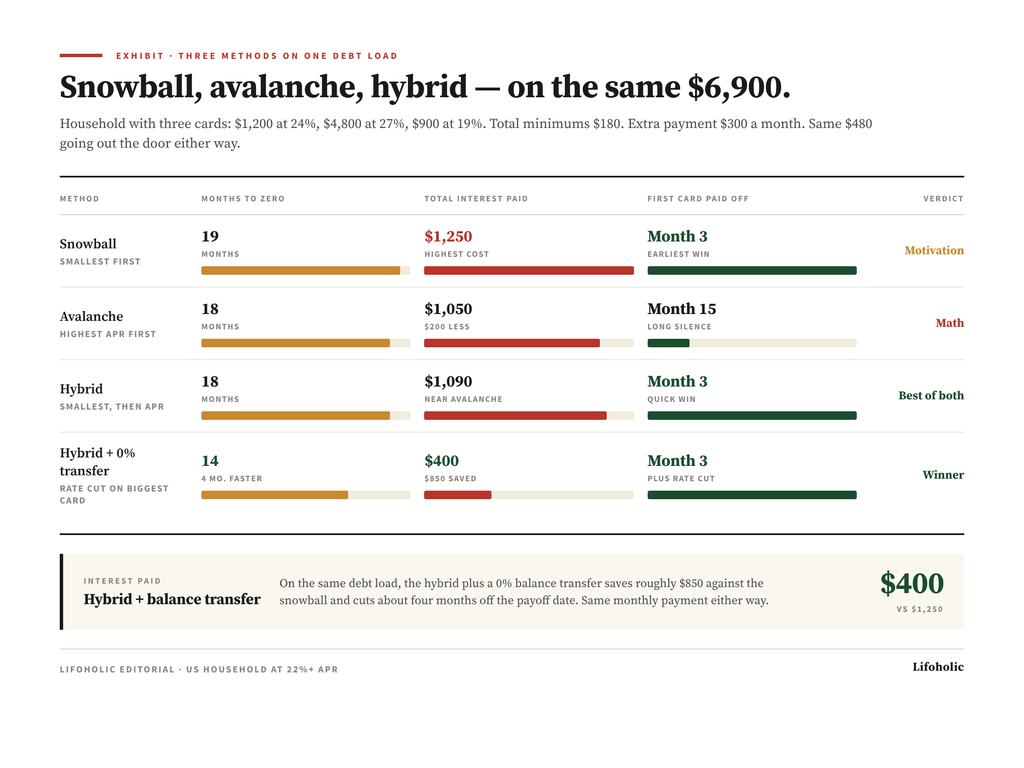
Total: $6,900 across three cards. Combined minimums: $180. The household can spare an extra $300 a month, for a total payment pool of $480.
Snowball path. Attack Card C first ($900, smallest). Done in about three months. Roll its $25 + $300 = $325 onto Card A. Pay Card A off in about four to five months. Roll its $35 + $325 = $360 onto Card B. Pay Card B off in about eleven months. Total time: roughly 19 months. Total interest: roughly $1,250.
Avalanche path. Attack Card B first ($4,800, highest APR). About fifteen months on one card with no visible wins. Then Card A, then Card C. Total time: roughly 18 months. Total interest: roughly $1,050.
Hybrid path. Three months on Card C for the quick win. Then pivot to Card B (highest APR). Then Card A. Total time: roughly 18 months. Total interest: roughly $1,090. One visible win inside the first quarter, plus almost all the avalanche’s savings.
Hybrid plus balance transfer. Move Card B to a 0% card with a 3% fee ($144). Three months on Card C. Then put the full $455 toward the now-0% Card B balance, which melts without compounding. Then Card A. Total time: roughly 14 months. Total interest: roughly $400. That is $650 to $850 saved compared to any of the other methods, and the household crosses the finish line nearly half a year sooner.
Where to put the first extra dollar this week
If this article has to collapse into a single next action, here it is.
- Log into every credit card account and write down three numbers for each: balance, APR, minimum payment. Takes twenty minutes.
- If any APR is above 20%, spend thirty minutes checking balance-transfer offers on sites like NerdWallet, Bankrate or your existing bank’s pre-approvals page. Apply if the math works.
- Pick the method: snowball if motivation is the problem, avalanche if math is, hybrid if it is honestly both.
- Set up autopay for every minimum.
- Set up a second autopay for the extra payment to the one target card.
- Put the physical cards somewhere they cannot be used by accident.
- Check the balances once a month. Not once a day. Progress is slow and that is fine.
The interactive calculator below runs the math on real balances and APRs, shows the snowball and avalanche side by side, and lets a household see the payoff date move in real time as they drag the extra-payment slider. It is the clearest way to make the choice without doing the arithmetic by hand.
FAQ
Is the snowball or avalanche method better?
The avalanche saves more interest on paper. The snowball gets more people to zero in practice. For most households with mixed balances and real-world motivation levels, the hybrid — one small balance first, then avalanche the rest — produces the best combined result.
Does paying off credit cards hurt my credit score?
No, the opposite. Paying down balances lowers the credit utilisation ratio, which is the single biggest moveable factor in a FICO score. Closing the account after paying it off can hurt the score — leave the account open with a zero balance.
Should I pay off credit cards or build an emergency fund first?
Build a small starter fund of about $1,000 or one month of essentials, then attack the credit cards. A 22% APR debt costs more than any emergency fund earns. Once the cards are at zero, rebuild the full three-to-six-month fund.
Is a 0% balance transfer card worth it?
Almost always yes, if the credit score qualifies and the balance can be paid off inside the promotional period (usually 15 to 21 months). The 3% to 5% transfer fee is almost always far smaller than the interest it replaces.
Should I use a personal loan to consolidate credit card debt?
Sometimes. A personal loan at 10% to 14% is a clear win over a credit card at 24%. The risk is that the credit cards are now empty and the household charges them back up, ending with both the loan and new card debt. Only consolidate if the cards are going in a drawer afterward.
How long does it take to pay off $10,000 in credit card debt?
At minimum payments only: roughly 25 to 30 years. With a disciplined snowball or avalanche and about $300 to $400 in extra payment a month: roughly two to three years. With a 0% balance transfer card and the same extra payment: 18 to 24 months.



Join the Lifoholic community conversation. We welcome thoughtful insights, questions, and authentic experiences from our readers.
RECOMMENDED DISCUSSIONS